Limitless AI Review 2026: The Wearable Memory Assistant That Meta Just Bought
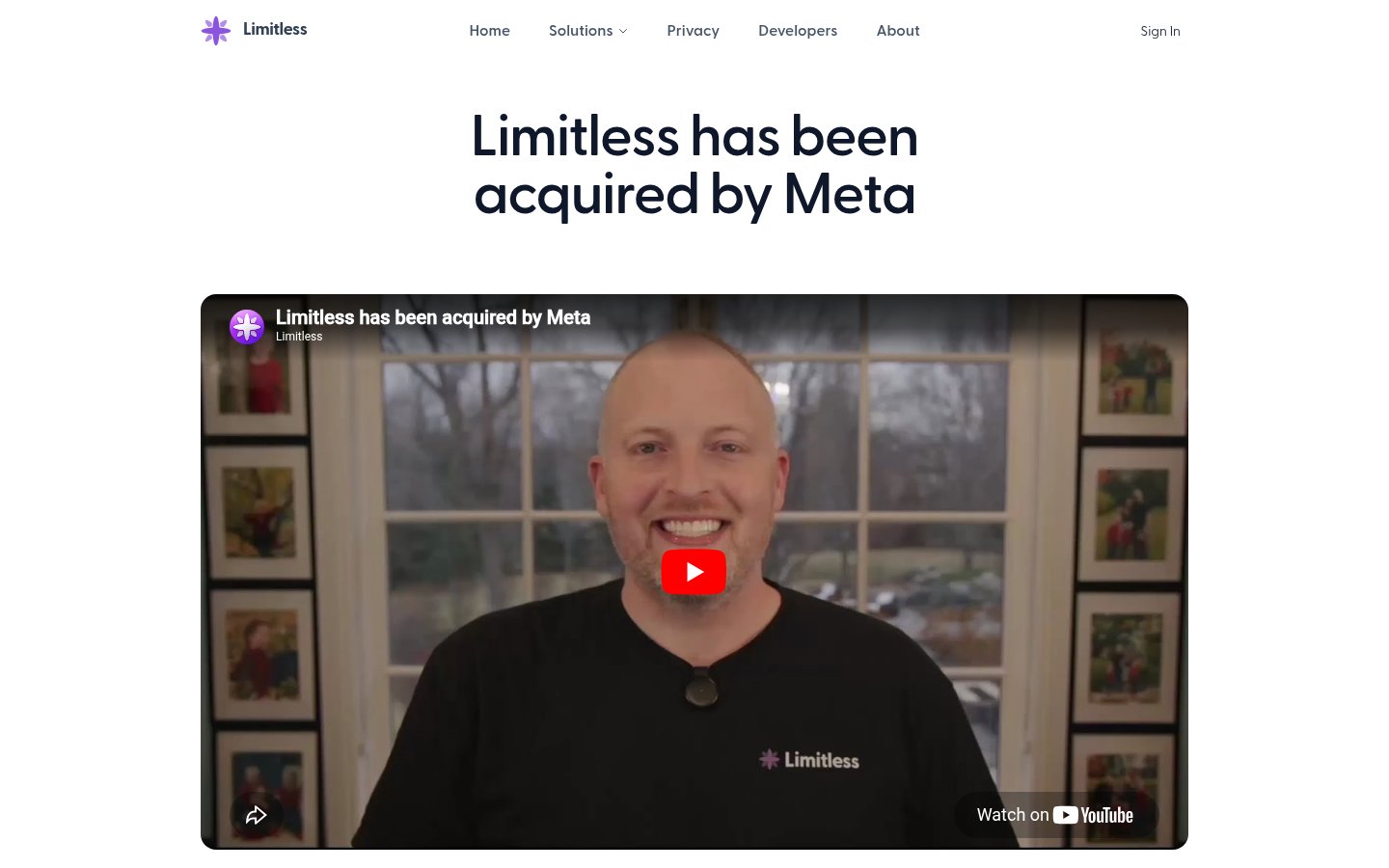
Limitless AI has been acquired by Meta, ending new Pendant sales but giving existing users free Unlimited plans. Here's what the acquisition means, how the product worked, and what it tells us about where wearable AI is heading.
Limitless
Limitless
limitless.aiLimitless AI has been acquired by Meta, ending new Pendant sales but giving existing users free Unlimited plans. Here's what the acquisition means, how the product worked, and what it tells us about where wearable AI is heading.
Quick facts
- Status
- Acquired by Meta, no new sales
- Pendant support
- At least 1 year post-acquisition
- Subscription cost (existing users)
- Free (upgraded to Unlimited)
- Hardware cost (historical)
- $99 one-time
- Rewind desktop app
- Being sunset
- Data export
- Available in-app
Pros
- Records both in-person and virtual meetings from a single small device
- Natural language recall across months of conversation history
- All existing customers upgraded to Unlimited plan for free post-acquisition
- Clean data export option available
- 92-95% transcription accuracy in clean audio environments
Cons
- No longer available for new customers
- Rewind desktop app being sunset as part of Meta transition
- Speaker diarization struggles in noisy or crowded environments
- Updated Meta Privacy Policy and ToS warrant scrutiny
- Regional availability being reduced post-acquisition
See Limitless for yourself
Free to start, no credit card needed for the trial.
Updated May 2026
Note: As of May 2026, Limitless AI has been acquired by Meta. The Pendant is no longer available for purchase by new customers. This review is maintained for existing users and for historical context on the wearable AI memory category.
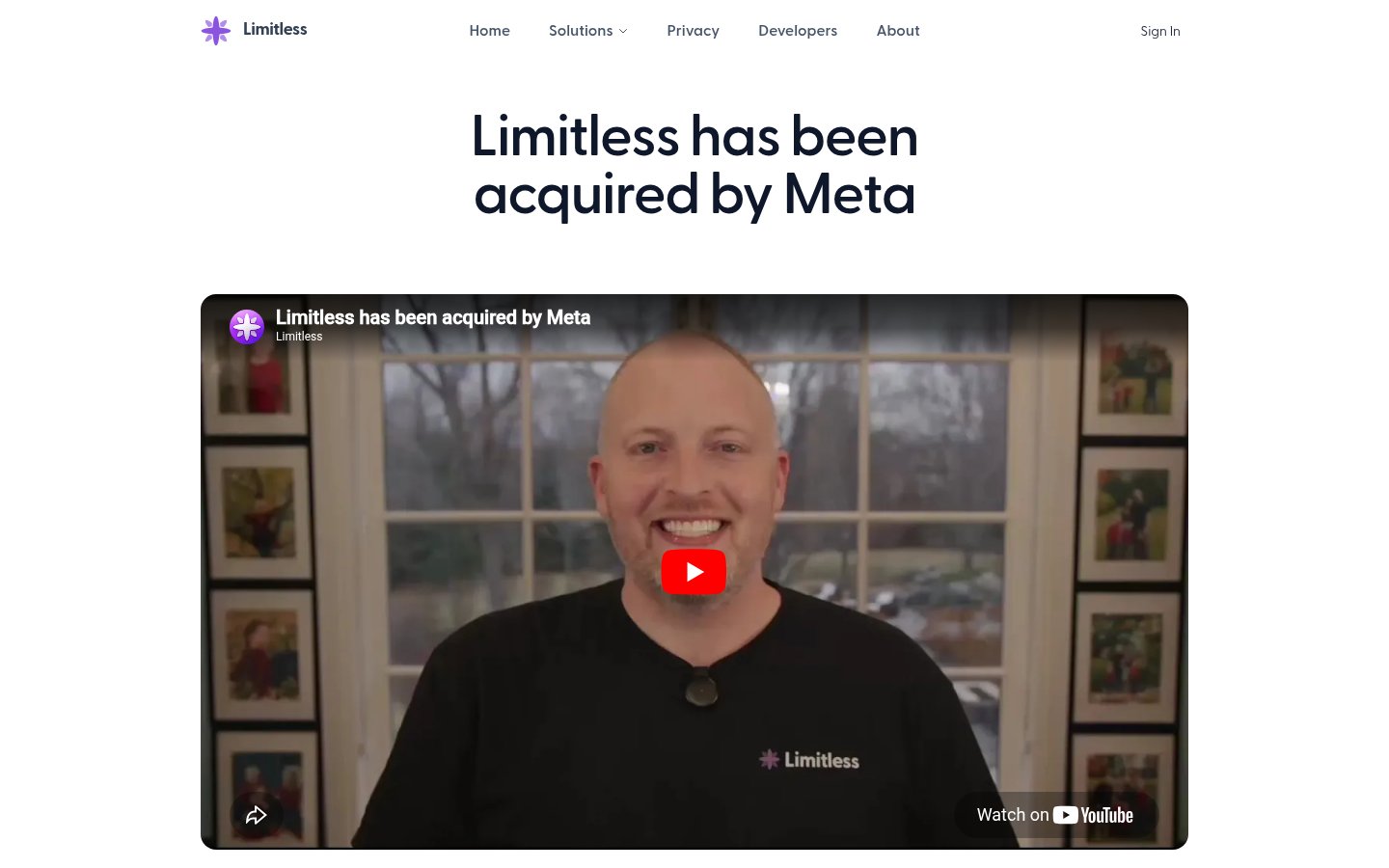
Let's start with the news that changes everything about this review: Limitless AI has been acquired by Meta. Co-founder and CEO Dan Siroker announced the deal in 2026, and the company is no longer selling its flagship Pendant device to new customers. Existing subscribers get their plans upgraded to the Unlimited tier for free, meaning you no longer need to pay a subscription at all, and support continues for at least another year.
So why review it now? Because Limitless represents one of the most interesting experiments in the "AI memory" category, and understanding what it built, what worked, and what didn't tells us a lot about where wearable AI is heading. If you already own a Pendant, this review will help you decide whether to keep using it. And if you're weighing alternatives, the landscape context here matters.
The core promise of Limitless was audacious: wear a small device, let it passively capture your conversations and meetings, and then use AI to surface that information back to you on demand. Your life, indexed and searchable. It sounds either miraculous or dystopian depending on your disposition, and in practice, it was a bit of both.
What Is Limitless AI?
Limitless AI started life as Rewind: a desktop app that recorded everything on your screen and mic, creating a searchable memory of your digital life. The company pivoted and expanded into hardware with the Pendant, a small wearable device (roughly the size of a large shirt button) that clipped to your clothing and recorded ambient audio throughout your day.
The AI layer on top did the heavy lifting: transcribing conversations, summarizing meetings, identifying action items, and letting you query your recorded history in natural language. "What did Sarah say about the Q3 budget last Tuesday?" wasn't a hypothetical, it was exactly the kind of question Limitless was designed to answer.
CEO Dan Siroker, previously known for his work on Obama's 2008 digital campaign and as a Y Combinator alum, framed Limitless as building toward a "personal AI" that actually knows you. In his acquisition announcement, Siroker noted that when Limitless started five years ago, "AI was a pipe dream to many" and "hardware startups were considered unfundable", let alone a company doing both. Meta's acquisition validates that the vision, however ahead of its time it initially seemed, has become something the biggest players in tech are now racing toward.
Meta's stated rationale aligns directly with Limitless's mission: Meta has announced a vision to bring "personal superintelligence to everyone," with AI-enabled wearables as a key pillar. Limitless is joining that effort.
Key Features
| Feature | Details |
|---|---|
| Pendant Hardware | Small wearable clip device, passive always-on recording |
| Meeting Transcription | Real-time and post-meeting transcription with speaker labels |
| AI Summaries | Automatic meeting/conversation summaries with action items |
| Natural Language Search | Query your recorded history conversationally |
| Rewind (Desktop) | Screen + audio recording of all desktop activity, being sunset |
| Calendar Integration | Auto-links recordings to calendar events |
| App Integration | Zoom, Google Meet, Microsoft Teams meeting capture |
| Privacy Mode | Consent-based recording notifications for other parties |
| Data Export | Full export of all user data (newly prioritized feature) |
| Cross-Platform | iOS, Android, macOS, Windows apps |
How the Pendant Actually Works
The Pendant itself was a well-designed piece of hardware, small, light, and unobtrusive enough that you could wear it all day without thinking about it. Battery life ran around 8 hours of continuous recording, which covers a standard workday. It charged via USB-C and synced to the app over Bluetooth.
Audio quality was genuinely good for ambient capture. In quiet office environments or one-on-one meetings, transcription accuracy was high, competitive with dedicated transcription tools like Otter.ai, with independent assessments putting it in the 92-95% range for clean audio environments. The real challenge was noisy environments: open offices, coffee shops, and group discussions with overlapping speakers all caused noticeable accuracy drops.
Speaker diarization, identifying who said what, was available but required some upfront setup. The system learned voices over time, and it got markedly better after a few weeks of regular use. This is one of those features that rewards patience but frustrates new users who expect it to work perfectly out of the box. In virtual meetings, Otter.ai has a slight structural advantage here because it can match voices to calendar invites; Limitless closes that gap in its Pro tier but still misattributes occasionally in crowded group settings.
The companion app (iOS and Android) was clean and fast. The search interface let you type natural language queries, and the AI would return timestamped clips with surrounding context. The calendar integration was particularly well-done: meetings from Google Calendar or Outlook would appear as sessions, and the Pendant's recordings would automatically attach to the right event.
Where Limitless genuinely differentiated itself from software-only competitors was scope. Otter.ai, for all its strengths, is limited to virtual meetings and uploaded audio files. Limitless captured in-person conversations, hallway chats, phone calls, and virtual meetings from a single device. If even a meaningful fraction of your important conversations happen face-to-face, that's a decisive advantage.
The Rewind Desktop App
Before the Pendant, Rewind was Limitless's flagship product, a macOS app (later Windows) that captured a continuous scroll of your screen activity and microphone input, creating a searchable record of everything you did on your computer.
It was one of those tools that felt borderline-magical when it worked. Forgot where you read something? Search for it. Can't remember what that Slack message said before it was deleted? It was probably in Rewind.
The privacy architecture was smart: everything was stored locally and processed on-device, using Apple Silicon's efficiency to run inference without sending data to the cloud. This was a key selling point for privacy-conscious users and enterprises.
Rewind is now being sunset as part of the Meta transition. This is confirmed, Limitless's own acquisition FAQ states that non-Pendant functionality, including Rewind, will be sunset. Existing users can export their data. This is a genuine loss, the desktop app had a devoted following and solved a real problem in a way no obvious alternative currently does at the same level of integration.
What the Meta Acquisition Means in Practice
For existing Pendant owners, the near-term picture is actually quite good:
- Subscriptions are free. All existing customers have been moved to the Unlimited Plan at no charge. Whatever you were paying monthly, you're no longer paying it.
- Support continues for at least another year, per Siroker's announcement.
- Your data is safe regardless of whether you continue using the device. Export is easy and prominently offered.
- Regional availability is changing. The acquisition FAQ notes there will be updates to regional availability, so users outside the US should check whether their region remains supported.
For anyone who wanted to buy a Pendant, the window has closed. New sales have stopped and no timeline for any Meta-branded successor has been announced publicly.
The updated Privacy Policy and Terms of Service are worth reading before continuing to use the service under Meta's umbrella. The original Limitless privacy model was built around local processing and user control, it's reasonable to scrutinize whether those commitments carry forward intact under new ownership.
Pricing (Pre-Acquisition, for Reference)
Limitless operated on a tiered model before the acquisition. For historical context and for anyone comparing the category:
| Tier | Cost | What You Got |
|---|---|---|
| Free | $0/month | Basic transcription, limited storage, core search |
| Pro | ~$19/month | Extended storage, enhanced speaker diarization, priority processing |
| Pendant Hardware | ~$99 one-time | The physical device itself |
| Unlimited | Previously paid tier | Now granted free to all existing customers post-acquisition |
The free tier was, by most accounts, genuinely usable rather than a crippled demo, a relatively rare thing in the subscription AI space.
Who It Was Built For
Limitless made the most sense for a specific type of professional: someone whose working life is dense with conversations, where the cost of forgetting something said in a meeting is real. Sales professionals who need to recall what a prospect said three calls ago. Executives managing multiple teams across dozens of weekly touchpoints. Consultants who bill by the hour and need clean records of client conversations. Researchers conducting interviews.
For people who primarily work asynchronously, heavy writers, solo operators, developers, the value proposition was thinner. The Pendant is a listening device. If there's not much to listen to, there's not much to surface back.
The consent and privacy dimension also required active management. Recording other people without their awareness is, depending on jurisdiction, potentially illegal and almost certainly impolite. Limitless built in consent notification features, but using them consistently in every professional context takes discipline. This wasn't a dealbreaker so much as a real operational consideration that buyers needed to think through honestly.
The Broader Picture
Limitless's acquisition by Meta is a signal, not just a business transaction. The major platforms are converging on the idea that the next computing interface is worn on the body and understands the context of your life. Meta's Ray-Ban smart glasses, its internal AI assistant work, and now Limitless all point in the same direction.
What Limitless proved, and why Meta presumably paid for it, is that people will wear ambient recording devices if the AI output is useful enough and the hardware is small enough. That's not a trivial demonstration. The category of "always-on AI that knows what happened in your day" is going to get much more crowded, better-funded, and more capable over the next few years. Limitless got there first, built a real user base, and got acquired for it.
For existing users deciding whether to stick around through the Meta transition: the hardware still works, the service is now free, and you have a clean exit path if you want it. That's a better situation than most acquisitions leave users in. For everyone else, watch what Meta builds next.
Verdict
A genuinely compelling AI memory wearable that proved people will adopt ambient recording devices when the AI output is useful enough, compelling enough that Meta acquired it. Existing users are in a good position with free Unlimited plans and continued support; new buyers can no longer get in, and the Rewind desktop app is being sunset.
Try LimitlessAlternatives
- Otter.ai
Best software-only alternative for virtual meeting transcription; no hardware required
- Meta AI (forthcoming)
The likely successor, integrated into Meta's wearable ecosystem
- Plaud Note
Alternative AI recording pendant still available for purchase
- Fireflies.ai
Strong option for virtual meeting capture and AI summaries without hardware
Frequently Asked Questions
Tools & Services Mentioned
infobro.ai Editorial Team
We research every tool from its documentation, pricing pages, product screenshots and public developer discussion, and say plainly what the evidence does and does not show. Drafts are AI-assisted and reviewed by our editors before publication. We revisit each article every 6 months to reflect platform changes. Learn more about our process.