Mem.ai Review 2026: The AI Note-Taking App That Actually Thinks With You
Mem.ai positions itself as an AI thought partner, not just a note-taking app. After real-world use through 2026, we break down what the automatic organization, semantic search, and chat-with-your-notes features actually deliver, and where the product still falls short.
Mem.ai positions itself as an AI thought partner, not just a note-taking app. After real-world use through 2026, we break down what the automatic organization, semantic search, and chat-with-your-notes features actually deliver, and where the product still falls short.
Quick facts
- Launched
- 2020
- Free plan
- Yes (limited)
- Pro plan
- ~$12/month
- Teams plan
- Custom pricing
- Platforms
- Web, iOS, browser extension
- Offline support
- iOS only
- Best for
- Solo knowledge workers with large note bases
Pros
- Semantic search that finds notes by meaning, not just keywords
- Automatic organization that actually connects related notes without manual tagging
- Chat with your notes feature answers questions using your own stored knowledge
- Voice capture and meeting transcription are fast and accurate
- Gets smarter over time as your note base grows
- Clean, distraction-free writing interface
Cons
- Note-taking basics (highlighting, scroll, formatting) lag behind competitors
- Mobile experience rated poorly by independent reviewers
- Customer support is slow or unresponsive according to multiple user reviews
- Learning curve requires patience, first week is disorienting for folder-trained users
- AI features feel less differentiated if your note base is small
- Free tier is too limited for serious daily use
See Mem.ai for yourself
Free to start, no credit card needed for the trial.
Mem.ai Review 2026: The AI Note-Taking App That Actually Thinks With You
Updated May 2026
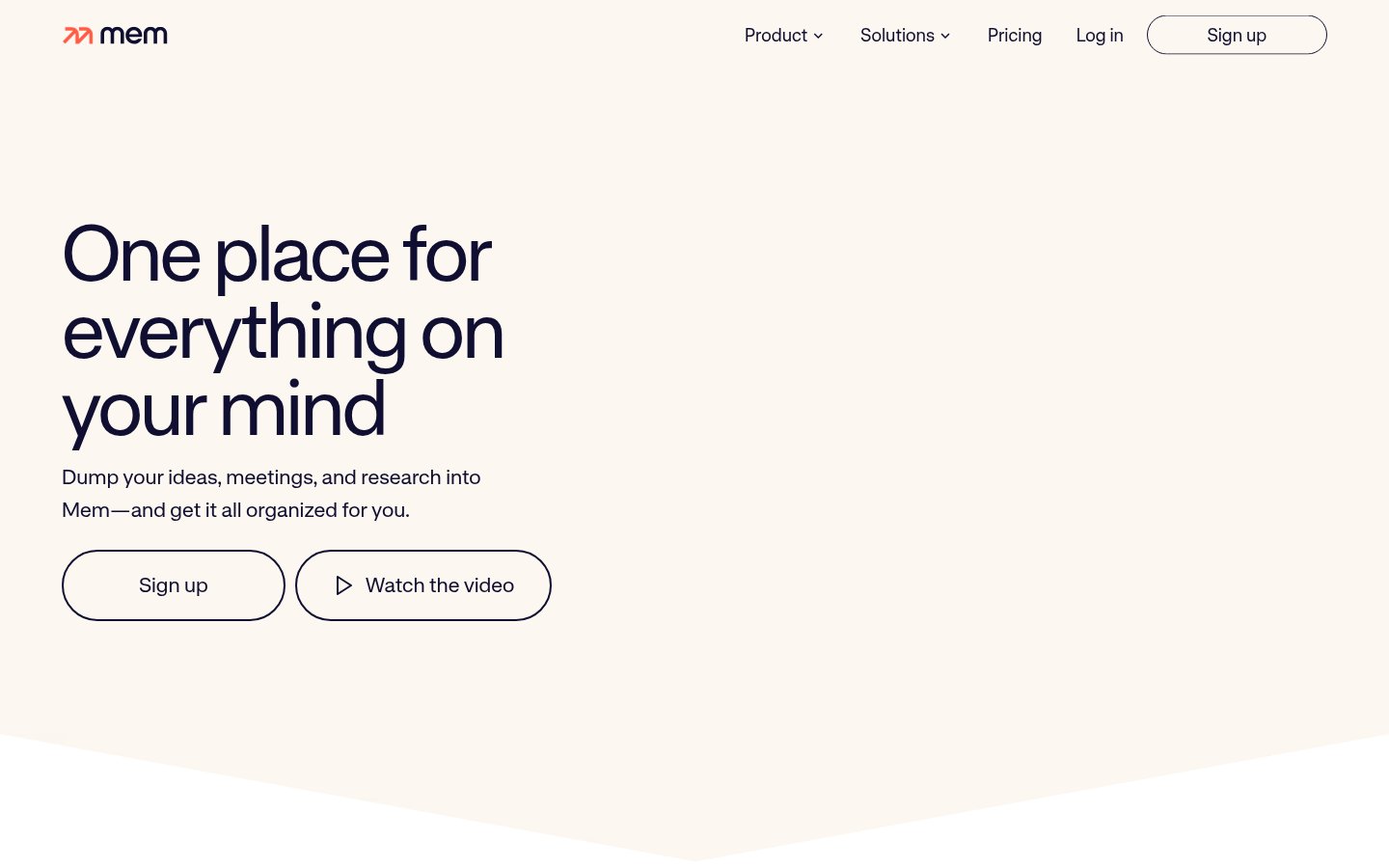
Let me be direct: most note-taking apps are just fancy text editors with a search bar. Mem.ai is trying to be something different, a second brain that actively surfaces what you wrote six months ago, connects dots you didn't know existed, and gets out of the way when you just need to type fast. After Mem 2.0's release and months of real-world use into 2026, the question isn't whether Mem has good ideas. It clearly does. The question is whether those ideas work well enough to justify switching from whatever you're using now.
Short answer: for the right person, yes. For everyone else, probably not.
What Is Mem.ai?
Mem.ai launched in 2020 (some sources cite 2019 as the founding year) and spent its early years building toward a singular vision: a note-taking app where AI does the organizing for you. No folders. No tags (unless you want them). No elaborate linking rituals. You just write, and Mem figures out the rest.
Mem 2.0 is the clearest realization of that vision yet. According to external reviewers, the version released in early 2026 represents a significant leap over 1.0 in speed, intelligence, and stability. The product is built around what the team calls an "AI thought partner", not a chatbot bolted onto a notes app, but an AI model trained on your own notes that helps you think, recall, and connect ideas.
In 2026, the AI note-taking category is genuinely crowded. Notion AI has hundreds of millions of users. Obsidian has a fiercely loyal power-user base. Reflect and Capacities both have strong followings. Mem isn't the biggest player, but it's arguably the most opinionated, and that's either its strength or its problem, depending on your workflow.
Key Features
| Feature | Details |
|---|---|
| Smart Write | AI writes alongside you, offering completions and suggestions based on your note history |
| Automatic Organization | AI groups and relates notes without manual tagging or folder structure |
| Semantic Search | Search by meaning, not just keywords, ask questions in plain English |
| Memory Graph | Visual map of how your notes connect across topics and time |
| Voice Notes (Mobile) | Capture voice memos that are automatically transcribed and filed |
| Daily Companion | AI-generated daily brief surfacing relevant notes and follow-ups |
| Offline Mode | Full offline support on mobile (iOS), notes sync when back online |
| Smart Summaries | One-click summaries of long notes or collections |
| Chat with Your Notes | Ask questions directly; Mem answers using your own stored knowledge |
| Meeting Transcription | Record, transcribe, and summarize meetings automatically |
| Web Clipper | Browser extension for saving articles and pages into your Mem workspace |
| Integrations | Connects with Zapier, Slack, Gmail, and calendar apps |
Pricing
Based on current external sources, Mem operates on a freemium model. The free tier exists but is restrictive enough that active users tend to hit its limits quickly. The honest test most reviewers suggest: use the free tier seriously for two weeks, if you're frustrated by what you can't access, the paid plan will likely pay for itself.
| Plan | Price | What's Included |
|---|---|---|
| Free | $0/month | Basic note-taking, limited AI features |
| Pro | ~$12/month | Full AI feature set, Collections, unlimited Daily Notes |
| Teams | Custom pricing | Team collaboration, shared workspaces |
Note: Pricing details are based on third-party sources as of May 2026. Confirm current pricing on Mem's website before subscribing.
For professionals who use Mem daily, capturing meeting notes, research, project thoughts, and ideas, the Pro tier is generally considered worth it by independent reviewers. The free plan is better treated as a trial than a long-term option.
What Mem Does Well
The Automatic Organization Is Genuinely Useful
This is Mem's core bet, and in 2026, it's more or less paying off. I've used apps that claim to auto-organize notes before, they usually mean "we have some basic tags we'll suggest." Mem's approach is different. It builds a semantic understanding of what you've written and uses that to group, relate, and surface notes contextually.
If you write a meeting note about a client project in March, then write a quick thought in April about a related idea, Mem connects them. You don't have to remember to link them. You don't have to file them in the same folder. They just surface together when they're relevant.
For people who think fast and capture a lot, writers, researchers, founders, consultants, this is a genuine time-saver. As one Substack creator put it: "Mem AI is one of the best note apps out there for parent-creators who think faster than they organize."
Semantic Search That Actually Works
Type "what did I say about the marketing budget in Q4?" and Mem finds it. This sounds obvious, but most note apps still rely on keyword matching. Semantic search means you can ask Mem in natural language and it retrieves the relevant content, even if your exact wording doesn't match.
Independent reviewers back this up, one reported finding notes 60% faster after 60 days of use compared to their previous system. It's not perfect; occasionally it misses context or surfaces loosely related notes. But it's consistently better than digging through folders or trying to remember your own tagging system.
Voice Notes and Meeting Transcription
The mobile app's voice capture is fast and clean. You hit record, speak your thought, and Mem transcribes and files it without you touching a keyboard. For anyone who has ideas in the car, on a walk, or mid-meeting, this alone is worth the subscription. The transcriptions are accurate for normal speech, though they occasionally stumble on technical jargon or proper nouns.
Mem 2.0 also brings more capable meeting transcription and summarization into the mix, it can record full meetings, produce transcripts, and extract summaries. For professionals who live in back-to-back calls, this is a meaningful addition that pushes Mem beyond simple note capture.
Chat With Your Notes
This is the feature that separates Mem from everything else in the space. You can literally ask it questions, "what were my main concerns about the Johnson proposal?", and it answers using the content of your notes, with citations. It's not using the general internet. It's using your brain, just better organized.
This works well in practice for recalling specifics from older notes. Where it's less impressive is when you have thin context, if you only have a few notes on a topic, the AI has little to work with, and the responses can feel hollow. One startup founder reviewed the feature positively, noting Mem "provides a great personal search engine" for accumulated knowledge.
What Mem Gets Wrong
The Learning Curve Is Real
Mem's no-folder philosophy sounds liberating. In practice, the first week is disorienting. Coming from Notion or Evernote, the absence of hierarchy feels uncomfortable. You have to trust the AI. For people deeply invested in their existing organizational system, that trust takes time to build, and some never build it.
Productivity Stack's independent assessment put it plainly: the first week will feel uncertain, the second week will start showing unexpected connections, and by the third week you'll know whether the AI-first approach fits how you actually think. That's a real time investment before the value becomes clear.
Note-Taking Basics Are Behind
This is a legitimate criticism that shows up consistently in user reviews. While Mem's AI layer is strong, some fundamental note-taking mechanics lag behind competitors. Reviewers have flagged missing highlighting functionality, no scroll bar for long notes, and imperfect tagging. One user review put it bluntly: "Development of the app seems to have stalled... I'm thinking of cancelling."
If you're evaluating Mem primarily as a writing environment rather than an AI recall tool, it may disappoint. Saner.ai's independent scorecard gave Mem's note-taking basics just 5/10, compared to 7.5/10 for AI features, a gap that tells you something about where the development priority sits.
The AI Features Aren't Unique Enough for Some Users
A recurring criticism in user reviews: the paid AI features don't feel differentiated enough from general-purpose AI tools. As one reviewer put it: "The paid AI features do exactly what every other product does, they mimic the functionality of free-to-use ChatGPT. It seems they care less about note-taking essentials than the hot new trendy buzz features."
This is a fair tension. Mem's AI is genuinely better when it has a large personal knowledge base to work with. But for users with fewer notes or who mainly want AI writing assistance, the case for paying over free alternatives is weaker.
Mobile Experience Needs Work
The iOS app earns praise for voice capture but criticism for overall polish. Independent reviewers rate the mobile experience at 4.5/10, well below the desktop product. If mobile is your primary capture device, this is worth factoring into your decision.
Customer Support Is a Concern
Multiple user reviews flag slow or absent customer support, including from the co-founders directly. Saner.ai's review gave customer support just 4/10. For a paid subscription product, this is a real risk, especially if you hit a bug or data sync issue.
Who Mem Is Actually For
Mem is built for solo knowledge workers who accumulate a lot of notes over time and hate maintaining organizational systems. If your notes are the raw material for your thinking, not just reminders or task lists, and you've got hundreds or thousands of them, Mem's recall and connection features start to shine.
Researchers, writers, consultants, and founders who capture constantly but retrieve rarely tend to get the most out of it. The more you put in, the smarter the AI gets about surfacing what matters.
Mem is a poor fit for teams that need real-time collaboration, anyone who relies on rich document formatting, project managers who need Kanban boards or structured workflows, and users who find comfort in knowing exactly where everything lives. If you love the feeling of a beautifully organized Obsidian vault or a meticulously structured Notion workspace, Mem will feel unsettling, the control is gone by design.
The honest recommendation from most independent reviewers: try the free tier for two to three weeks with daily use. Don't judge it in the first few days. The value compounds with use, and the first week is almost always the hardest.
The Bottom Line
Mem.ai is not trying to be the best note-taking app for everyone. It's trying to be the best note-taking app for people who want to stop thinking about note-taking entirely. For that specific user, it largely succeeds, the semantic search, automatic organization, and chat-with-your-notes features are genuinely impressive when you have enough material for them to work with.
But Mem asks you to accept real trade-offs: weaker note-taking basics, a mobile app that needs polish, limited customer support, and a learning curve that requires patience before the payoff arrives. The question isn't whether Mem's ideas are good. It's whether you're the kind of person those ideas were built for.
Verdict
Mem.ai delivers genuinely impressive AI recall and automatic organization for users who accumulate large personal knowledge bases, the semantic search and chat-with-notes features are real differentiators. But weak note-taking basics, a rough mobile experience, and limited customer support mean it's a strong fit for a specific type of user, not a universal upgrade. Try the free tier for two to three weeks before committing.
Try Mem.aiAlternatives
- Notion AI
Better for teams, structured databases, and rich document formatting
- Obsidian
Best for power users who want full control and local storage
- Reflect
Cleaner alternative for daily journaling and linked thinking
- Capacities
Strong option for object-based knowledge management with good formatting
Frequently Asked Questions
Tools & Services Mentioned
infobro.ai Editorial Team
We research every tool from its documentation, pricing pages, product screenshots and public developer discussion, and say plainly what the evidence does and does not show. Drafts are AI-assisted and reviewed by our editors before publication. We revisit each article every 6 months to reflect platform changes. Learn more about our process.