3Commas Review 2026: Can Its AI Actually Build Winning Crypto Trading Strategies?
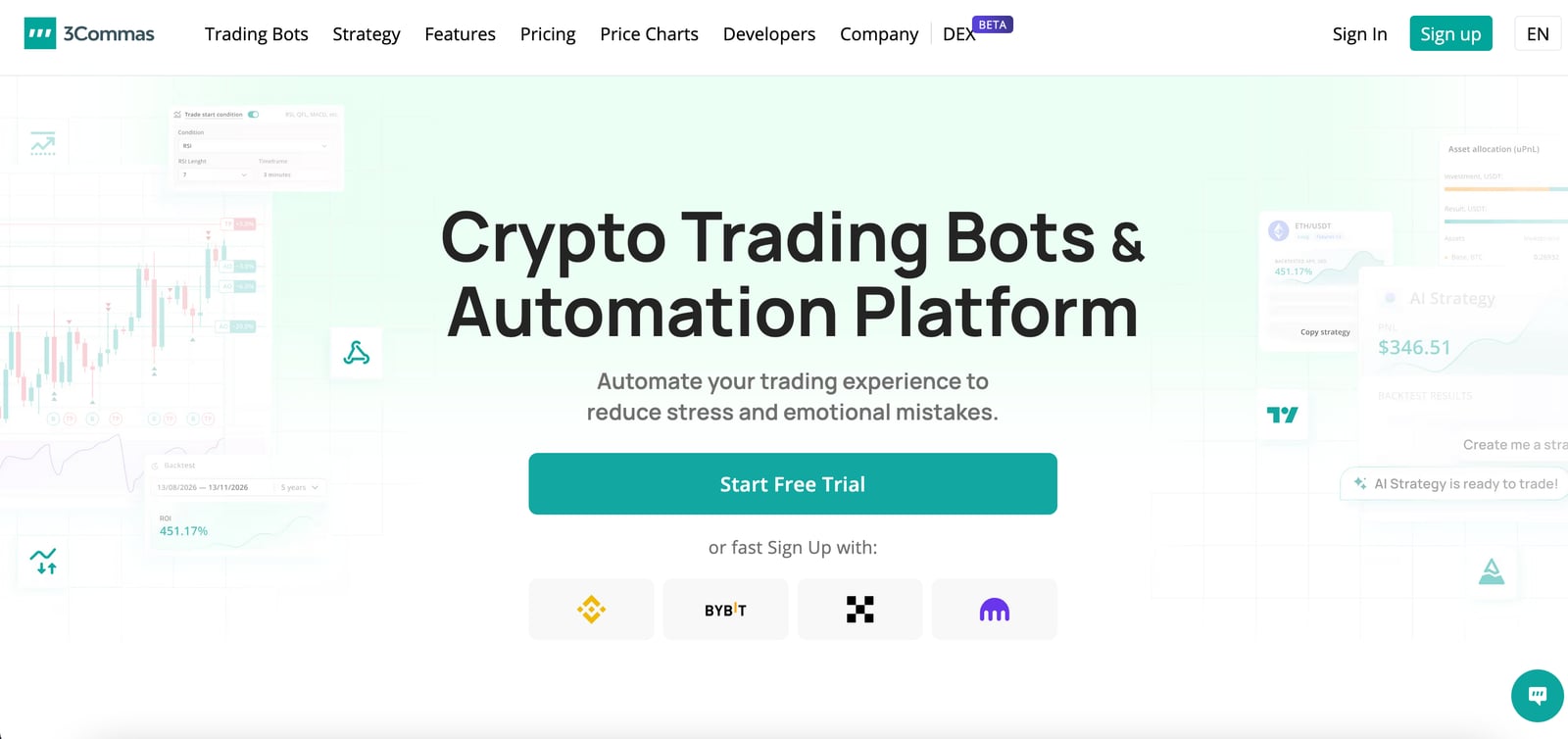
3Commas automates crypto trading with DCA, Grid, and Signal bots across 15+ exchanges. But does its new AI layer, QuantPilot, live up to the hype?
3Commas
3Commas
3commas.io3Commas automates crypto trading with DCA, Grid, and Signal bots across 15+ exchanges. But does its new AI layer, QuantPilot, live up to the hype?
Quick facts
- Free plan
- No, free trial only
- Starting price
- $15/mo (annual Starter)
- Exchanges supported
- 15+
- AI features
- AI Assistant (all plans) + QuantPilot (early access)
- Mobile app
- iOS and Android
- TradingView integration
- Yes, via webhook and Pine Script
- Futures trading
- Pro plan and above
Pros
- The DCA and Signal bot configurations are genuinely deep, with more customizable parameters than most competitors offer.
- TradingView integration via webhook is best-in-class, Pine Script strategies connect to live trading with minimal friction.
- 1-minute backtesting with up to unlimited historical data on Expert tier is a serious strategy validation tool.
- The mobile app covers nearly all desktop functionality, which is rare and genuinely useful for active traders.
- Flat subscription pricing with no profit-cut means your upside isn't shared with the platform.
Cons
- QuantPilot AI is in early access only, the headline AI feature isn't a finished product you can rely on in May 2026.
- No meaningful free tier exists; you must pay to use the platform beyond the trial period.
- Phone number required for registration, with reported blocking issues for some regions.
- Grid bots carry serious downside risk in trending markets, and the platform doesn't make this prominent enough for new users.
- The jump from Pro ($40/mo) to Expert ($110/mo) is steep and only justified for high-volume multi-account traders.
See 3Commas for yourself
Free to start, no credit card needed for the trial.
What 3Commas Actually Does
3Commas is a crypto trading automation platform that has been running since 2017. The core idea is simple: connect your exchange account via API, configure a bot with your rules, and let it trade around the clock without you touching a keyboard. It doesn't hold your funds, everything stays on your exchange. The bots execute orders on your behalf through read/write API keys.
What separates 3Commas from a basic limit-order bot is the depth of its strategy options. You get three distinct bot types: DCA (Dollar Cost Averaging), Grid, and Signal. Each serves a different market condition. DCA bots suit trending markets where you want to average into a position on dips. Grid bots thrive in sideways, ranging markets by placing a ladder of buy and sell orders between two price levels. Signal bots take external inputs from TradingView or webhook-connected services and fire orders based on those triggers. That's a genuinely flexible toolkit, and it's the reason the platform has stuck around this long in a market that churns through tools quickly.
The platform supports 15+ exchanges, including Binance, Bybit, OKX, KuCoin, Kraken, Coinbase Spot, Bitget USDT-M Futures, and more. You can manage all of them inside one dashboard, a real convenience if you're spread across multiple exchanges chasing liquidity or arbitrage. Crucially, 3Commas is now positioning itself around AI, not just automation. Their new QuantPilot layer is the headline feature for 2026, and that's where things get interesting.
The AI Layer: QuantPilot and What It Actually Claims to Do
The AI story at 3Commas has two parts. The first is the built-in AI Assistant, which is a feature available on all current paid plans. The second, and far more ambitious, is QuantPilot, billed as "the first agentic platform where AI builds, tests, and optimizes your strategies end-to-end."
QuantPilot launched in early access in April 2026. The pitch is that autonomous agents handle the full strategy lifecycle: they construct a strategy, backtest it against historical data, refine based on results, and deploy it. That would be a meaningful leap from the current model, where you configure the bot parameters yourself and the platform just executes. Agentic AI that actually proposes and iterates on trading strategies would move 3Commas closer to a signal-generation tool than a pure execution layer.
The critical caveat: QuantPilot is in early access as of this writing, not a general release. The platform is actively soliciting early users to "shape the product as it evolves," which is honest marketing for "this is still being built." What that means for you as a potential customer is that the AI strategy-building functionality is not yet a polished, tested feature you can rely on. It's a roadmap item with a working prototype attached.
The AI Assistant on current plans appears to be a more modest offering, likely an in-platform chat interface that can answer questions about strategy configuration, interpret market conditions, or suggest parameter adjustments. The research available doesn't give granular detail on what the Assistant can and can't do in practice, so anyone evaluating 3Commas purely on its AI credentials right now should temper expectations. The automation layer is mature and proven. The AI layer is early-stage.
If you want to think about the broader context of AI tools that actually know your context and adapt to it, the problem is real across the industry, our piece on The AI Personalization Problem: Why AI Tools Don't Know You (And What to Do About It) covers it well. QuantPilot's ambition is to solve exactly that problem for trading, but it's not there yet.
How It Works in Practice
Setting up a basic DCA bot on 3Commas follows a three-step flow: connect your exchange, configure bot parameters, go live. The exchange connection uses official Fast Connect integrations for the major exchanges, or manual API key entry for others. That part is standard and well-documented.
Where 3Commas earns its reputation is in the granularity of bot configuration. DCA bots let you set base order size, safety order size, the maximum number of safety orders, price deviation before a safety order triggers, take profit percentage, and whether trailing take profit is active. You can also set deal start conditions, specific technical indicators like RSI thresholds or signals from TradingView, rather than just having the bot open deals immediately. Multi-pair DCA bots can monitor over 100 pairs simultaneously and pick the one that best meets your configured conditions. That's genuinely useful for traders who want the bot to find opportunities rather than just execute a pre-determined pair.
The Smart Trade terminal sits alongside the bots for manual trades that need extra precision. Concurrent Take Profit and Stop Loss, multiple take profit targets (sell 50% at $10,000, 25% at $11,000, the rest at $11,500), and trailing stop loss all live here. It's the toolset a discretionary trader would want when they're in the market but don't want to stare at a screen.
The TradingView integration is a genuine differentiator. Pine Script strategies can pipe signals directly into Signal Bots via webhook. If you've already built a strategy in TradingView, the path from "I have a working alert" to "I have a live bot executing it" is shorter on 3Commas than almost anywhere else. That said, you need to know Pine Script or be willing to use someone else's published strategy. The platform doesn't write the signal logic for you, yet. That's what QuantPilot is supposed to change.
The mobile app covers essentially everything the desktop does: viewing active bots, adjusting parameters, checking portfolio balance, and placing Smart Trades. That's better than most competitors, where the app is clearly an afterthought.
One thing worth flagging: registration requires a phone number. Verifying this platform means going through SMS verification, and there are reports of the process being blocked for certain regions or number types. That's a friction point that shouldn't exist in 2026 for a platform charging $40-$110 per month.
Pricing Breakdown
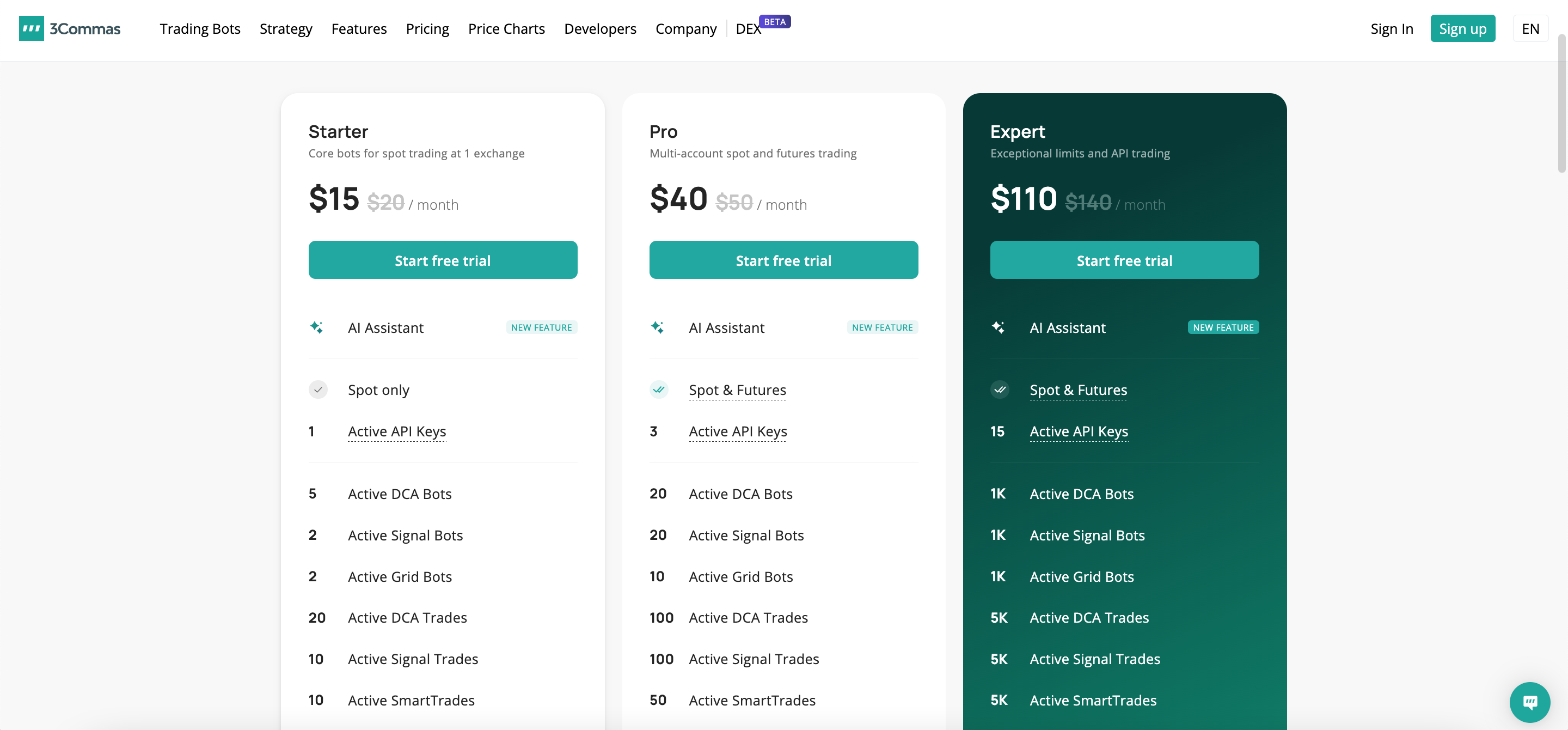
3Commas uses a tiered subscription model with no percentage cut of your profits. You pay a flat monthly fee and keep everything you make. Pricing as of May 2026:
| Plan | Monthly Price | Annual Price | Key Limits |
|---|---|---|---|
| Starter | $20/mo | $15/mo | 1 exchange, 5 DCA bots, spot only |
| Pro | $50/mo | $40/mo | 3 exchanges, 20 DCA bots, spot + futures |
| Expert | $140/mo | $110/mo | 15 exchanges, 1,000 DCA bots, full API |
| Custom | Contact sales | Contact sales | Unlimited, tailored |
All plans include a demo account, the mobile app, webhook execution, and access to signals and strategies. The AI Assistant is listed as a new feature on all paid tiers, though what that encompasses in practice differs from the QuantPilot early-access product.
The Starter plan at $15/month (annual) is genuinely entry-level: one exchange, five active DCA bots, two Signal bots, and spot trading only. No futures access. Backtesting is capped at 100 DCA backtests per month with a one-year lookback period. For someone just getting started with automation, this is workable. But you'll hit the limits faster than you expect.
Pro at $40/month (annual) is where most serious individual traders land. Three exchange accounts, 20 DCA bots, 20 Signal bots, 100 active DCA trades, and full futures access. The backtest allowance jumps to 500 per month with a two-year lookback. That's enough history to validate most strategies meaningfully.
Expert at $110/month (annual) is for professional traders or small funds: 15 API keys, 1,000 active bots of each type, 5,000 active trades, and full backtest history. The Developer API gets read and write access at this tier, enabling custom integrations. The jump from Pro to Expert is steep in price. Justify it only if you're genuinely running high-volume, multi-account operations.
There's a free trial mentioned across the site, though the specifics, duration and what's included, aren't fully spelled out in public materials. Assume it's time-limited with some feature constraints and treat it as a test-drive rather than a permanent free tier.
Standout Features in Depth
Multi-Pair DCA Bots with Dynamic Pair Selection
Most DCA bot implementations are static: you pick ETH/USDT, the bot trades ETH/USDT. 3Commas lets you point a multi-pair bot at a watchlist of 100+ pairs and have it dynamically select the pair that currently meets your opening conditions. In practice, this means the bot is constantly scanning, if your start condition is "RSI below 30 on the 1-hour chart," it will find whichever asset on your list hits that threshold first and open there. It's not AI in the modern sense, but it's a more intelligent allocation of trading capital than a single-pair bot. Combined with QuantPilot's eventual strategy-building capabilities, this architecture could become genuinely powerful.
TradingView Signal Integration and Webhook Execution
This is probably the most underrated feature on the platform. 3Commas doesn't just read TradingView signals, it executes them with full bot logic attached. A TradingView alert that would normally just send you a notification can instead fire a Signal Bot that opens a deal, manages take profit targets, handles stop losses, and closes positions. Pine Script users can encode complex multi-condition strategies and ship them to live trading without rewriting everything. The Signal Bot also supports simultaneous long and short positions from a single bot, which is harder to do cleanly on most competing platforms. For traders whose real edge is in strategy design rather than execution mechanics, this is where 3Commas earns its fee.
Backtesting on 1-Minute Historical Data
The backtest engine uses 1-minute granularity, which matters more than most traders realize. Backtesting on daily or hourly data smooths over the intraday volatility that actually determines whether a DCA strategy survives a real market. With up to two years of data on Pro and unlimited history on Expert, you can test strategies through multiple market cycles, the 2022-2023 bear market, the 2024 recovery, the 2025 volatility. That's enough history to distinguish robust strategies from ones that only worked in bull conditions. If you're serious about validating before deploying real capital, this is the feature you'll use most.
Limitations and Edge Cases
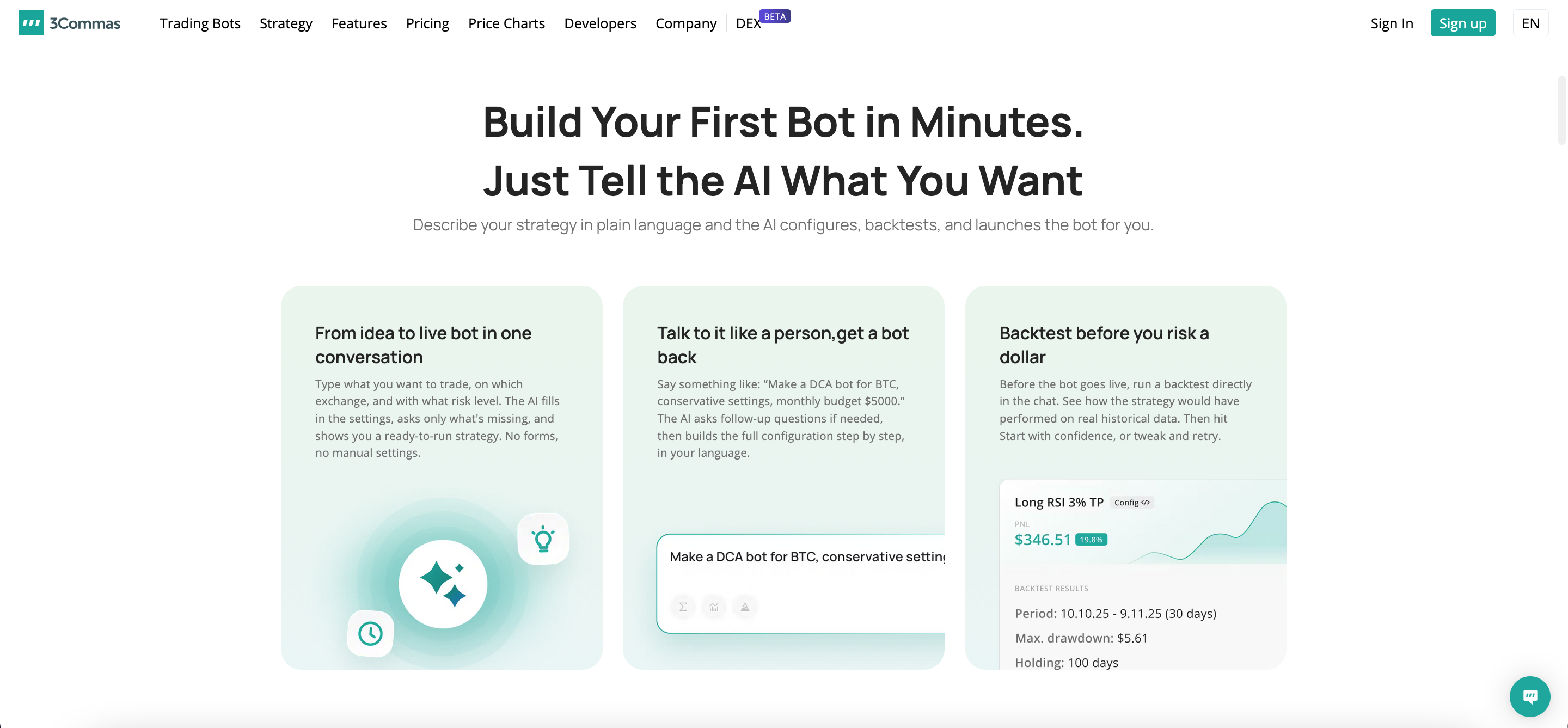
The QuantPilot AI is in early access and not production-ready. This is the most significant limitation for anyone evaluating 3Commas on its AI credentials specifically. If you want a platform where AI meaningfully helps design, refine, and deploy strategies today, 3Commas isn't there yet. It's getting there, but "early access" means you're a beta tester, not a customer of a finished product. Keep this in mind when weighing the platform against alternatives.
Grid bots have a known structural weakness: they underperform badly in strongly trending markets. A grid bot set between $80,000 and $100,000 BTC will get wrecked if price breaks to $60,000 or $130,000. This is inherent to the strategy type, not a 3Commas-specific bug, but the platform doesn't always make this risk prominent enough for new users who pick the Grid bot because it sounds simple.
The pricing structure penalizes multi-exchange users at lower tiers. If you want to run bots across even two exchanges, you need Pro ($40/month). That's not expensive in absolute terms, but combined with the bot count caps, it means a trader with a modest portfolio is spending real money on infrastructure before they've proven their strategy works.
The AI governance question is real. Any AI-assisted trading tool carries the risk of your capital being managed by logic you don't fully understand. This is a broader industry concern, our coverage of AI hallucinations hitting the courtroom illustrates what blind trust in AI outputs can cost. QuantPilot will need robust transparency tools to earn trust for live trading decisions.
The registration friction, phone number required, with reports of blocking, is a genuine barrier for privacy-conscious users or those in affected regions. If you're thinking about the AI privacy problem more broadly, handing your exchange API keys to a third-party platform is a significant trust decision that deserves careful thought regardless of the phone verification issue.
Customer support is live chat on all plans, with priority routing on Expert. There's no email ticket system described, which can be a problem if you have a complex API issue that needs a paper trail.
Who Should Use 3Commas
3Commas is built for traders who have a strategy, or at least a hypothesis, and want to execute it consistently without sitting at a screen. The sweet spot is someone who understands technical analysis, has used TradingView signals, and finds themselves either missing entries because they weren't watching or closing positions too early because they got emotional. The automation removes the behavioral mistakes. If you're a Pine Script user with a proven TradingView strategy, the Signal Bot integration alone is worth the Pro subscription.
Advanced traders running multiple exchange accounts will find the multi-account management genuinely useful, though they'll need Expert tier to get full value. Traders interested in the AI strategy-building angle should get on the QuantPilot early access list now to shape the product, while treating the current platform as the execution layer it is.
Anyone interested in how AI is changing the competitive dynamics of entire industries might find it useful to read about how Cloudflare cut 1,100 jobs while posting record revenue, trading platforms face the same pressure to show that AI adds real value, not just marketing narrative.
Who Should Skip It
Complete beginners to crypto trading should think carefully. The bots do exactly what you configure them to do, if you configure them wrong, they'll lose money efficiently and consistently. The learning curve isn't about using the software (that's manageable), it's about understanding the strategies well enough to configure them sensibly. A poorly-parameterized DCA bot in a bear market will average down into a position that keeps falling, and no amount of automation polish changes that outcome.
Traders looking for a fully managed, hands-off AI system aren't there yet with 3Commas. If you want something closer to "tell the AI your risk tolerance and let it handle everything," QuantPilot's eventual full release might fit that description, but the current product still requires substantial configuration input from you. Similarly, anyone who needs a completely free tier to start will find the platform doesn't offer one in any meaningful sense. The free trial gives you a taste, but you'll hit a paywall quickly. For those interested in comparing automation platforms more broadly, our Zapier Review and n8n Review cover the general-purpose automation space, though the use cases differ significantly from crypto-specific bots.
Onboarding Notes
The demo account included on all plans is the right place to start. You can test bot configurations against live market data without risking real capital, which is a sensible way to validate parameters before going live. The blog and resource library covers strategy fundamentals reasonably well for a SaaS platform, with posts on DCA mechanics, order types, and risk management published through early 2026.
The TradingView connection requires some setup, you'll need to create alerts in TradingView with the right webhook URL format that 3Commas provides. It's documented, but it's not a one-click setup. Budget an afternoon to get your first Signal Bot running end-to-end if you're new to webhooks. The payoff is worth it if TradingView is already part of your workflow.
Verdict
3Commas is one of the most mature crypto trading automation platforms available, with genuinely deep bot configuration, strong TradingView integration, and multi-exchange management that few competitors match. The AI story is real but early, QuantPilot shows real ambition, but it's not production-ready in May 2026, so buy this for the automation engine, not the AI pitch.
Try 3CommasAlternatives
- Cryptohopper
Better for beginners wanting a marketplace of pre-built strategies to copy
- Bitsgap
Cleaner UI with solid grid and DCA bots, good for traders who want simplicity over depth
- TradeSanta
Cheaper entry point with basic DCA and grid bots, suits budget-conscious beginners
- Wundertrading
Strong TradingView signal execution with copy trading, solid alternative for signal-focused traders
- Octobot
Open-source and self-hostable for privacy-first traders who want full control
Frequently Asked Questions
Tools & Services Mentioned

infobro.ai Editorial Team
We research every tool from its documentation, pricing pages, product screenshots and public developer discussion, and say plainly what the evidence does and does not show. Drafts are AI-assisted and reviewed by our editors before publication. We revisit each article every 6 months to reflect platform changes. Learn more about our process.