Can I Legally Write a Book Using AI? Yes, but You May Not Own It
Publishing a book written with AI is legal. Owning it is the harder question. What US and UK law protect, what KDP makes you declare, and how much of the prose you need to write yourself.
 Stanislav VovchykOct 28, 202611 min readUpdated Nov 4, 2026
On this page · 9 sections
- 1. Publishing it is legal; owning it is a separate test
- 2. What you own depends on how much prose the AI wrote
- 3. My verdict on the heavily rewritten AI draft
- 4. KDP: declare generated text, images and translations
- 5. Publisher contracts: the originality warranty
- 6. Infringement: your output is your liability
- 7. Your AI tool's terms assign rights, but they can't create copyright
- 8. A proof-of-authorship checklist
- 9. FAQ
In short
- Yes, you can legally write and sell a book with AI, but in the US you own copyright only in the parts a human wrote, substantially rewrote, or arranged.
- Prompts alone never make you the author, so raw AI passages can be copied by others and must be excluded when you register with the US Copyright Office.
- Amazon KDP accepts AI-generated books but requires you to declare generated text, images and translations separately, while AI-assisted editing of your own writing needs no disclosure.
- Run a plagiarism check and keep dated drafts and chat logs, because echoed text is your liability and a publisher's originality warranty makes you cover their costs.
Last checked November 4, 2026. General information, not legal advice. UK reform and KDP policy are still changing.
Yes, you can legally write a book with AI and sell it, including one drafted in ChatGPT. No major market bans it, and Amazon KDP accepts AI-generated books as long as you declare the generated parts. Where authors get caught out is ownership. In the US, copyright covers only what a human authored. Passages the AI wrote on its own can be reproduced by others, and you'd have no copyright to stop them. So how much of the prose the model wrote decides how much of the book you can enforce.
Publishing it is legal; owning it is a separate test
No law in the United States or any other major jurisdiction prohibits using AI to write a book, full-length or otherwise. Nobody is going to prosecute you for it. The trouble authors run into is civil or commercial:
- A retailer removes the book or closes your account because you misrepresented AI content. On KDP, it's a false declaration that costs you the title.
- A publisher deal goes wrong because the contract promised something about originality that AI-drafted text can't deliver (more below).
- Nonfiction goes out with wrong facts. Invented studies or quotes are published under your name, and you answer for them.
- Someone copies your book and you can't stop them, because the copied parts were never yours to protect.
The first three come down to how you behave. The last one comes down to how the book was made, and most of this article deals with it.
What you own depends on how much prose the AI wrote
US copyright protects only human authorship. Thaler tried to register a work with an AI system as its sole author. The Copyright Office refused, and the D.C. Circuit upheld the refusal in Thaler v. Perlmutter in 2025. According to the law firm Astraea, the Supreme Court left that ruling standing in March 2026. The Office's January 2025 report on copyrightability puts the principle in one sentence: "when an AI technology determines the expressive elements of its output, the generated material is not the product of human authorship."
The report is specific about prompts. Typing instructions and letting the system produce the text does not make you the author of that text, however detailed or clever the prompt. What does count:
- sentences you wrote yourself
- substantial modification of AI output, where you rewrite rather than tidy
- the creative selection, coordination and arrangement of material, including AI material, into a structure that is yours
That list is what "significant human input" means in practice. A prompt doesn't qualify, and neither does a passage you accepted as the model wrote it.
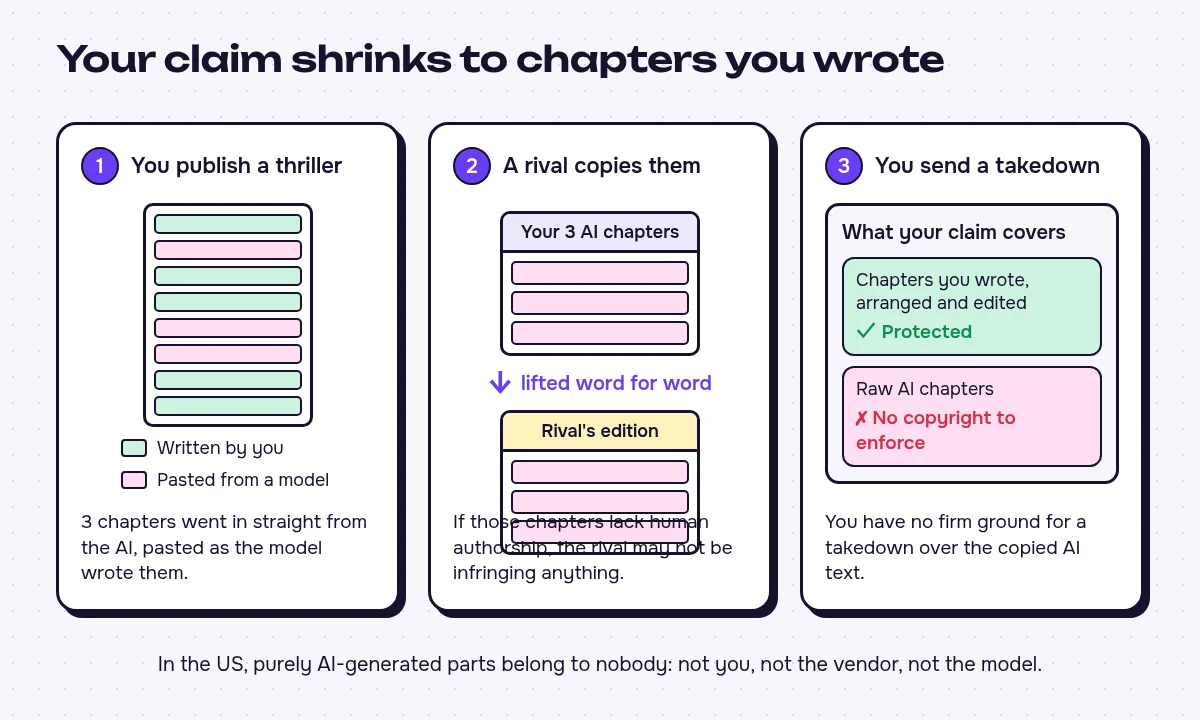
So if an AI writes a book, who owns it? In the US, nobody owns the purely AI-generated parts. They are not yours, not the vendor's and not the model's. You own your contribution and nothing beyond it.
Here is what that means for a seller. Say you publish a thriller with three chapters pasted straight from a model, and a rival seller lifts those chapters into their own edition. If those chapters lack human authorship, the rival may not be infringing anything. You can't send a takedown on firm ground or sue over text you hold no copyright in. The chapters you wrote, arranged and edited are still protected, so your claim narrows to exactly those parts.
Registration makes the gap explicit. When you register a book with the US Copyright Office, you have to identify AI-generated material and exclude it from your claim. A registration that knowingly leaves it out can be invalidated, and then you lose the registration you were counting on in a dispute. You need to know which passages came from the model before you file, which is why the checklist below starts with records.
The UK rule
The UK starts from a different place. If you wrote and shaped the book and AI only assisted, standard copyright applies and lasts for your life plus 70 years. A wholly AI-generated book falls under section 9(3) of the Copyright, Designs and Patents Act, the "computer-generated works" rule, which grants 50 years of protection. That provision is contested and rarely tested in court, and the government floated repealing it in its March 2026 report. I wouldn't build a publishing plan on a rule that may not survive the next round of reform.
The EU and China treat AI authorship differently again, so if you sell into those markets, don't assume either the US or the UK answer carries over. Ask a local lawyer how your book would be treated there.
| What you did with AI | US | UK | Disclose to KDP? |
|---|---|---|---|
| Brainstormed, researched, outlined, then wrote it yourself | Yours | Yours | No (AI-assisted) |
| Grammar and line edits on your own draft | Yours | Yours | No (AI-assisted) |
| AI drafted scenes, you rewrote heavily | Your rewriting, selection and arrangement. Surviving raw passages not | Depends on how far you shaped it | Yes (I'd declare it) |
| Pasted raw chapters, light cleanup | Little beyond arrangement | Relies on the contested s9(3) rule | Yes |
| AI cover art or interior images | Purely generated images not protected | Same uncertainty | Yes |
| AI translation of your book | Your original text yes. The AI-translated text sits with other AI output | Unclear | Yes |
The top two rows are what most people mean by AI-assisted writing: the tool helped you think or polish, and every sentence on the page is yours. The bottom three are AI-generated, whatever you did afterwards. The heavy-rewrite row is the one that needs a judgment call.
My verdict on the heavily rewritten AI draft
You can defend it, but it's the weakest position in the table. Your protection covers what you changed, and any AI sentences that survive stay unprotected. If you want a book you can enforce, write the first version yourself and use AI for outlines, critique and line edits. If you do draft with AI, rewrite until so little of the model's phrasing survives that you could defend each sentence as yours. Keep the before-and-after files. If your authorship is ever questioned, the difference between the AI draft and your final text is the evidence.
KDP: declare generated text, images and translations
You can sell AI-generated books on Amazon. KDP's content guidelines separate two kinds of AI use. AI-generated content is text, images or translations a tool produced, and you must disclose it when you publish. AI-assisted use covers work you created yourself and then brainstormed, refined or grammar-checked with a tool, and it needs no disclosure.
The disclosure goes into Amazon's internal records, and readers don't see it. Books get rejected or pulled for non-disclosure, quality problems or intellectual-property problems, not for using AI.
Answer separately for text, images and translations. A novel you wrote yourself with an AI-generated cover is still a yes on images. Editing AI output afterwards doesn't turn it into your own writing, so for heavily rewritten AI drafts I'd tick the box. Declaring costs you nothing, while a false "no" that comes to light puts the book and the account at risk. The policy is still changing, so reread KDP's current AI guidance before a large upload.
Publisher contracts: the originality warranty
A traditional deal adds an obligation copyright law doesn't. Almost every publishing contract has an originality warranty: you promise the work is original, that you wrote it, and that you own the rights you're licensing to the publisher. It usually comes with an indemnity, meaning that if the warranty turns out to be false, you cover the publisher's costs.
AI-generated text strains that promise twice over. Text you didn't author isn't yours to warrant as original. And if no one holds copyright in those passages, you can't grant the publisher exclusive rights in them, which is the asset it thinks it's paying for. Some publishers now add a separate clause requiring you to disclose any AI use or banning AI-generated text outright.
Before you sign, search the contract for "AI", "artificial intelligence", "originality", "warranty" and "indemnity", and read each clause those searches turn up. If you write fiction and want a traditional deal, I'd skip generative drafting and keep AI to outlines and critique. Tell your agent or editor how you used AI before you submit, not after the warranty is signed. If you hire a ghostwriter or developmental editor, put in writing whether and how they may use AI, because their output becomes part of what you warrant.
Infringement: your output is your liability
Models can echo existing text. If an echoed passage ends up in your book, you published it and the liability is yours, whoever typed it. The law firm Astraea warns that prompting a model to continue a copyrighted book series or closely mimic an existing work can make you directly liable for an infringing derivative work. Avoid those prompts, then check what the model gave you, because infringement turns on what your text copies.
Training is a separate fight. In Bartz v. Anthropic, the court found that training a model on lawfully acquired books was fair use, but that building a library of pirated books was not. That ruling decides the vendor's liability for how its model was built. It doesn't decide whether a passage in your published book copies someone else's, and that question stays with you.
Run a plagiarism check before you publish. Both of these tools list plagiarism checking in our directory:
| Tool | Free plan | Paid plan | API |
|---|---|---|---|
| Originality.ai | 10K words (100 credits one time); 60 credits (3 scans/day); 1 credit = 100 words | $14.95/mo, or $12.95/mo billed yearly | Yes |
| Copyleaks AI Detector | Yes | $16.99/mo, or $13.99/mo billed yearly | Yes |
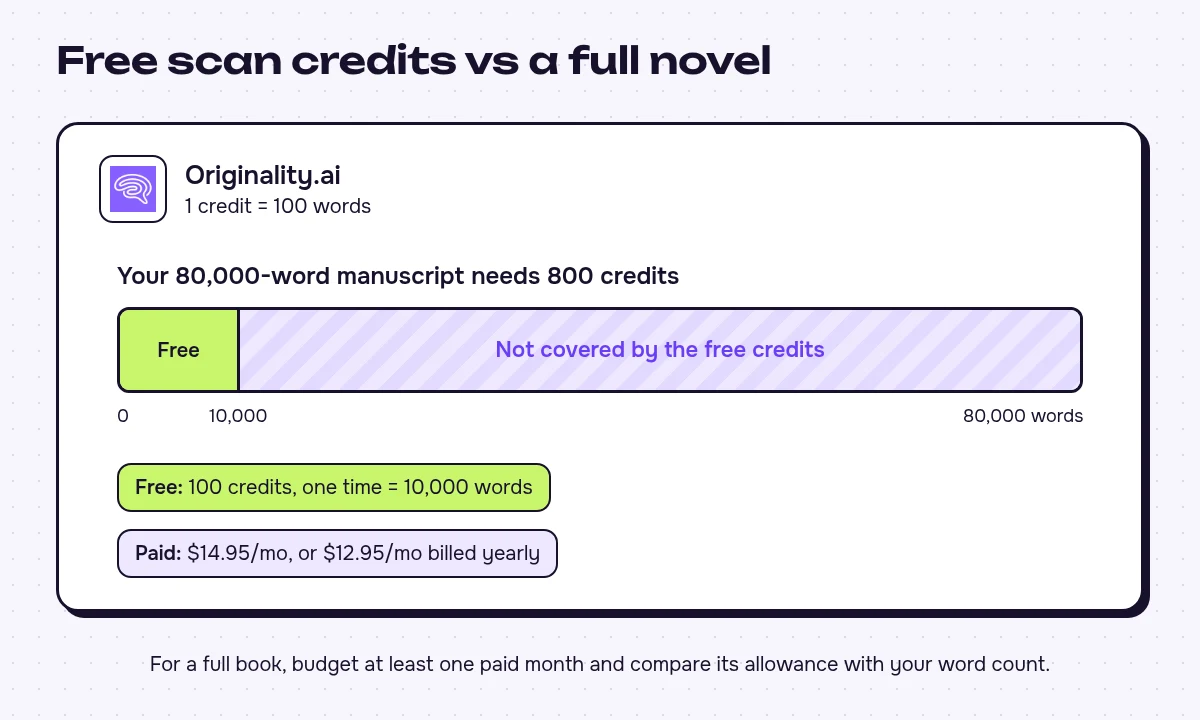
Do the math before you rely on the free tier. Originality.ai charges 1 credit per 100 words, so an 80,000-word manuscript needs 800 credits, and the 100 one-time free credits cover only 10,000 words. For a full book I'd budget for at least one paid month at $14.95, compare its credit allowance with your word count before you buy, and give the AI-drafted sections extra attention.
For nonfiction, check every claim, quote and citation against the original source. A fabricated study or a fake quote attributed to a real person is the kind of error a model produces confidently.
Your AI tool's terms assign rights, but they can't create copyright
OpenAI, Anthropic and Midjourney assign you whatever rights they hold in the output. That is useful, because the vendor won't claim your text. But as Astraea puts it, "a contract cannot grant copyright protection that federal law denies." The assignment hands over the vendor's interest and leaves unprotected text unprotected. Check the terms of whichever assistant you draft with, such as ChatGPT, Claude or Gemini. Look for who owns the output and whether commercial use is allowed, and save a dated copy with your manuscript.
ChatGPT and DeepL train on customer content under their privacy terms, and Grammarly does unless you opt out. Among the AI writing assistants we list, Writer.com, LanguageTool, Hemingway Editor and ProWritingAid say they don't. If you're pasting an unpublished manuscript into a tool, I'd weigh that more heavily than which model writes better prose. ProWritingAid is built for fiction line editing and critique, which fits the "write it yourself, polish with AI" route that keeps the whole book yours. To pick a drafting tool by type of draft, see which AI is better than ChatGPT for writing.
A proof-of-authorship checklist
If your copyright, contract or KDP status is ever questioned, your records are your evidence. Build them while you write, because you can't recreate them later:
- Save dated drafts, outlines and edit histories. They show your hand in the work at each stage.
- Export prompt and chat logs for each session where AI produced text you kept.
- Mark AI-drafted passages in a working copy, so you can describe them accurately to KDP and exclude them correctly when you register with the Copyright Office.
- Answer the KDP AI question honestly for text, images and translations separately.
- Save your AI tool's terms as they stood when you wrote the book.
- Run a plagiarism check on the full manuscript before publishing.
- Fact-check every claim and citation in nonfiction.
- Search your contract for the AI, originality, warranty and indemnity clauses, and tell your agent or editor about your AI use before you sign.
FAQ
What is the 30% rule for AI writing?
There is no 30% rule. No statute or Copyright Office guidance sets a percentage. The test is whether a human authored each expressive part. To me the figure reads like a forum rule of thumb repeated until it sounded official, and a ratio misleads in both directions. A book that is "only" 20% raw AI chapters still has 20% you can't protect, and you still have to disclose and exclude it. A book where AI suggested every sentence and you rewrote each one can be on firmer ground than a book with a few raw chapters pasted in, even though the model touched far more of it.
Is using AI to write a book cheating, or unethical?
It isn't cheating in any legal sense. Ethically, I think the line is honesty with the people who rely on you: KDP gets an accurate declaration, your agent or publisher hears about it before signing, and you don't market the book as something it isn't. Readers who pick a book because they believe one person wrote every line are relying on you too. If AI drafted large parts, I wouldn't sell the book on the strength of your personal voice.
My AI book app promises "full ownership." Do I still have to declare it to KDP?
Yes. AIWriteBook's pricing page, for example, says you have "full ownership and commercial rights to everything you create." That promise is between you and the app. It doesn't change Amazon's rules, so if the app wrote the chapters, KDP still expects you to declare them as AI-generated.
Tools in this article 6




Written by
Stanislav Vovchyk
Founder and editor of infobro.ai
I run infobro.ai: I decide what it covers and how tools are evaluated.
I research every tool from its documentation, pricing pages, product screenshots and public developer discussion, and say plainly what the evidence does and does not show.
More guides