The AI Dependency Problem: Why You're Outsourcing Your Thinking (And How to Use AI Without Losing Your Edge)
AI tools are making professionals faster but potentially shallower. Here's how to use AI without eroding the judgment, intuition, and expertise that actually make you valuable.
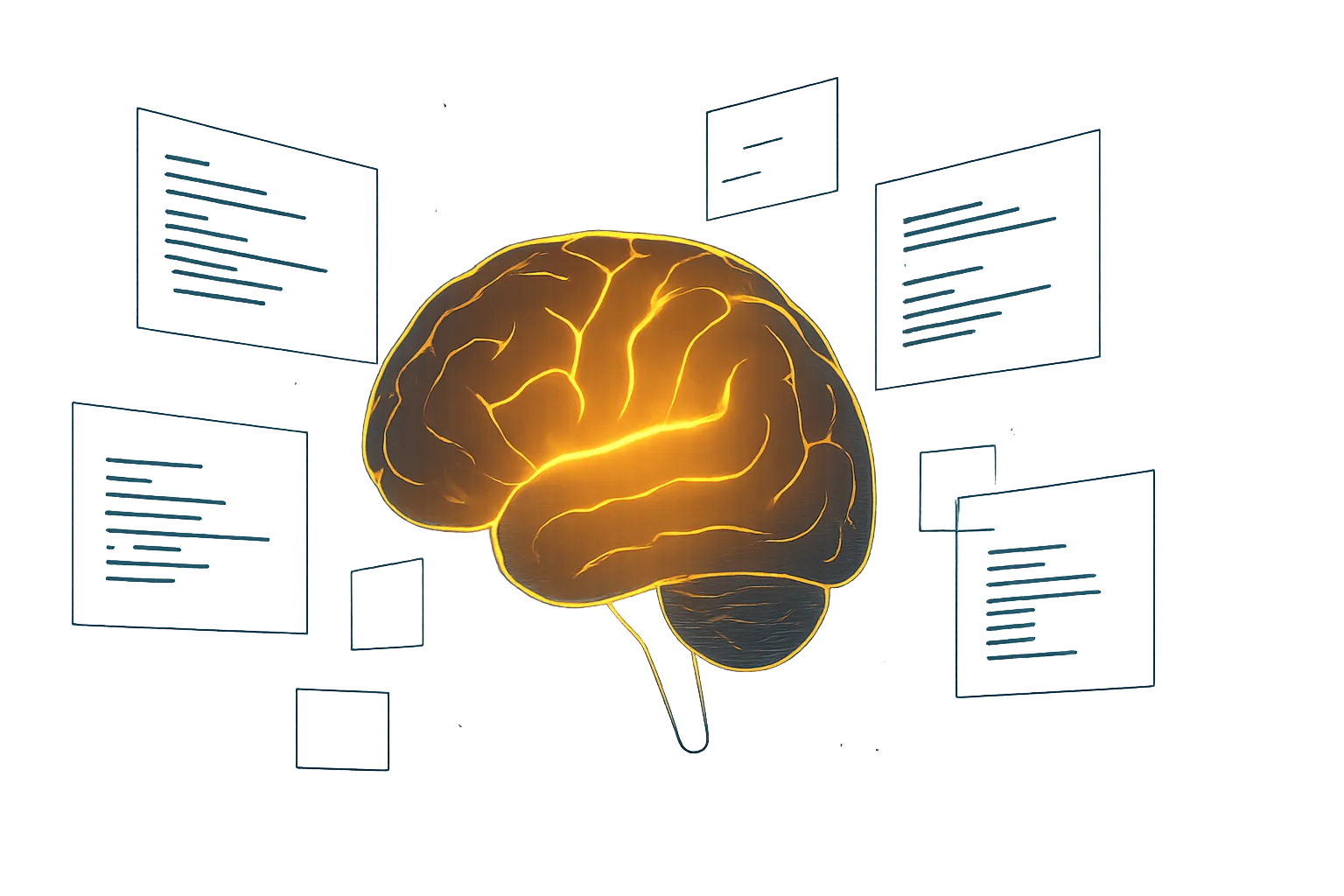
There's a pattern I keep noticing among people who use AI heavily. They get faster, their output volume goes up, and their work looks polished. But ask them a hard question about their domain without the AI in front of them, and there's a pause that wasn't there two years ago.
That pause is the problem.
AI tools are extraordinary at handling the mechanical work of thinking: drafting, summarizing, structuring, comparing. But mechanical thinking is also where expertise gets built. When you skip the friction, you skip the learning. Do it long enough, and you don't just get faster. You get shallower.
This isn't an argument against AI. It's an argument for using it deliberately, in ways that strengthen your judgment rather than quietly replacing it.
The Dependency Trap Nobody Talks About
Most AI productivity advice focuses on one direction: how to get more out of AI. More output, faster turnaround, better prompts. That's useful. But almost nobody asks what you're giving up in exchange.
Here's what's actually happening in a lot of workflows. Someone gets Mem.ai or a similar tool, starts having it summarize every meeting, draft every follow-up email, and synthesize every document they read. Their throughput triples. Their inbox hits zero. Their manager loves them.
Six months later, they realize they can't write a clear paragraph without AI cleanup. They struggle to recall specific arguments from documents they "read" via AI summary. They start asking AI what they think about a problem before they've actually thought about it themselves.
This is cognitive offloading, and it's not hypothetical. It's the predictable result of outsourcing the effortful parts of thinking on a consistent basis. Your brain is efficient, it won't maintain skills it doesn't need. Give it an easier path and it'll take it.
The professionals who avoid this trap aren't the ones who use AI less. They're the ones who use it differently.
Where AI Should and Shouldn't Touch Your Thinking
The clearest way to protect your expertise while still getting the benefits of AI is to draw a line between first-order and second-order thinking.
First-order thinking is the analysis, judgment, and synthesis that produces your actual intellectual output. This is where you're building something: forming a position, evaluating evidence, making a recommendation, identifying what others missed. This is where your value lives.
Second-order thinking is everything that supports first-order thinking: researching what's already known, organizing information, drafting structure, formatting, handling repetitive communication. This is where AI genuinely shines without cost to your expertise.
The mistake most people make is letting AI drift into first-order territory without noticing. You start by having AI draft an outline (fine), then you start having it generate the analysis within that outline (risky), then you start accepting its conclusions with light edits (now you're not thinking anymore).
The drift happens gradually. You have to be deliberate about where the line is.
Practical Rules for Using AI Without Eroding Your Judgment
Always think first, then use AI
Before you open any AI tool on a substantive problem, spend at least five minutes working it through yourself. Write down your initial take. Form a hypothesis. Identify what you don't know.
Then bring AI in to challenge, supplement, or extend what you've already thought. This isn't just a productivity tip, it's how you stay sharp. When you encounter AI output that contradicts your initial thinking, that's where the real intellectual work happens. You either update your view with good reason, or you identify why the AI is wrong. Both outcomes build expertise. Neither happens if you never think first.
This approach also makes you dramatically better at spotting bad AI output. Professionals who think independently before consulting AI are far more likely to catch the kind of confident, plausible-sounding errors that lead to real problems. That matters more than ever given how courts are now sanctioning lawyers over AI hallucinations, situations that almost always happen when someone accepts AI output without independent verification.
Use AI to stress-test your thinking, not generate it
One of the best uses of AI is adversarial: ask it to argue against your position, find flaws in your reasoning, or identify what you might be missing. This is qualitatively different from asking AI to build the argument for you.
When you argue with AI, your reasoning gets sharper. When you transcribe AI's reasoning as your own, it doesn't.
Specific prompts that work well here:
- "Here's my current thinking on X. What's the strongest case against this?"
- "I'm planning to recommend Y. What would an informed skeptic say?"
- "Here are the factors I'm weighing. What am I probably not considering?"
Notice that all of these start with your thinking. The AI is responding to you, not generating what you'll then adopt.
Protect your writing process
Writing is thinking. This is not a cliché, it's a description of how coherent reasoning actually develops. The act of forcing ideas into precise sentences reveals where your logic is fuzzy, what you actually believe versus what you assumed you believed, and how well you understand the subject.
Use AI to clean up writing you've already done. Use it to suggest cleaner phrasing, catch inconsistencies, or tighten structure. Don't use it to generate the first draft on anything that requires your professional judgment.
This is especially true for persuasive writing: pitches, recommendations, strategy memos, client communication. These documents are where your professional reputation lives. If you're not writing them, you're not developing the skill that makes them good.
The AI Output Quality Problem is real, but the deeper issue isn't model quality, it's whether your own standards are high enough to catch the gaps.
Build deliberate no-AI zones
Not every task benefits from AI assistance, and some tasks actively become worse with it. The problem is that once you have AI tools in your workflow, the temptation to use them everywhere is strong.
Pick specific types of work where you'll deliberately go AI-free:
- Initial problem framing on new projects
- One-on-one conversations and mentoring
- Any work where you're the primary expert being consulted
- Creative or strategic work where your distinctive perspective is the deliverable
Going AI-free in these zones isn't Luddism. It's maintenance. Like exercising muscles you don't want to atrophy.
Review AI outputs critically, not gratefully
Most people review AI outputs looking for things to fix. That's backwards. You should be reviewing them looking for things to reject.
Approach AI output the way a good editor approaches a draft from a junior writer: with the assumption that it will need substantive work, that it might be structurally wrong, and that the final product needs to reflect your judgment, not just the AI's initial pass.
This is especially important for research and analysis tasks. Tools like Semantic Scholar or Zotero can surface relevant literature efficiently, but the synthesis, what it means, how it connects, what it implies for your specific situation, that's yours to do. Handing that synthesis to AI and accepting its version is where expertise quietly disappears.
The Specific Risks by Profession
Different types of work have different dependency failure modes.
Analysts and researchers most often lose the ability to form independent hypotheses. They get better at processing existing information and worse at generating novel interpretations. If you're always asking AI "what does this data suggest," you stop developing the intuition to notice what the data doesn't say.
Writers and communicators lose voice and distinctiveness. AI-assisted writing converges toward a particular register: clear, balanced, slightly bland. The idiosyncratic perspective that makes writing worth reading gets averaged out. The fix is writing independently first and using AI only for polish, never for substance.
Managers and leaders risk losing judgment on people and situations. AI is genuinely useful for structuring decision frameworks and stress-testing plans. It's useless for the actual judgment call, and using it as a substitute atrophies exactly the skill you need. This connects to a broader concern: if you can't articulate your reasoning without consulting an AI, you probably shouldn't be in the meeting.
Developers who rely too heavily on AI code generation can lose the mental models that make debugging and architecture decisions possible. Lovable and similar tools are impressive at getting to working code quickly, but if you can't read the output critically, you own brittle code you don't understand.
What Deliberate AI Use Actually Looks Like
Here's a concrete example of the difference between dependency and deliberate use.
Dependency pattern: Meeting ends. You immediately feed the transcript to an AI meeting tool, read the AI summary, respond to action items based on the summary, file the AI notes, move on.
Deliberate pattern: Meeting ends. You spend three minutes writing down what you think the key decisions and open questions were, in your own words. Then you use the AI summary to check what you missed and catch anything you got wrong. Your notes reflect your understanding, corrected by AI where needed.
The second pattern takes four extra minutes. It keeps your recall and synthesis muscles working. Six months later, the person using the first pattern struggles to remember what happened in meetings unless they pull up the AI summary. The person using the second pattern actually remembers.
This is also why the AI memory problem isn't just about tools, it's about whether you're keeping your own memory and comprehension skills active, or outsourcing those too.
The Consistency Question
There's another dimension to this worth naming directly. When your thinking runs through AI tools, your output quality becomes dependent on your prompting skill and the AI's current capabilities. When those wobble, and they do, your work wobbles with them.
Professionals who've maintained independent judgment have a baseline that doesn't depend on any tool. That baseline is what AI consistency problems can't touch, because it's not coming from the AI.
Your judgment, refined through years of practice, is the one thing that doesn't have a bad day because of a model update.
A Framework for Auditing Your Own AI Use
If you want to honestly assess where you are on the dependency spectrum, ask yourself these questions:
| Question | Healthy Use | Dependency Signal |
|---|---|---|
| Can you write a first draft without AI? | Yes, comfortably | No, or it feels unusually hard |
| Do you form opinions before consulting AI? | Consistently | Rarely or never |
| Can you explain your AI-assisted conclusions? | In full detail | Only at surface level |
| Do you catch AI errors in your domain? | Regularly | Occasionally or not at all |
| Does your thinking feel sharper than 2 years ago? | Yes or neutral | Noticeably weaker |
If you're seeing dependency signals in two or more categories, your workflow has drifted too far toward outsourcing. That's fixable, but only if you acknowledge it.
The Actual Opportunity
The professionals who'll be most valuable over the next five years aren't the ones who use AI the most. They're the ones who've figured out how to use it without becoming dependent on it.
That means maintaining the hard skills that AI can't replicate: genuine domain expertise, the ability to make judgment calls under uncertainty, the capacity to communicate persuasively in your own voice, and the integrity to know when an AI output is wrong.
AI is a powerful tool for doing more. The risk is doing more while becoming less. The whole point of using these tools well is to arrive somewhere better, not just faster, but sharper, more capable, more distinctly yourself.
That doesn't happen by default. It requires being deliberate about where your thinking ends and the machine's begins.
Frequently Asked Questions
Tools & Services Mentioned

Founder and editor of infobro.ai
We research every tool from its documentation, pricing pages, product screenshots and public developer discussion, and say plainly what the evidence does and does not show. Drafts are written with AI assistance under our editorial rules, and we revisit articles to reflect platform changes. Learn more about our process.