Top 9 AI Tools for Healthcare Professionals in 2026: Ranked by What Actually Improves Patient Care
From AI scribes cutting documentation time in half to clinical decision support that catches what tired clinicians miss, here are the healthcare AI tools actually worth your time in 2026.
Healthcare AI is no longer a pilot program or a conference talking point. In 2026, it's sitting in the exam room, reading your radiology scans, and writing your SOAP notes before you've finished saying goodbye to the patient. The question isn't whether to adopt it. It's which tools are actually worth trusting with something as consequential as patient care.
This list focuses on tools that earn their place at the clinical workstation: AI scribes that actually cut documentation time, platforms that surface clinically relevant insights rather than noise, and scheduling or workflow tools that remove friction without adding confusion. We've looked at what each tool does specifically, how it integrates into existing clinical environments, and who it actually serves. If a tool exists primarily to impress investors rather than help clinicians, it's not here.
A quick note on scope: the healthcare AI market is crowded with platforms that promise everything. We've kept this list tight. General productivity tools, EHR systems without meaningful AI differentiation, and tools primarily aimed at hospital administrators rather than clinicians have been excluded. If you're a physician, PA, NP, or clinical team lead trying to figure out where AI actually earns its keep, this is for you.
If you're curious how AI is reshaping adjacent professional fields, our breakdown of what independent financial advisors actually use AI for in 2026 offers useful parallels on selective, high-stakes AI adoption.
1. Abridge
Official website: abridge.com
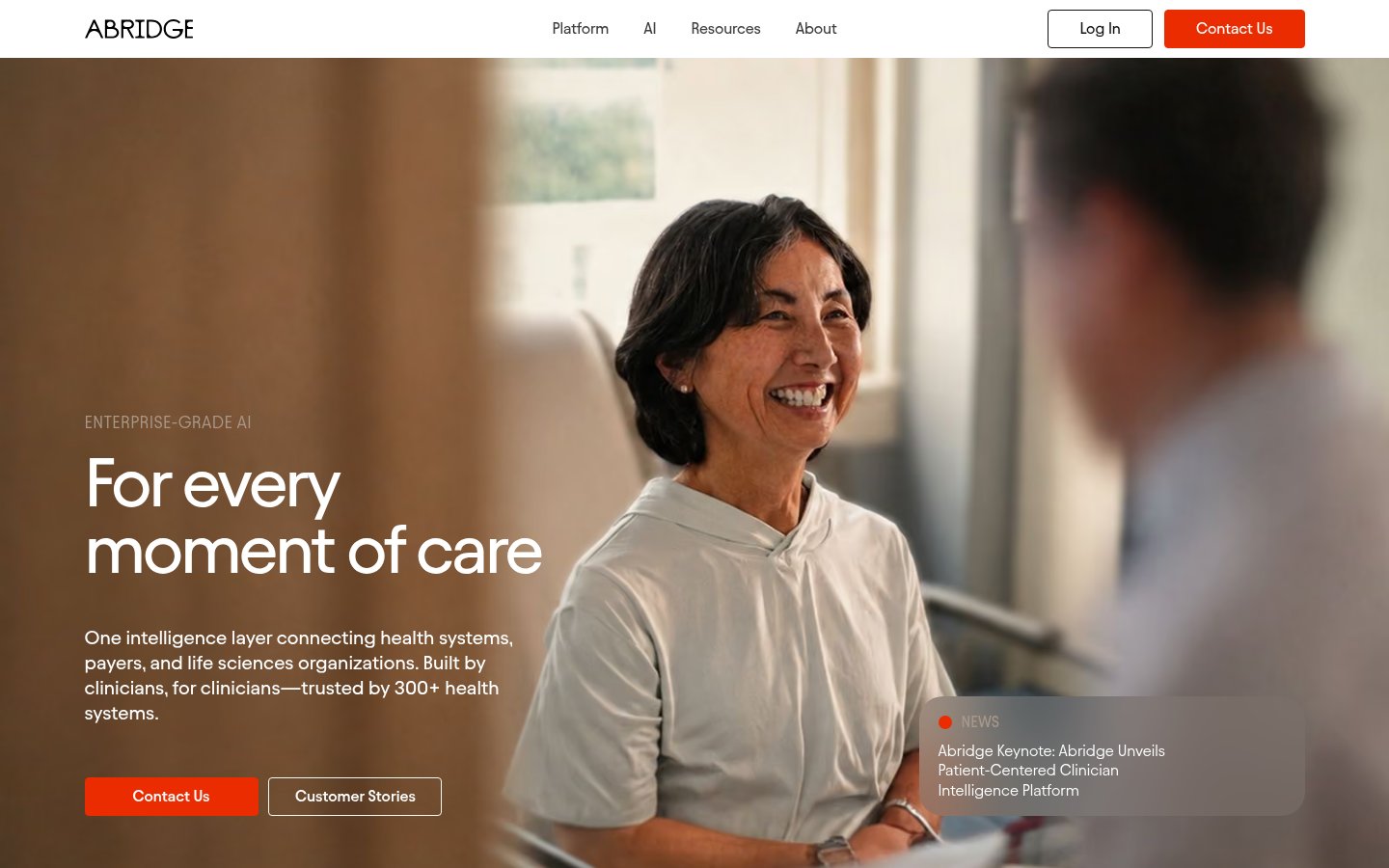
Abridge sits at the top of this list because it's doing something the other AI scribes haven't fully cracked: generating clinically structured documentation that sounds like the physician wrote it, not like a chatbot summarized the encounter. Built in partnership with UCSF and the University of Pittsburgh Medical Center, Abridge captures the ambient conversation in the exam room and converts it into draft clinical notes in near real-time.
The differentiation isn't just accuracy. It's that Abridge was built with a specific bias toward patient safety. The system flags when clinicians mention medications, dosage changes, or follow-up instructions, making those moments surfaceable in the note rather than buried. For specialties where missed medication context causes downstream harm, that's not a minor feature.
Abridge integrates with Epic, which is table stakes for serious health system adoption. The interface for reviewing and editing generated notes is clean. Physicians report spending significantly less time on after-hours documentation.
Pricing: Enterprise contracts through health systems. No publicly listed individual pricing.
Best for: Health systems and academic medical centers using Epic who want an AI scribe with genuine clinical pedigree, not just fast transcription.
Pros: UCSF and UPMC clinical partnerships add real credibility, deep Epic integration, safety-flagging for medication and follow-up mentions, note quality that reads as physician-authored.
Cons: Not accessible for solo practitioners or small practices, enterprise-only pricing with no self-serve option, requires institutional rollout.
Try Abridge →2. Freed
Official website: freed.ai
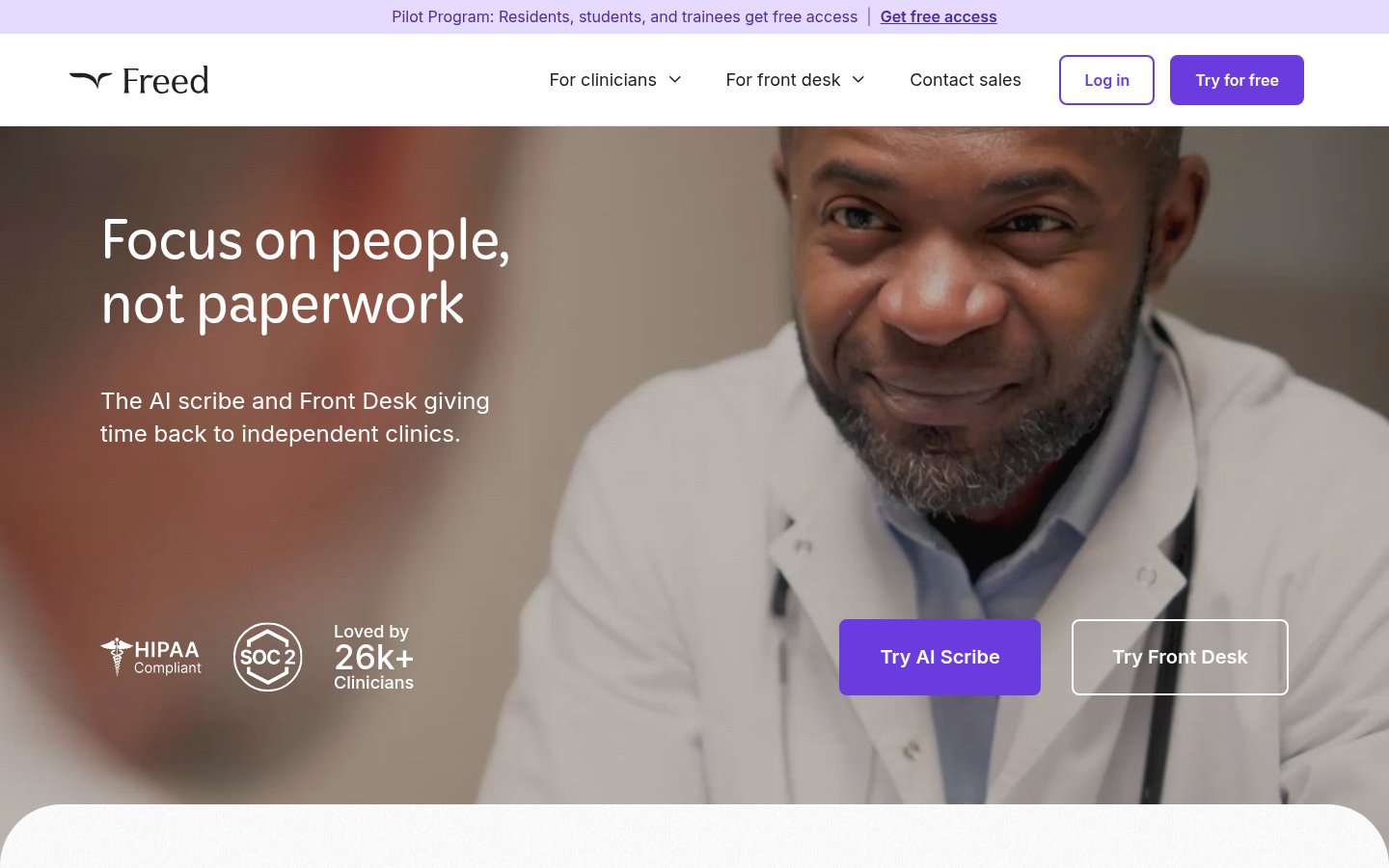
Freed is where independent clinicians actually live. While Abridge dominates health system deployments, Freed targets the solo practitioner, the small group practice, and the clinician who can't wait six months for an enterprise procurement cycle. The pitch is simple: record the encounter on your phone or computer, and Freed produces a structured clinical note within seconds.
What makes Freed stand out at this tier is note customization. Physicians can train the system on their preferred note style, which means the output doesn't just capture what was said. It captures it the way you'd actually write it. That learning curve pays off after a few encounters.
Freed also handles the patient-facing side: it generates after-visit summaries that can be shared directly with patients, which is a genuinely useful feature for practices trying to improve patient literacy and reduce callback volume.
The HIPAA compliance is in order, which matters more than some clinicians realize when they're tempted to just use a general-purpose AI transcription tool.
Pricing: Paid subscription starting at $99/month per clinician. No enterprise wall.
Best for: Independent physicians, NPs, and PAs who want a capable AI scribe without institutional IT involvement.
Pros: No enterprise contract required, fast note generation, customizable note style per clinician, patient-facing summaries included, HIPAA compliant.
Cons: Less clinical depth than Abridge for complex multi-problem encounters, no native EHR integration (copy-paste workflow), quality varies across specialties.
Try Freed →3. Nabla Copilot
Official website: nabla.com
Nabla started in France and has moved aggressively into the US market. It's an ambient AI scribe with a few notable differentiators. The first is multimodal input: Nabla can work with phone audio, desktop audio, and telehealth video calls, which makes it one of the more flexible scribing tools for practices running hybrid care models. The second is specialty depth. Nabla has documented support for over 45 medical specialties, which matters for something like psychiatry or oncology where generic note templates fall apart quickly.
The interface is genuinely well designed. The real-time transcription display lets clinicians monitor what's being captured during the encounter, and the post-encounter editing experience is faster than most competitors.
Nabla also offers a patient-facing app that generates visit summaries and allows patients to review their care instructions. The adoption data on this feature isn't fully public, but the concept is sound, and practices working on patient engagement metrics will find it useful.
It integrates with Epic, Athenahealth, and several other major EHRs, which puts it ahead of Freed on the integration side.
Pricing: Paid plans per clinician per month. Enterprise pricing available. Exact current figures require direct contact.
Best for: Practices running hybrid telehealth and in-person models, or those in specialties where generic note templates fail.
Pros: 45+ specialty templates, telehealth-native design, strong EHR integrations, real-time transcription monitoring, solid patient summary feature.
Cons: Pricing requires sales contact for most tiers, less brand recognition in the US than Abridge or Freed, rollout support varies by region.
Try Nabla Copilot →4. Suki AI
Official website: suki.ai
Suki has been in this space longer than most of its competitors. That longevity shows in its EHR integration depth: it connects with Epic, Cerner, Athenahealth, and several others, and it handles structured data entry rather than just free-text note generation. That distinction matters. A lot of AI scribes produce a well-written paragraph that a clinician then has to manually translate into structured EHR fields. Suki can write directly into those fields.
The voice-first interface is the other signature feature. Suki is designed to be controlled almost entirely by voice, which means minimal keyboard interaction during encounters. For clinicians who find themselves toggling between a computer and a patient constantly, that friction reduction is real.
Suki has also added clinical decision support features in recent updates, surfacing relevant clinical guidelines and drug interaction information in context during the encounter. It's not as deep as a dedicated CDT platform, but it's useful for primary care and hospitalists who want a single tool doing more work.
Pricing: Enterprise pricing. Suki works with health systems and large group practices. Individual clinician pricing is available in some markets.
Best for: Clinicians who want deep EHR structured data entry, not just ambient note generation.
Pros: Longest track record in AI scribing, deep EHR structured data entry, voice-first design, multi-EHR support, embedded clinical decision hints.
Cons: Voice interface has a learning curve, enterprise deployment adds onboarding time, clinical decision features are supplementary not primary.
Try Suki AI →5. DeepScribe
Official website: deepscribe.ai
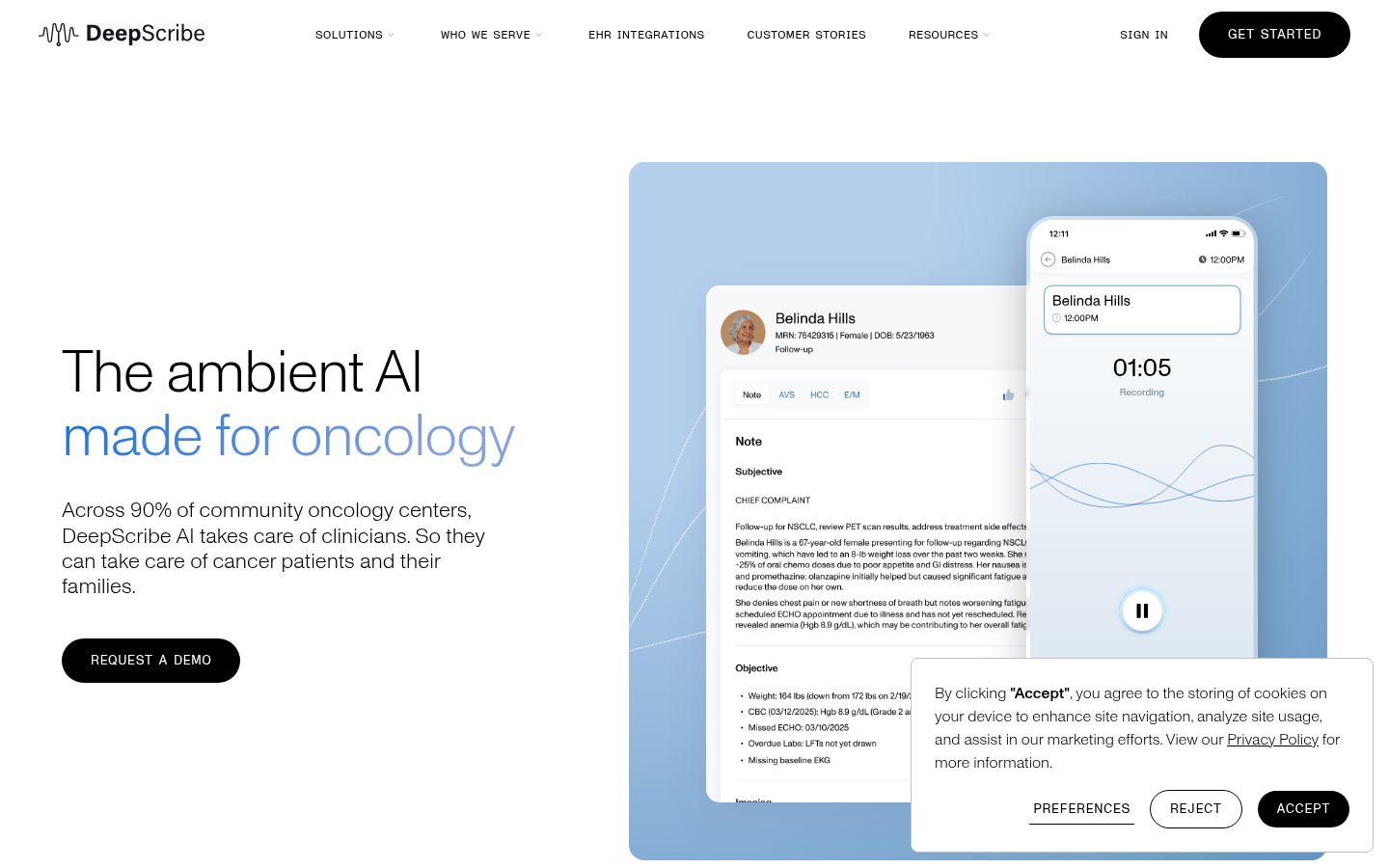
DeepScribe takes a slightly different approach from most ambient scribes. It focuses heavily on the post-encounter review workflow. The generated note lands in a review interface where physicians can see which portions were auto-populated from the conversation, approve or edit specific sections, and track changes over time. For physicians who are cautious about AI-generated content entering the medical record without clear review, that transparency is worth a lot.
DeepScribe also makes a specific case for specialty practices. Its documentation for oncology, neurology, and orthopedics is more developed than most general-purpose scribes, which tends to be where generic tools produce the worst output.
The system has been deployed across a number of large health systems and group practices, and it integrates with major EHRs. The review interface is genuinely one of the better-designed ones in this category.
Pricing: Enterprise pricing only. Direct sales contact required.
Best for: Specialty practices where note accuracy is highest stakes and where clinicians want transparent, auditable AI note generation.
Pros: Transparent review interface shows what AI generated vs. what was manual, specialty-optimized documentation, strong enterprise deployment track record.
Cons: No self-serve or SMB tier, enterprise-only means slow procurement, less suited for primary care volume workflows.
Try DeepScribe →6. Microsoft Dragon Copilot
Official website: nuance.com
Dragon has been in clinical documentation for decades. The Copilot iteration brings generative AI into that established infrastructure, which means health systems that already run Dragon Medical One don't need a new vendor, a new procurement cycle, or a new IT integration. They just get meaningfully better documentation.
The combination of ambient capture and Dragon's legacy voice recognition accuracy is genuinely competitive. For hospitals already deep in the Microsoft ecosystem, Dragon Copilot connects to Microsoft 365, Teams, and Azure health services, which creates workflow integrations that standalone scribes can't match.
The honest caveat: Dragon Copilot is best understood as an upgrade path for existing Dragon customers, not the first choice for a practice coming in cold. The interface carries years of legacy design decisions, and the onboarding isn't as clean as Freed or Nabla for new users. But if you're already a Dragon shop, the Copilot upgrade is an easy yes.
The AI radiology discussion is a useful parallel here: just as AI in rural hospitals is now infrastructure rather than innovation, clinical AI scribing at health systems is reaching a similar baseline. Dragon Copilot is what that baseline looks like for Microsoft-aligned institutions.
Pricing: Enterprise pricing through Nuance/Microsoft. Existing Dragon customers may have upgrade paths within current contracts.
Best for: Health systems already running Dragon Medical One who want generative AI added to existing infrastructure.
Pros: Decades of clinical voice recognition accuracy, deep Microsoft ecosystem integration, no new vendor for existing Dragon customers, strong compliance infrastructure.
Cons: Legacy interface feels dated compared to newer competitors, not the right choice for new adopters without existing Dragon investment, Microsoft-centric stack limits flexibility.
Try Microsoft Dragon Copilot →7. Heidi Health

Official website: heidihealth.com
Heidi Health is the most accessible ambient scribe on this list, and accessibility is genuinely a feature when you're looking at solo GPs and small practices in markets where other tools don't reach. Heidi started in Australia and has expanded significantly. It runs in the browser, requires no app installation, and works on any device with a microphone.
The note generation is fast. The quality across general practice and family medicine encounters is solid. For a clinician seeing 25-30 patients a day in a busy primary care setting, Heidi removes the after-hours documentation that used to be an unavoidable part of the job.
Heidi has a free tier, which is unusual in this category and worth acknowledging. It's limited, but it lets clinicians actually try the tool before committing. That matters in a market where most competitors require a demo call and a contract before you see the product.
The limitations are real: Heidi doesn't match the specialty depth of Nabla or the EHR integration depth of Suki. For primary care volume work, though, it punches above its price point.
Pricing: Free tier available. Paid plans for higher volume and additional features. Exact current pricing is listed on their website.
Best for: Solo GPs and small primary care practices who want a fast, low-friction AI scribe with a genuine free starting point.
Pros: Free tier available, browser-based with no installation, fast note generation for primary care, accessible in markets outside the US, straightforward onboarding.
Cons: Limited specialty depth, no native EHR integration, free tier has volume caps, not designed for complex multi-specialty encounters.
Try Heidi Health →8. SOAPNoteAI
Official website: soapnoteai.com
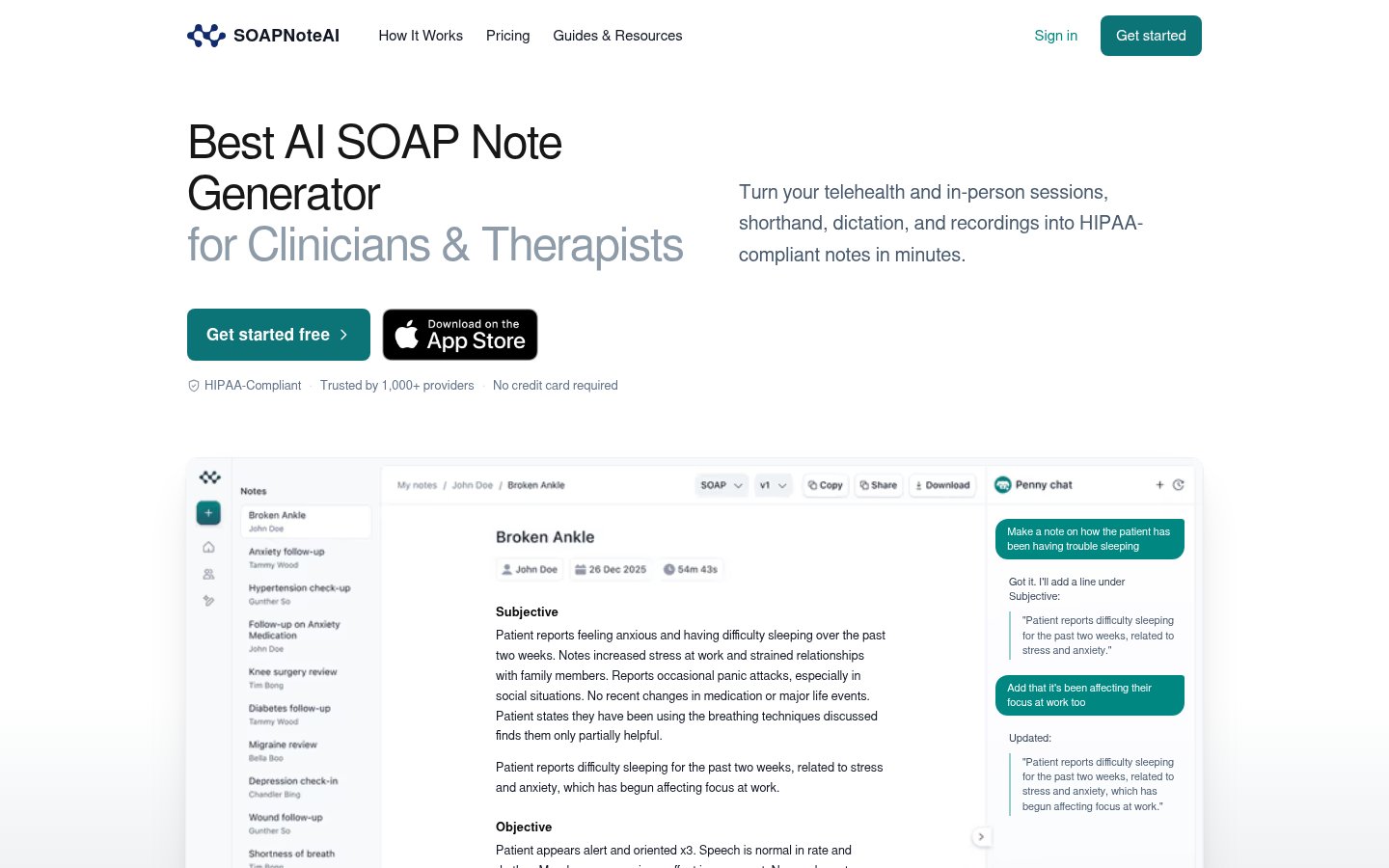
SOAPNoteAI does one thing and does it without friction: it takes clinical encounter input and produces a properly structured SOAP note. There's no ambient listening, no app to install, no enterprise pitch. You describe or transcribe the encounter, and you get a formatted SOAP note back.
That simplicity is the product. For clinicians who don't want to hand a microphone to an AI during patient encounters but still want to save the 15 minutes it takes to write structured notes from scratch, SOAPNoteAI fills that gap. It supports a range of templates across common specialties and allows for some customization.
The pricing is low, which makes it genuinely accessible for solo practitioners or those in settings where AI tool budgets are tight. It won't impress anyone looking for ambient capture or EHR integration. But for the clinician who writes notes after the encounter from memory or quick jottings, it's a meaningful time saver.
The tool is worth mentioning in the context of how independent restaurant operators use AI for targeted, specific tasks rather than comprehensive platforms. SOAPNoteAI represents the same philosophy applied to clinical documentation: solve one specific problem, solve it well.
Pricing: Low-cost subscription. Free trial available. Specific pricing tiers listed on site.
Best for: Clinicians who prefer post-encounter note generation from typed or dictated input rather than ambient in-room recording.
Pros: No ambient microphone required, simple low-friction workflow, low cost, multiple specialty templates, fast note output.
Cons: No ambient capture, no EHR integration, limited customization depth, less suitable for high-volume practices needing real-time documentation.
Try SOAPNoteAI →9. Innovaccer
Official website: innovaccer.com
Innovaccer earns the final spot because it addresses something none of the scribes above touch: population health and clinical data unification at scale. For large health systems juggling value-based care contracts, risk stratification, and chronic disease management, Innovaccer's AI-powered health data platform is one of the most capable tools available.
The core product ingests data from disparate EHRs, claims systems, and care management platforms and creates a unified patient record that feeds AI-driven care gap identification and population risk scoring. For a health system managing tens of thousands of patients across multiple sites, that's operationally significant. It finds the patients who are about to fall through the cracks before they do.
Innovaccer isn't a bedside tool and isn't trying to be. It plays at the health system strategy layer. Clinical leadership, population health teams, and care management coordinators are its actual users. If that describes your context, it's genuinely worth evaluating.
Pricing: Enterprise. Direct sales and implementation required.
Best for: Large health systems and ACOs focused on value-based care, population health management, and cross-EHR data unification.
Pros: Genuine population health capability, multi-EHR data unification, AI-driven care gap and risk identification, purpose-built for value-based care models.
Cons: Not relevant for individual clinicians or small practices, heavy enterprise implementation, high complexity relative to the other tools on this list.
Try Innovaccer →How These 9 Compare at a Glance
| Tool | Best Use Case | Ambient Capture | EHR Integration | Pricing Model | Best For |
|---|---|---|---|---|---|
| Abridge | Clinical documentation | Yes | Epic (deep) | Enterprise | Health systems |
| Freed | Independent practice | Yes | None (copy-paste) | ~$99/month | Solo clinicians |
| Nabla Copilot | Hybrid/telehealth | Yes | Epic, Athena, others | Paid/Enterprise | Specialty & telehealth |
| Suki AI | Structured EHR entry | Yes | Epic, Cerner, Athena | Enterprise | Multi-EHR practices |
| DeepScribe | Specialty documentation | Yes | Major EHRs | Enterprise | Specialty practices |
| Microsoft Dragon Copilot | Existing Dragon shops | Yes | Deep Microsoft stack | Enterprise | Dragon customers |
| Heidi Health | Primary care volume | Yes | None | Free + Paid | Small/solo GP practices |
| SOAPNoteAI | Post-encounter notes | No | None | Low-cost subscription | Post-encounter workflows |
| Innovaccer | Population health | No | Multi-EHR unified | Enterprise | Health systems/ACOs |
How I Ranked These
The ranking logic here is clinical impact first, then accessibility, then specificity of fit. Abridge goes first not because it's the most popular but because the combination of clinical partnership depth, Epic integration, and safety-focused design gives it the most credibility for high-stakes documentation. Freed goes second because for the actual majority of US clinicians, solo and small-group practitioners, it's the most practical and immediately useful tool on the list.
The middle of the list reflects tools that excel in specific contexts: telehealth (Nabla), structured data entry (Suki), specialty depth (DeepScribe), and enterprise Microsoft alignment (Dragon Copilot). Tools lower on the list aren't worse, they're more narrowly applicable. Heidi is excellent for its target market. SOAPNoteAI solves a specific problem well. Innovaccer is genuinely capable but relevant to a much smaller slice of clinical professionals.
What's notably absent from this list: general-purpose AI assistants dressed up with medical disclaimers, EHR vendors adding chatbots to legacy interfaces without meaningful AI redesign, and tools that market to healthcare but can't demonstrate clinical validation. The AI space in healthcare is noisy. The tools above at least have a clear reason to exist.
Related reading
Frequently Asked Questions
Tools & Services Mentioned
infobro.ai Editorial Team
We research every tool from its documentation, pricing pages, product screenshots and public developer discussion, and say plainly what the evidence does and does not show. Drafts are AI-assisted and reviewed by our editors before publication. We revisit each article every 6 months to reflect platform changes. Learn more about our process.