How Independent Physical Therapy Clinics Are Actually Using AI in 2026
From ambient documentation to remote monitoring, here's what AI is actually doing inside independent PT clinics in 2026, and where it's still falling short.
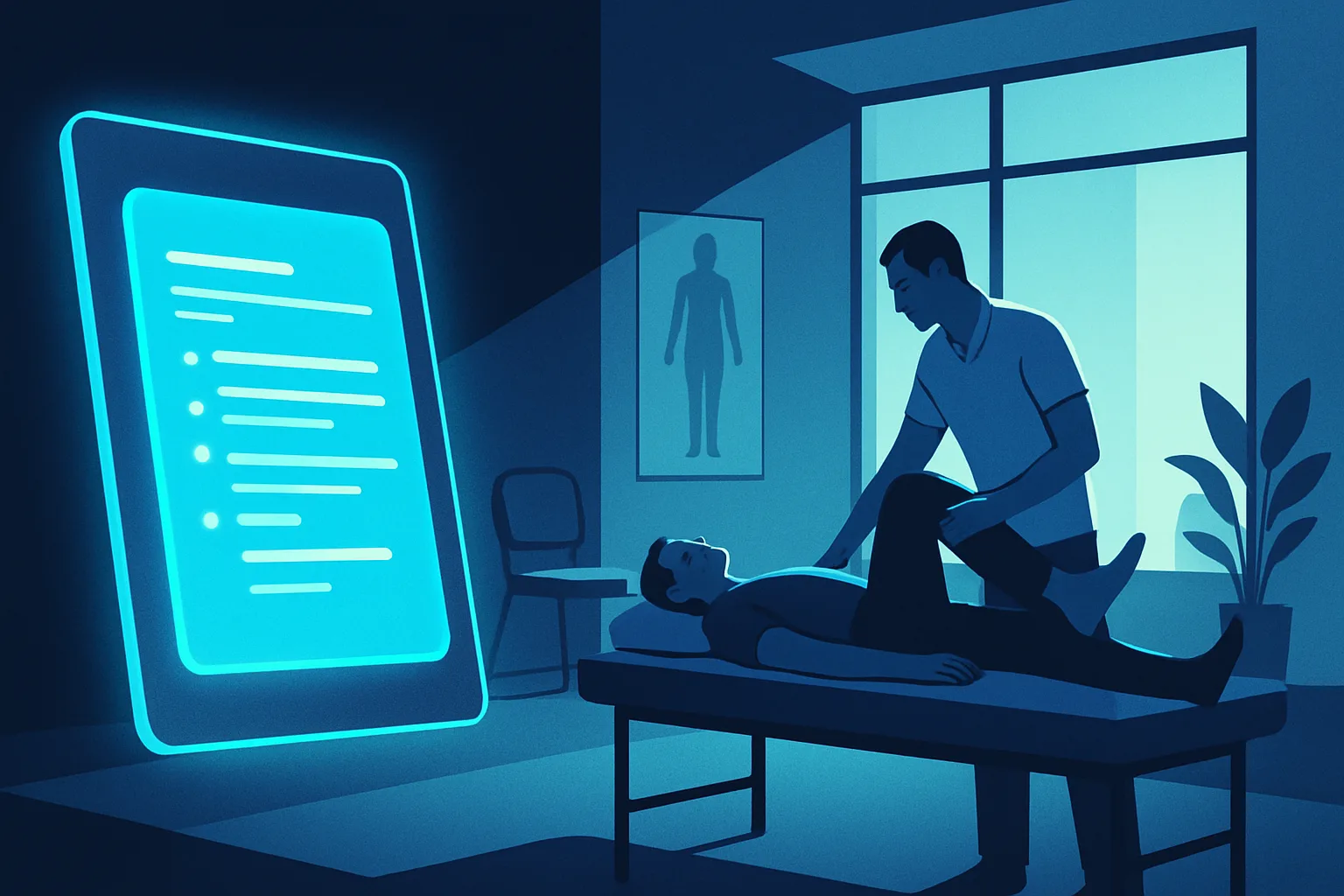
Physical therapists spend roughly half their working day on paperwork. That's not a new complaint, but in 2026, it's finally being fixed at scale. Independent PT clinics are one of the quieter success stories in the AI tools market right now: not splashy, not venture-funded, but genuinely productive. The tools that matter most aren't the futuristic ones on conference slides. They're the ones that cut charting time, catch billing denials before they happen, and keep patients engaged between visits.
Here's a clear-eyed look at where the technology is actually delivering, where it still needs watching, and how a lean private practice should think about building an AI setup in 2026.
Why Physical Therapy Is a Good Fit for AI Right Now
The math is simple. PT clinics run on clinical documentation, scheduling, billing, and home exercise adherence. All four are repetitive, structured, and rule-bound. That's exactly where AI tools perform well today.
The U.S. AI in physical therapy market hit an estimated $224.54 million in 2026, with software holding a 64% share of that, according to Towards Healthcare. The musculoskeletal rehabilitation segment alone accounted for 34% of market share in 2025. These aren't abstract projections from five years ago; they reflect the real procurement decisions small clinic operators are making today.
What's changed most in the last 18 months is the quality of PT-specific AI documentation. Generic medical scribes have existed for a while, but they were built for physicians and handled PT-specific documentation poorly. Range of motion readings, manual muscle testing grades, functional mobility assessments, special orthopaedic tests. Those need structured, specific output formats. The tools worth using in a PT context now handle those properly.
AI Documentation: Where the Hours Actually Come Back
A large multisite study published in JAMA in April 2026 found that ambient AI scribes cut documentation time meaningfully, with frequent users saving roughly 27 minutes per day and average users saving around 13 minutes per day. For a clinician seeing 10-12 patients a shift, that compounds fast.
Ambient documentation in a PT context works like this: the clinician conducts the session normally while the tool listens passively, then generates a structured SOAP note, including objective measurements, which the clinician reviews and signs. No dictation, no template filling during the visit.
The PT-specific tools worth knowing:
-
DeepCura ($129/month, roughly 1,000 credits per month at one credit per standard note) is built for PT workflows. It captures ROM values with degree measurements, MMT grades, special test results, and functional mobility documentation. It integrates bidirectionally with major EHR systems including athenahealth, Epic, eClinicalWorks, and Cerner, and adds an AI receptionist and billing fax management in the same platform. For practices that want a single tool for documentation and front-office automation, this is currently the most complete option.
-
WebPT Scribe (pricing embedded in WebPT subscription) is the natural choice for the large slice of PT clinics already running WebPT as their EMR. The documentation is purpose-built for rehab workflows, and the integration is native. If you're already on WebPT, there's a low barrier to activating this.
-
OneChart (~$79/month) is the budget-accessible option. Passive ambient listening with rehab-oriented SOAP templates. Less comprehensive than DeepCura on EHR integration, but usable for smaller practices that just want documentation relief without a complex setup.
-
Claire sits in a useful niche: detailed home exercise program documentation with illustrated patient-facing materials. For clinics where HEP compliance is a known problem, it's worth looking at specifically for that workflow, even if you use another tool for the clinical note itself.
Every one of these tools still requires clinician review before finalisation. That's not a caveat to bury, it's the correct workflow. AI drafts speed up the charting; they don't replace clinical judgment on the note.
This category is where independent PT clinics should spend their attention first. The ROI is direct and measurable: time saved per clinician per day, documented and trackable. As covered in our piece on how AI medical scribes actually work in 2026, the ambient documentation space has matured considerably, but the gap between generic and specialty-specific tools is still large enough to matter.
Billing and Revenue Cycle: The Denial Problem Is Real
Billing errors and claim denials are a chronic profit leak in PT practices. Therapy billing is complicated, 8-minute rule compliance, prior authorisation requirements, payer-specific documentation standards, and a single documentation gap can flip a billable unit into a denial.
AI billing tools in this space do a few specific things:
Pre-claim scrubbing. Before a claim is submitted, the system checks it against payer rules and flags missing documentation, unsupported codes, or 8-minute rule violations. Catching these before submission is far cheaper than appealing a denial after the fact.
Prior authorisation automation. This is where AI has made the biggest practical difference for small clinics in 2026. Prior auth is time-consuming and highly rule-bound, a good fit for automation. Platforms like SPRY PT and platforms built on rehab-specific RCM logic now automate much of the prior auth workflow, reducing the administrative burden on front desk staff. SPRY PT positions its platform specifically on automated billing and real-time patient data, though pricing isn't publicly listed and requires a demo.
Coding suggestions from documentation. When the AI scribe generates a note, better platforms now suggest CPT codes based on what the note actually contains. This reduces undercoding (clinicians billing for less than they delivered) and flags overcoding before it becomes a compliance problem.
The 2026 CMS update expanded the Remote Therapeutic Monitoring CPT code set, specifically codes 98979, 98984, and 98985, to reflect more nuanced monitoring activities. This created a legitimate new billing opportunity for clinics that have RTM workflows in place. AI-enhanced RTM platforms can now automate adherence tracking and symptom flagging in ways that support these billing codes. If your practice isn't billing RTM correctly, that's a direct revenue gap worth fixing.
Remote Therapeutic Monitoring: The Care Extension That Actually Works
Remote therapeutic monitoring isn't new, but the AI layer on top of it is increasingly useful. The basic model: patients use a connected app or wearable between visits, the platform tracks exercise adherence and symptom changes, and the clinician sees a structured summary rather than raw data they'd need to interpret manually.
What AI adds to this:
- Automated adherence tracking. Rather than relying on patient self-report, the system logs when exercises were completed and how long they took.
- Symptom flagging. If a patient logs escalating pain scores or skips three consecutive sessions, the system surfaces this to the clinician proactively rather than waiting for the next appointment.
- Engagement prompts. Automated check-in messages tied to the patient's specific program, not generic wellness content.
The strongest evidence base for AI in PT right now sits in computer vision and machine learning for movement analysis, where AI tools have shown real effectiveness in detecting and classifying movement patterns across clinical and home settings. Depth camera-based physiotherapy assessment is a growing area, with multiple peer-reviewed studies in 2025 supporting the approach.
For independent clinics, the practical question is integration. RTM platforms need to talk to your scheduling system and billing stack. A disconnected RTM tool just creates more data silos and more manual reconciliation. If your current EMR doesn't have a native RTM module or a clean integration pathway, factor that switching cost into your evaluation.
Scheduling and Patient Engagement
Scheduling in PT clinics has a specific problem that generic scheduling tools don't handle well: recurring visit sequences. A patient who needs 3x/week for 4 weeks, then 2x/week for 4 weeks, requires sequential booking logic that a basic calendar tool isn't built for.
AI scheduling tools built for PT handle this, and the better ones also manage waitlist logic, cancellation backfill, and prior authorisation expiration tracking (so you don't keep scheduling visits that won't be covered).
Patient engagement between visits is the other piece. Home exercise program compliance is notoriously low. Patients who receive illustrated, personalised HEP materials with automated follow-up prompts complete more of their program. The ROI isn't just clinical outcomes, it's also the RTM billing opportunity those touchpoints support.
For reference, the field service industry has seen similar gains from AI scheduling tools, and our piece on AI dispatch and scheduling for field service businesses covers the general pattern well. The PT equivalent is further specialised, but the underlying logic is the same: AI handles the matching and sequencing logic that humans do slowly and inconsistently.
What the Market Doesn't Have Yet
It's worth being direct about the gaps.
AI clinical reasoning tools are in early stages for PT. The appeal is obvious: an AI that suggests treatment progressions based on outcomes data across similar patient profiles. The evidence for this is thin. A 2025 observational study in the Journal of Medical Systems looked at large language models in personalised rehab for knee osteoarthritis, but the results were observational, not interventional, and the clinical integration pathway is unclear for a small practice.
Movement analysis at home via camera is technically promising. The peer-reviewed evidence for depth camera-based movement assessment is growing. But consumer-grade implementation for unsupervised home use is still rough. Lighting, camera placement, and patient compliance with setup requirements all introduce noise. This is a watch-and-wait category for most independent clinics.
AI-generated treatment plans are not something an independent clinician should use uncritically from a current commercial tool. The marketing often outpaces what's actually validated. Use AI for the administrative and documentation layers; keep clinical decision-making where it belongs.
This is a version of the same lesson that applies across healthcare AI. As the story about hikers rescued after trusting AI trail advice illustrates, AI tools built for information retrieval and generation can produce confident-sounding output that's wrong in ways that matter. In physical therapy, that risk is lower than in navigation, but the principle of active clinician verification holds.
How to Build an AI Stack for an Independent PT Clinic
Independent PT clinics don't need a sprawling tool stack. They need a few well-connected pieces. Here's the architecture that makes sense in 2026:
| Layer | What to Look For | Example Tools |
|---|---|---|
| Documentation | Ambient AI scribe with PT-specific templates, EHR integration | DeepCura, WebPT Scribe, OneChart |
| Billing / RCM | Pre-claim scrubbing, 8-minute rule support, prior auth automation | SPRY PT, platform-native RCM |
| Scheduling | Recurring visit logic, waitlist backfill, auth tracking | EMR-native schedulers |
| RTM | Automated adherence tracking, symptom flagging, CPT billing support | RTM-specific platforms |
| HEP / Patient Engagement | Illustrated exercise programs, automated check-ins | Claire, platform-native HEP modules |
The biggest mistake independent clinics make is buying five disconnected tools that don't share data. You end up with more logins, more reconciliation work, and no unified picture of clinic performance. A single platform that covers documentation, billing, scheduling, and patient engagement will almost always beat a patchwork of best-of-breed tools for a practice with fewer than 10 clinicians.
The second biggest mistake is treating AI documentation as a set-and-forget system. Every AI-drafted note needs review. Not because the tools are bad, but because the clinician's signature means they're taking responsibility for the content. Build the review step into the workflow from day one, not as an afterthought.
The Economics
AI documentation tools for PT run roughly $79 to $129 per clinician per month for standalone scribes. That's a straightforward ROI calculation: if a tool saves a clinician 13 minutes of documentation per day, that's roughly an hour per week of recovered clinical or administrative time. At any reasonable billing rate, the tool pays for itself quickly.
Billing automation is harder to quantify up front but often has a larger impact. Denial rates in PT billing frequently run 10-15% of claims. If AI pre-claim scrubbing cuts that by half, the revenue recovery on a mid-volume practice can dwarf the cost of the software several times over.
The broader AI cost environment is also shifting. Coverage of Google's TurboQuant inference cost reductions points to a trend that will eventually compress per-note AI costs further. Tools that currently charge per-credit models may shift pricing structures over the next 12 months as underlying inference gets cheaper.
The U.S. AI in physical therapy software market is growing at a 25.28% CAGR through 2035, according to Towards Healthcare. That growth isn't speculative, it reflects the real adoption decisions already happening inside clinics like yours.
Practical Next Steps
If you're running an independent PT practice and haven't moved on AI documentation yet, here's the sequence that makes sense:
-
Start with documentation. It's the fastest return and the lowest clinical risk. Run a trial of DeepCura or WebPT Scribe for 30 days and measure charting time before and after. The data will tell you whether to continue.
-
Audit your billing denial rate. Pull your last three months of claims data and categorise denials by type. If documentation gaps are driving more than 20% of denials, that's the next problem AI billing tools can help fix.
-
Check RTM eligibility. Look at your current patient census and identify who qualifies for RTM billing under the 2026 CMS codes. If a meaningful percentage of your patients qualify and you're not billing RTM, you have a revenue gap that's fixable without adding clinical staff.
-
Evaluate your stack for integration. Before adding any new tool, check whether it integrates with your current EMR and billing system. A tool that requires manual data export is a tool that creates more work, not less.
The practices that are getting the most from AI in 2026 aren't the ones with the most tools. They're the ones with the fewest tools that are properly connected. That's the standard to hold any vendor to before signing a contract.
For context on how similar dynamics are playing out in other small practice settings, the approach we documented for independent veterinary practices maps closely to what works in PT: start with documentation, fix the billing leak, then layer on patient-facing tools once the operational foundation is solid.
And if you're wondering whether AI cost structures are sustainable as you build out your stack, the conversation around per-seat SaaS pricing models shifting to agent-based models is worth following. Some PT platforms are already experimenting with usage-based pricing, which could meaningfully change the economics for high-volume practices.
The technology isn't magic, and it isn't the future. It's working, today, in clinics that chose the right tools and built the right habits around them.
Sources
- Towards Healthcare, U.S. AI in Physical Therapy Market sizing report, April 2026
- DeepCura, Best AI Scribe for Physical Therapy 2026, tool pricing and feature comparison
- BTE Technologies / TherapySpark, AI in Physical Therapy: Practical Tools for Clinics, including 2026 CMS RTM code update citation
- PT Practice Pro, AI Physical Therapy Software overview including JAMA documentation time study, April 2026
Frequently Asked Questions

infobro.ai Editorial Team
We research every tool from its documentation, pricing pages, product screenshots and public developer discussion, and say plainly what the evidence does and does not show. Drafts are AI-assisted and reviewed by our editors before publication. We revisit each article every 6 months to reflect platform changes. Learn more about our process.