
Top 9 AI Tools for Real Estate Agents in 2026: Ranked by What Actually Wins Listings
The real estate AI market is crowded with hype. Here are 9 tools that actually help agents close deals, qualify leads faster, and cut admin time in 2026.

Entry price, per month
The cheapest plan with a published monthly price. 6 of 9 tools publish one; the rest are quote-only.
- 1. Lofty$449/mo
- 2. Structurely$499/mo
- 3. ReonomyNot published
- 4. Otter.aiFree / $16.99
- 5. Homes.ai / ListingAI$29/mo
- 6. Ylopo$295/mo
- 7. OffrsNot published
- 8. Sidekick by MoxiWorksNot published
- 9. ChatGPTFree / $20
Real estate is a relationship business with a serious paperwork problem. Agents spend hours on tasks that don't require their expertise, writing listing descriptions, manually following up with cold leads, pulling comps from three different portals, and answering the same questions about a property over and over. AI doesn't solve the relationship part. But it absolutely can handle the rest.
The tools in this list were selected because they address real workflows agents actually deal with every day: lead qualification, listing content, CRM automation, market analysis, and client communication. This isn't a roundup of "AI-powered" tools that just added a chatbot to their dashboard. These are platforms where AI is doing material work.
One pattern that keeps coming up across the industry: firms are deploying AI everywhere but measuring results almost nowhere. The Professional Services Firms Are Using AI Everywhere and Measuring It Almost Nowhere problem is real in real estate too. So where possible, I've flagged what each tool actually affects and how you'd know if it's working.
1. Lofty (formerly Chime)

Official website: lofty.com
Lofty has been one of the most complete AI-native CRMs built specifically for real estate since its rebrand from Chime, and it's held that position into 2026. The platform combines lead generation, an AI-powered CRM, a website builder, and team collaboration tools in one system. What sets it apart is the AI assistant that scores leads, predicts which contacts are most likely to transact in the next 90 days, and automatically triggers follow-up sequences without agent input.
The lead scoring model pulls behavioral signals from how contacts interact with property listings, email opens, and web activity, then surfaces the hottest prospects in a daily digest. Agents who used to rely on gut feel to prioritize their pipeline now have something more objective to work with.
The team management features are stronger than most competitors at this price point. Brokerages can assign leads by geography, price point, or agent capacity without manual intervention. The AI-driven dialer and texting tools are built in, not bolted on.
Pricing: Tiered plans starting around $449/month for small teams, with enterprise pricing for large brokerages. No free tier.
Best for: Mid-size to large teams and brokerages that want a single platform handling CRM, lead gen, and AI follow-up automation.
Pros: Best-in-class lead scoring, strong team routing, all-in-one platform reduces tool sprawl, behavioral prediction model is genuinely useful
Cons: Expensive for solo agents, onboarding takes time to configure properly, no free trial reported
Try Lofty →2. Structurely
Official website: structurely.com
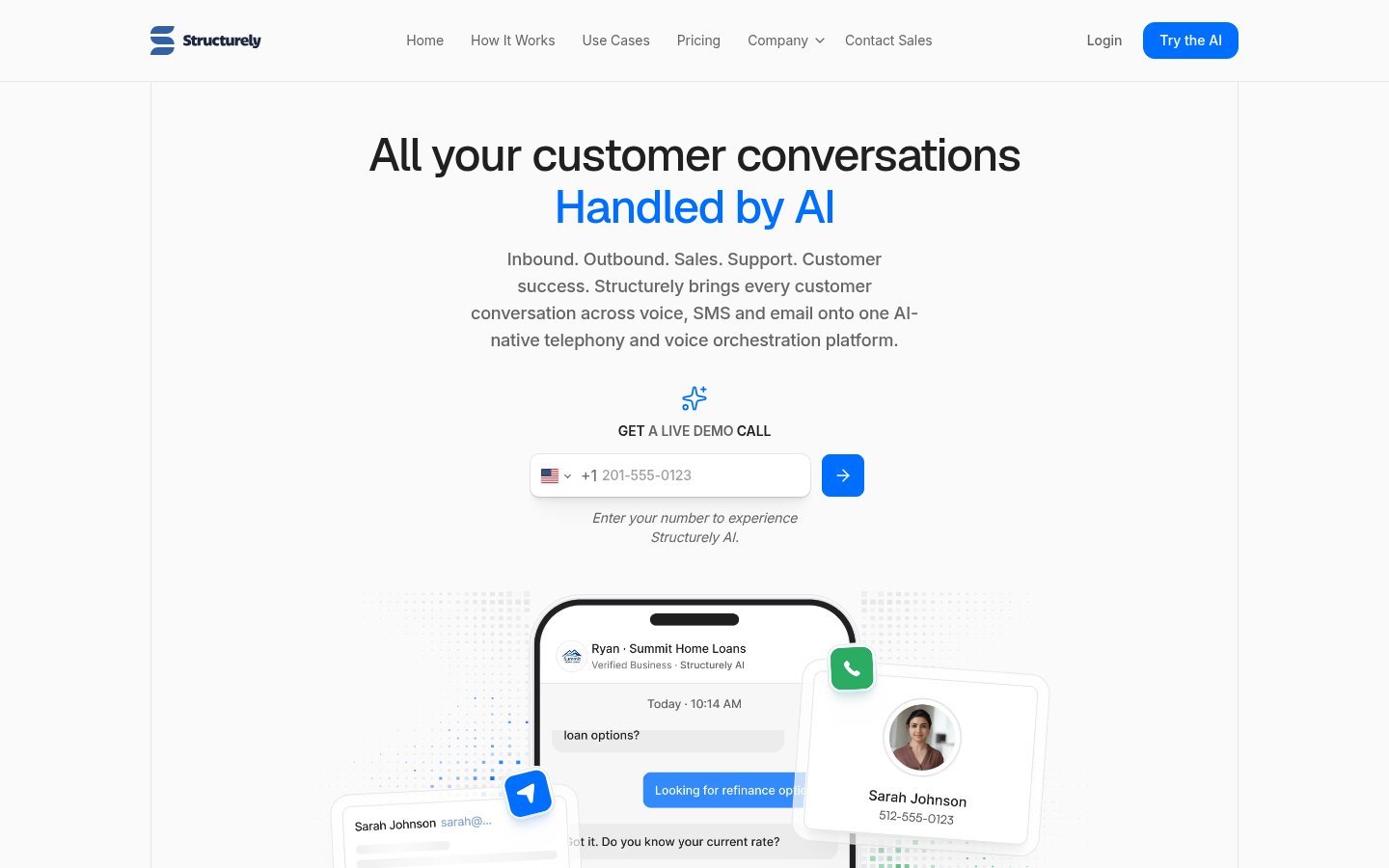
Structurely's entire value proposition is one thing: talking to leads before the agent does. The AI has real-time text and email conversations with inbound leads, asks qualifying questions, answers basic property questions, and only escalates once someone is genuinely interested and ready to speak with a human.
This matters because the industry's dirty secret is that most lead follow-up is terrible. A buyer fills out a form at 11pm, gets a call the next afternoon, and has already moved on. Structurely responds within seconds, every time, for every lead, regardless of volume.
The quality of the conversation has improved substantially. The AI understands context, handles objections like "just browsing" with grace, and tracks where each prospect is in the funnel. Integrations with major CRMs including Follow Up Boss, kvCORE, and Salesforce mean you don't have to replace your existing stack to use it.
For teams running high-volume lead sources like Zillow Premier Agent or realtor.com, Structurely pays for itself quickly if your current contact rate is below 50%.
Pricing: Starts around $499/month for AI assistant with unlimited conversations. Custom pricing for enterprise.
Best for: High-volume lead teams who can't humanly respond to every inbound inquiry within the critical first-response window.
Pros: 24/7 AI follow-up, CRM integrations with major platforms, genuine conversation quality, fast response times
Cons: Doesn't replace CRM entirely, premium pricing for smaller teams, some leads may prefer talking to a human sooner
Try Structurely →3. Reonomy
Official website: reonomy.com
Reonomy is a commercial real estate data and prospecting platform that uses AI to surface property intelligence and ownership data at a scale that would take a research team weeks to compile manually. It's owned by CoStar Group, which gives it access to one of the deepest commercial property datasets in North America.
The core use case is prospecting: identify properties that match specific criteria (asset type, size, sale history, mortgage maturity dates, ownership structure), then get owner contact information to reach out directly. The AI layers on signals like owners who haven't sold in 15+ years and have maturing debt, which is exactly the kind of motivated-seller intelligence that separates smart prospectors from average ones.
For residential agents, Reonomy is probably overkill. But for commercial brokers and CRE investors who need deep ownership data and off-market deal sourcing, it's one of the most defensible data tools in the market. The platform also tracks transaction history, permit activity, and tenant data on multi-tenant properties.
Pricing: Enterprise pricing; exact tiers aren't published publicly. Typically sold to teams and organizations rather than individual agents.
Best for: Commercial real estate brokers, CRE investment teams, and anyone doing serious off-market deal sourcing.
Pros: Unmatched commercial property data depth, powerful ownership filtering, transaction history and debt intelligence, CoStar data backing
Cons: Too expensive and complex for residential-only agents, pricing is opaque, learning curve for new users
Try Reonomy →4. Otter.ai (for real estate)
Official website: otter.ai
Otter.ai isn't built exclusively for real estate, but its use case in the industry is specific and genuinely valuable: transcribing client calls, listing appointments, and showing feedback so agents never lose a detail again. The AI generates summaries, pulls out action items, and creates searchable records of every conversation.
An agent who does 20 showings a week simply can't remember every buyer comment, pricing objection, or timeline detail from each conversation. Otter solves that without requiring any behavior change, you just let it run in the background on calls or in-person meetings (where permitted).
The 2025 updates added an AI chat interface where you can ask questions about past conversations: "What did Sarah say about the school district?" or "Which clients mentioned they'd need to sell their current home first?" That's useful. Teams on the Business plan get shared workspaces so assistants can handle notes and follow-up for multiple agents.
Pricing: Free plan available with limited monthly minutes. Pro plan at $16.99/user/month, Business at $30/user/month. Enterprise pricing separate.
Best for: Agents who spend significant time on calls and in-person meetings and want accurate records without manual note-taking.
Pros: Accurate transcription, AI summaries with action items, searchable conversation history, affordable entry point, integrates with Zoom and other meeting tools
Cons: Not real-estate-specific, in-person recording requires disclosure in many states, free plan has strict minute limits
Try Otter.ai →5. Homes.ai / ListingAI
Official website: listingai.com
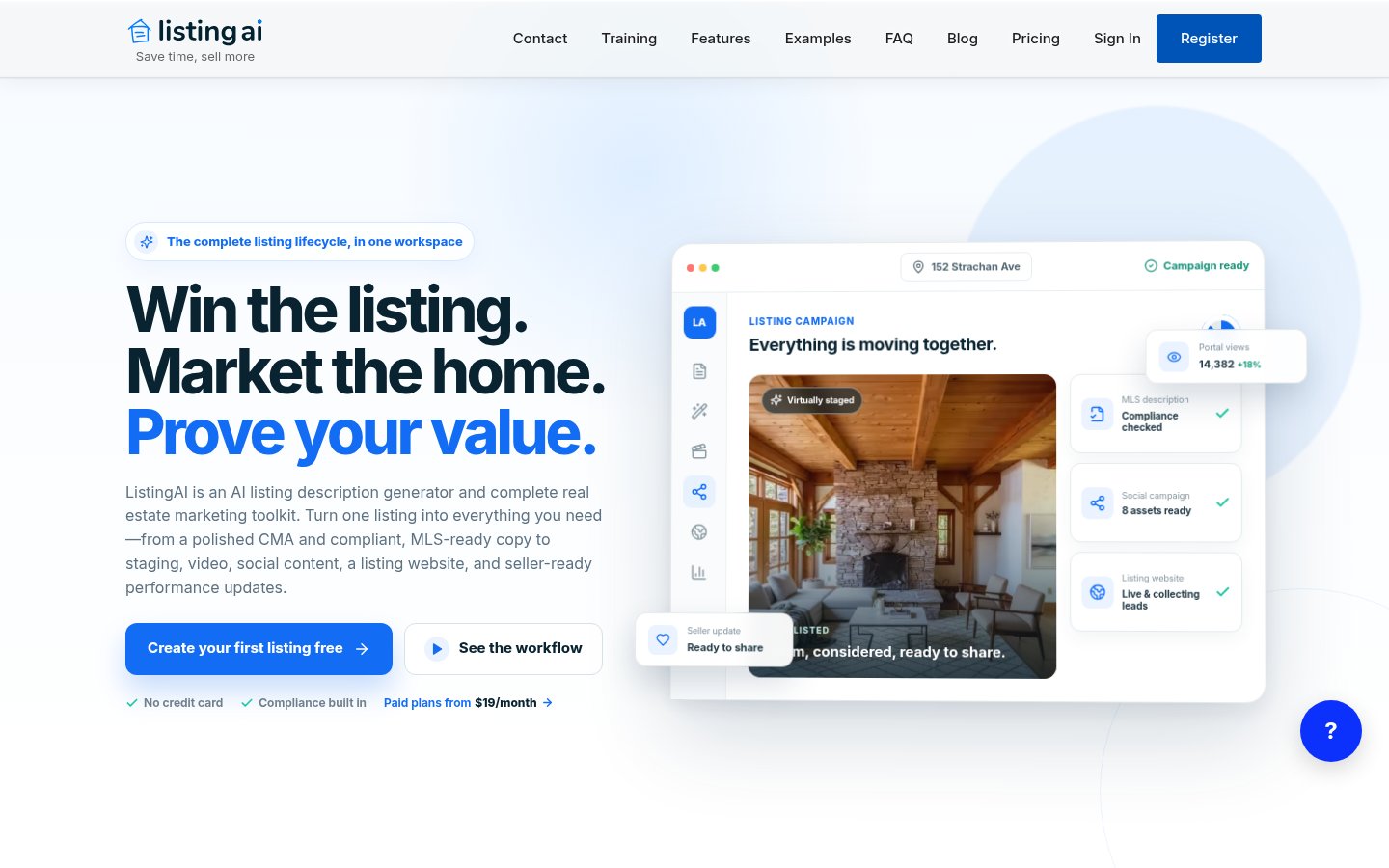
Writing listing descriptions is one of those tasks that takes a disproportionate amount of an agent's cognitive energy relative to its actual value. ListingAI solves that problem directly. Enter property details, features, neighborhood highlights, and a tone preference, the platform generates multiple listing description drafts that agents can edit and publish in minutes.
The output quality is meaningfully better than generic ChatGPT prompting because the model is trained specifically on real estate copy, understands MLS character limits, and knows how to balance features with emotional hooks. The platform also generates social media captions, email campaigns, and open house marketing copy from the same property inputs.
For agents who list frequently, the time savings add up fast. Writing a strong listing description from scratch typically takes 30-45 minutes of focused work. ListingAI cuts that to under 10. That's not trivial when you're managing multiple active listings simultaneously.
The tool doesn't replace a great agent's local knowledge and storytelling instincts, but it gets you 80% of the way there instantly, which is the right way to think about it.
Pricing: Plans reported starting around $29/month for individual agents, with team plans available.
Best for: Active listing agents who want to eliminate the content creation bottleneck without sacrificing quality.
Pros: Real-estate-specific training, fast turnaround, handles multiple content formats, affordable for solo agents
Cons: Output still requires agent review and personalization, limited to content creation (not a full platform), some listings need heavy editing for unique properties
Try ListingAI →6. Ylopo
Official website: ylopo.com
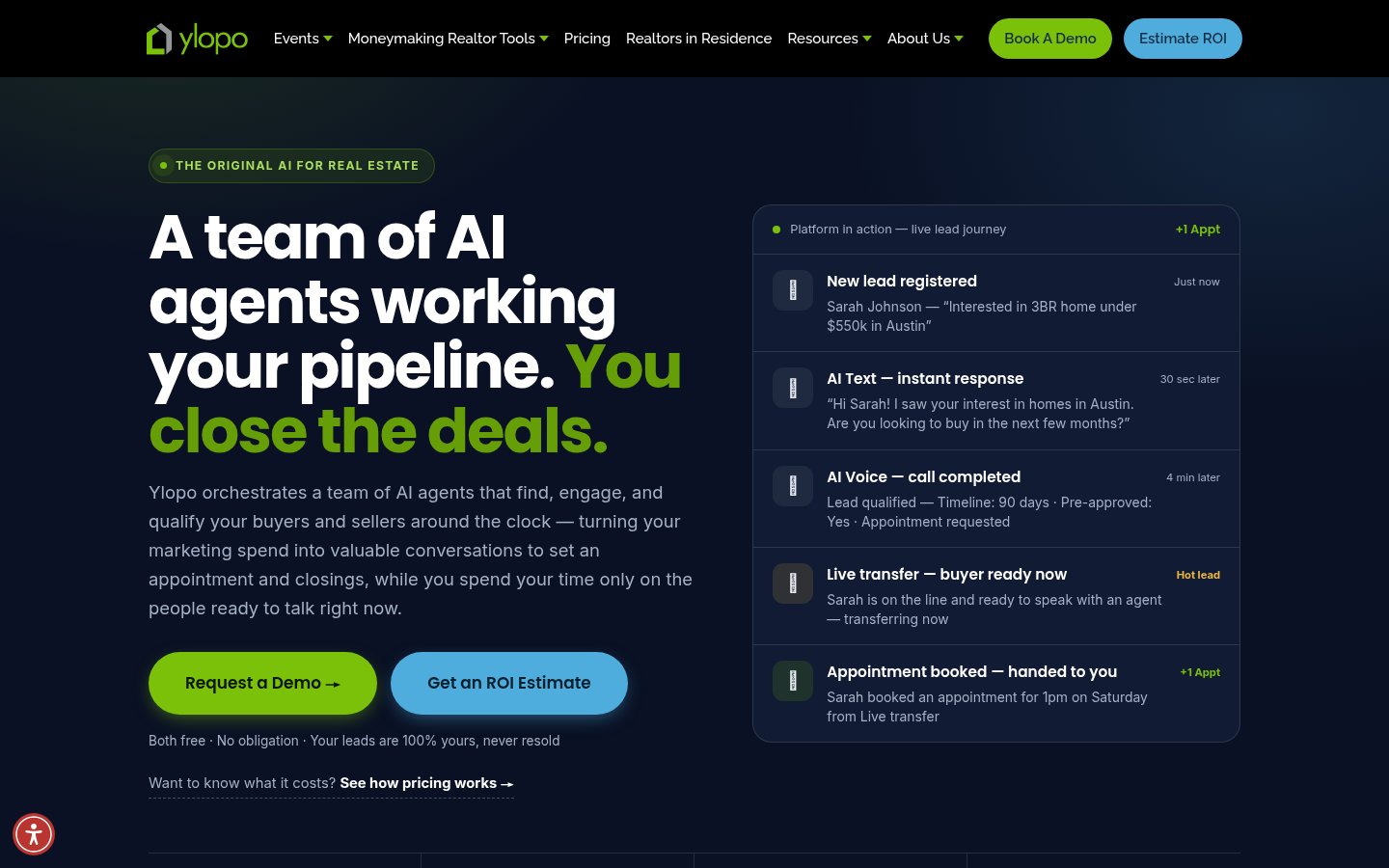
Ylopo is a digital marketing and lead generation platform built specifically for real estate, and it's one of the few that has built genuine AI into both the advertising and lead nurturing sides of the funnel. The platform runs targeted Facebook and Google ads using AI to optimize for lead quality rather than just volume, which is a meaningful distinction.
The "Raiya" AI text assistant handles lead nurturing 24/7, similar to Structurely, but Ylopo's version is more tightly integrated with its own lead generation pipeline. Leads that come through Ylopo's ads get immediate AI follow-up, behavioral tracking as they browse property search tools, and escalation to human agents when they're warm.
The property search experience Ylopo provides is also above average, fast, mobile-optimized, and built to keep buyers engaged long enough to capture behavioral data. Agents get signals like which listings a lead viewed multiple times or saved, which is solid intelligence for prioritizing outreach.
Pricing: Plans starting around $295/month plus ad spend, with additional fees for AI nurturing features. Not the cheapest option, but competitive for what's included.
Best for: Agents who want AI-optimized paid advertising plus automated lead nurturing in a real-estate-specific platform.
Pros: AI ad optimization, built-in lead nurturing, property search behavioral data, active product development
Cons: Ad spend is additional cost on top of platform fee, works best with ongoing paid campaigns, setup takes several weeks to optimize
Try Ylopo →7. Offrs
Official website: offrs.com
Offrs takes a predictive analytics approach to real estate prospecting. The platform uses AI to identify homeowners in a given territory who are statistically likely to list their home within the next 12 months, before they've talked to any agent. The model analyzes hundreds of data points including years in home, equity position, life events, and neighborhood sale velocity to produce a ranked list of likely sellers.
This is genuinely useful intelligence for agents who farm geographic territories. Instead of sending postcards to every home in a zip code, you can concentrate your marketing budget on the 20% of homeowners the model identifies as high-probability sellers. That's a meaningful efficiency gain in direct mail, door knocking, and digital retargeting campaigns.
The platform also provides seller leads, a transaction management feature, and SMART data reports. Accuracy claims vary by market, and like any predictive model, results depend on data quality in your specific area. But agents who run disciplined geographic farming operations find it easier to prioritize with Offrs than without it.
Pricing: Territory-based pricing. Exact rates depend on zip code exclusivity and market size. Plans typically start around $200-400/month for a defined territory.
Best for: Agents who farm specific geographic territories and want to prioritize outreach based on predictive seller likelihood.
Pros: Predictive seller identification, territory exclusivity available, complements direct mail and door-knocking campaigns, focuses budget on high-probability contacts
Cons: Predictive accuracy varies by market, requires patience (it's a farming tool, not instant lead gen), pricing model isn't fully transparent
Try Offrs →8. Sidekick by MoxiWorks

Official website: moxiworks.com
MoxiWorks is a real estate tech platform used by some of the largest brokerages in North America, and Sidekick is its AI assistant layer built on top of the core CRM and productivity tools. What makes it worth including here is the brokerage-level data advantage: Sidekick can pull context from an agent's actual transaction history, contacts, and MLS activity, not just generic AI outputs.
The assistant helps agents with tasks like drafting client emails, preparing CMA presentations, summarizing contact history before calls, and generating activity reports. Because it has access to real contact and transaction data, the outputs are more relevant than what you'd get from a general-purpose AI tool. Ask it to "write a follow-up email to my buyer clients who toured homes last week" and it can actually do that with context.
For solo agents, MoxiWorks may be more platform than you need. This is primarily a brokerage technology play, where the value compounds when multiple agents on a team are all connected in the same ecosystem.
Pricing: Enterprise pricing through brokerage agreements. Not available for individual agent purchase outside of an affiliated brokerage.
Best for: Agents at brokerages already running MoxiWorks who want to use AI on top of their existing data and workflows.
Pros: Deep CRM and transaction data integration, brokerage-scale network data, practical task automation, email and content drafting are genuinely useful
Cons: Not available to independent agents, requires brokerage-level adoption, Sidekick is only as good as the underlying CRM data quality
Try MoxiWorks →9. ChatGPT (with real estate prompting)
Official website: chatgpt.com
Yes, ChatGPT belongs on this list. Not because it's real-estate-specific, it isn't, but because for a large portion of real estate tasks, it's the most practical and accessible AI tool available, and agents who learn to use it well have a real advantage over those who don't.
Listing descriptions, buyer emails, neighborhood marketing copy, market update newsletters, objection handling scripts, social media captions. ChatGPT handles all of these well when prompted with context. The GPT-4o model available in 2026 understands real estate terminology and produces output that requires only light editing. Custom GPTs with built-in real estate personas and prompt frameworks are available from the GPT store and shareable across a team.
The honest limitation is that it has no access to your CRM, your MLS, or your client history. Every task starts from scratch. That's the gap that purpose-built tools like Lofty and Structurely fill. But for content creation, scripts, and research, ChatGPT at $20/month is hard to argue with. Some agents who understand it well enough are doing work that would have cost them hours of time or freelancer fees.
Pricing: Free tier with limited access. ChatGPT Plus at $20/month for individuals. Team plan at $30/user/month.
Best for: Agents who want flexible AI assistance for content, emails, scripts, and research without committing to a real-estate-specific platform.
Pros: Versatile, affordable, excellent writing quality, custom GPTs available, constantly improving
Cons: No CRM or MLS integration, no persistent client context, requires solid prompting skills to get best results, not purpose-built for real estate
Try ChatGPT →Comparison Table
| Tool | Primary Use Case | Real Estate Specific | Pricing Starts | Best For |
|---|---|---|---|---|
| Lofty | AI CRM + lead management | Yes | ~$449/mo | Teams and brokerages |
| Structurely | AI lead follow-up | Yes | ~$499/mo | High-volume lead teams |
| Reonomy | Commercial data + prospecting | Yes (CRE) | Enterprise | Commercial brokers |
| Otter.ai | Call transcription + notes | No | Free / $16.99/mo | Meeting-heavy agents |
| ListingAI | Listing content creation | Yes | ~$29/mo | Active listing agents |
| Ylopo | AI ad optimization + nurturing | Yes | ~$295/mo + ad spend | Paid marketing users |
| Offrs | Predictive seller identification | Yes | ~$200-400/mo | Geographic farmers |
| MoxiWorks Sidekick | CRM-integrated AI assistant | Yes | Enterprise (brokerage) | Brokerage-level users |
| ChatGPT | General AI writing + research | No | Free / $20/mo | Content and scripts |
How I Ranked These
The order reflects how much measurable impact each tool has on the workflows that actually produce revenue for a real estate agent: getting more leads, converting the leads you have, and reducing the time spent on tasks that don't require your expertise.
Lofty goes first because it's the most complete system for teams, lead gen, CRM, AI nurturing, and team management in one place. Structurely is second because the problem it solves (fast, quality lead response at any hour) is one of the biggest quantifiable losses in real estate operations.
Reonomy is ranked third despite being a specialist tool because commercial real estate prospecting is a domain where data quality has an enormous direct effect on deal flow, and Reonomy's depth is genuinely hard to replicate.
The tools lower in the list aren't worse, they serve different needs. Otter.ai and ChatGPT are here because they're tools many agents should be using already, regardless of what else is in their stack. ListingAI and Offrs are role-specific: if listing copy or territory farming is a significant part of your business, they punch well above their price.
For solo agents and small teams just starting with AI, the honest advice is to start with ChatGPT and Otter.ai, get comfortable with what AI can actually do, and then evaluate the purpose-built platforms once you have a clear sense of where your biggest time and conversion losses are. The how solo and small-firm professionals are actually using AI in 2026 framework applies directly here: identify one workflow, fix it, then expand.
Real estate AI tools are getting better fast. But the agents who get the most from them in 2026 aren't the ones with the biggest tech stacks, they're the ones who understand which problem they're actually solving.
Frequently Asked Questions
Tools & Services Mentioned

Founder and editor of infobro.ai
We research every tool from its documentation, pricing pages, product screenshots and public developer discussion, and say plainly what the evidence does and does not show. Drafts are written with AI assistance under our editorial rules, and we revisit articles to reflect platform changes. Learn more about our process.