How Independent Dental Practices Are Actually Using AI in 2026
From FDA-cleared imaging AI to voice-activated perio charting, here's what's actually working for independent dental practices in 2026, and what's still hype.
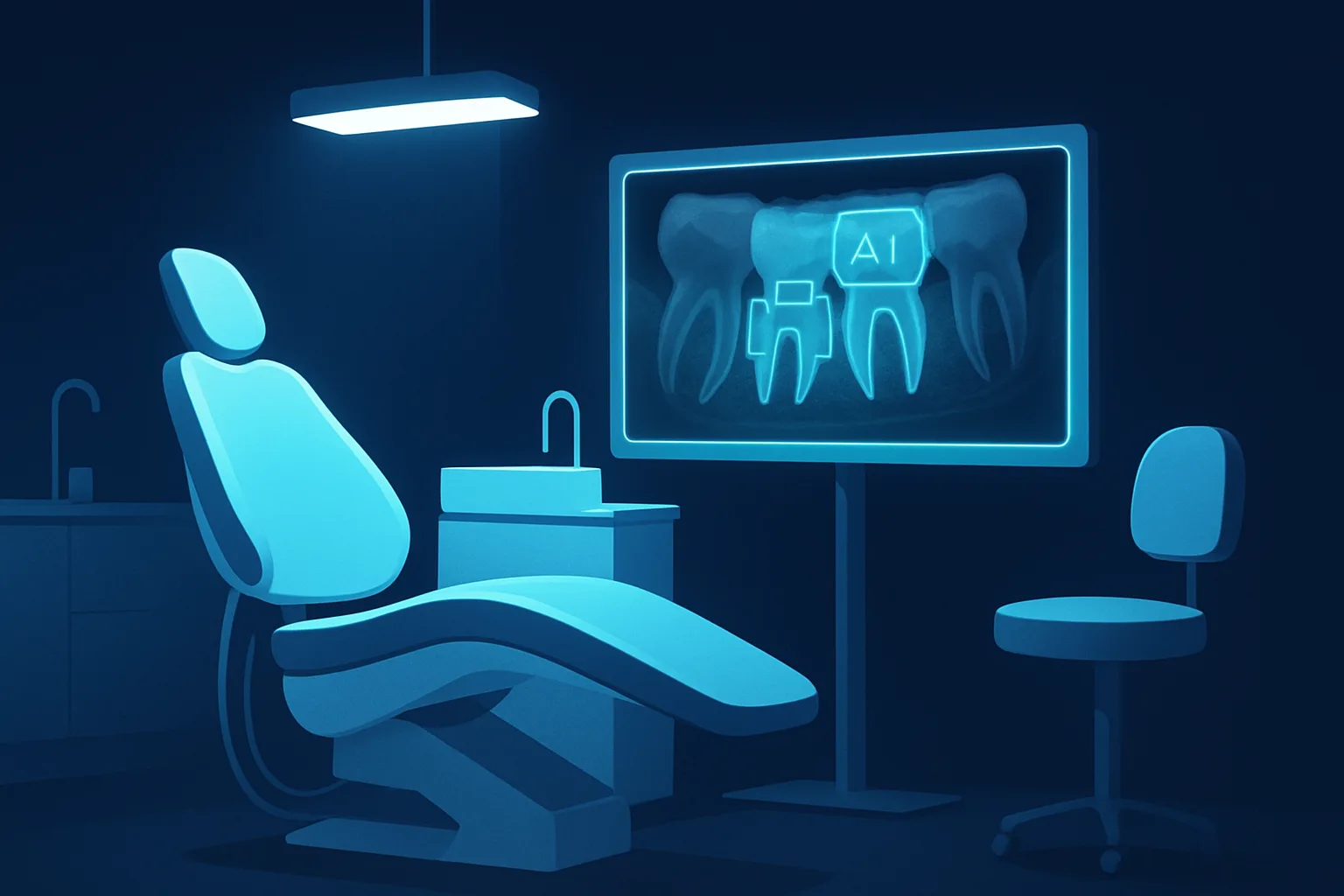
Dentistry is not an industry most people associate with fast tech adoption. And yet, as of 2026, it's one of the cleaner examples of AI actually solving real clinical problems rather than creating new ones. The regulatory path is clearer than in most healthcare segments. The pain points are concrete. The tools are specific.
This isn't a landscape overview. It's a practical breakdown of what independent dental practices are actually doing with AI right now, what's worth prioritizing, and what's still a distraction.
The Clinical AI Layer: Imaging First, Everything Else Second
If you run an independent practice and you're trying to figure out where AI actually earns its keep, start with imaging. Five dental AI tools have FDA 510(k) clearance for US practices in 2026: Overjet, Pearl, and VideaHealth cover 2D radiograph analysis for general diagnostics; Diagnocat and Orca Dental AI cover 3D CBCT and orthodontic workflows.
That clearance distinction matters more than vendors will admit. Using non-cleared AI for diagnostic assistance in a clinical setting is a liability question your malpractice insurer is increasingly paying attention to.
Overjet is the multi-DSO standard. It covers caries, bone level measurement, and perio, and its presence across large group practices means the company has deep PMS integrations and a well-worn implementation process. For independent practices already inside a Dentrix or Eaglesoft workflow, Overjet fits predictably.
Pearl's Second Opinion (FDA clearance K210365) offers the widest single-clearance pathology coverage of the three: caries, periapical radiolucencies, calculus, crown findings, filling findings, implant findings, bridge findings, root canal findings, and restoration margin discrepancies. If you're treating a broad patient mix and want one tool to flag the most conditions, Pearl's coverage list is the longest. It integrates with Dentrix, Eaglesoft, Open Dental, Curve, and Carestack.
VideaHealth claims training on the largest labeled dental radiograph dataset among its competitors, though independent verification of that claim isn't possible from published sources. What is verifiable: it runs as "Detect AI" inside Dentrix Ascend natively. If your practice already runs Ascend, VideaHealth isn't a third-party integration you have to manage; it's already there.
The honest advice for a solo practice: pick one imaging AI tool, not three. There's genuine overlap between them. Running Overjet and Pearl simultaneously won't double your diagnostic accuracy; it'll double your licensing spend and create workflow confusion at the chair.
Voice Charting: The Use Case That's Actually Sticking
Perio charting is one of those tasks that's been due for automation for years. It requires an assistant to call out pocket depths while the clinician probes, it's time-consuming, and accuracy degrades when teams are rushed.
Bola AI is the current market leader in dental-specific voice charting. The company reports 10,000+ dentists and hygienists on the platform and 3 million+ charts completed. It integrates with Curve Dental and Henry Schein practice management systems, and independent practitioners consistently cite documentation quality as the primary reason they stayed after the trial period. If your top priority is getting charting done faster without compromising on PMS integration, Bola AI is the clearest choice.
Denti.AI is the more technically ambitious option. Its Voice Perio feature claims assistant-free charting completed in under five minutes with 99% voice accuracy in noisy environments, citing over one million charts completed. More notably, Denti.AI is the only dental AI product with FDA clearance for all three major dental concerns (caries, periapical radiolucencies, and bone levels) on both panoramic and intraoral X-rays. For periodontal specialists or technology-forward practices that want a single platform covering both imaging analysis and documentation, Denti.AI does things no other vendor does.
The trade-off is maturity. Bola AI's 10,000+ user base gives you more confidence that the AI has been trained on a wide variety of dental charting scenarios. Denti.AI's clinical breadth is real, but it's positioned more for DSOs and specialist practices than for a busy solo general dentist.
Front-Office AI: Where Most Independent Practices Should Start
Here's a counterintuitive reality: for most independent practices, the front-office AI tools generate faster ROI than the clinical ones. Missed calls, scheduling gaps, and slow recall follow-up are costly and immediately measurable. A radiograph AI saves time per exam; an AI receptionist that answers calls at 9 PM and books appointments books appointments that would otherwise be lost.
The category has gotten more specific. Platforms like Weave now offer AI receptionist features handling inbound calls in multiple languages with identity verification. Dental Intelligence focuses on analytics, pulling production and scheduling data to surface where the schedule is bleeding and where recall is weak. Yapi handles patient communication and forms automation.
A 2024 ADA survey found that 38% of practices using AI-enhanced radiology reported a 15% reduction in diagnostic errors compared with traditional radiograph interpretation. Front-office numbers are harder to benchmark across practices because every practice's scheduling situation differs, but the directional pattern is clear: AI phone coverage converts after-hours inquiries that would otherwise go unanswered.
For smaller practices that are also thinking about the cost side of these investments, What AI Customer Service Agents Actually Cost Small Businesses (And What They Actually Save) is worth reading before committing to any front-office AI vendor. The pricing structures vary significantly and the ROI math isn't always as clean as vendor decks suggest.
What Your PMS Determines
PMS compatibility is the single most important filter when evaluating any dental AI tool, and most practices don't treat it that way. The market has fragmented into tools that work well inside specific systems and tolerate others.
Here's a rough map based on published integration lists:
| AI Tool | Primary PMS Integrations |
|---|---|
| Pearl Second Opinion | Dentrix, Eaglesoft, Open Dental, Curve, Carestack |
| Overjet | Dentrix, Dentrix Ascend, Eaglesoft, Denticon, and others |
| VideaHealth | Dentrix, Dentrix Ascend (native as Detect AI) |
| Denti.AI | Dentrix, Eaglesoft, Open Dental, plus 7 additional systems |
| Bola AI | Curve Dental, Henry Schein PMS |
If you run Open Dental, your shortlist is Pearl, Denti.AI, and Overjet. If you run Dentrix Ascend, VideaHealth is already in your system. This isn't a preferences conversation; it's a compatibility one. Choosing a tool that doesn't integrate natively with your PMS means manual data entry somewhere, and that negates the time savings that justified the purchase.
This pattern mirrors what you see across other independent service businesses. How Independent Physical Therapy Clinics Are Actually Using AI in 2026 shows the same dynamic: the practices that get real value from AI are the ones that matched tools to existing systems rather than bolting on something new and hoping it connects.
Specialty-Specific Considerations
General dentists and independent practices trail in AI adoption compared to DSO networks, but the gap is closing. Specialty practices are further along in specific areas:
Endodontists were the earliest adopters, driven by CBCT-heavy diagnostic workflows. 3D imaging AI (Diagnocat specifically) is already standard in many endo practices.
Orthodontists have DentalMonitoring, which shifts some oversight to the patient's smartphone. The patient scans at home via mobile app; the AI analyzes the images and flags deviations from treatment plan. This reduces in-office check-in frequency without losing clinical oversight, which matters for orthodontic practices managing high patient volumes.
Periodontists were pulled in by Overjet's bone-level measurement workflow, which fits naturally into perio charting and patient education.
General dentists running independently can genuinely benefit from starting with one imaging AI and one front-office tool. Don't try to do everything at once.
The Three-Vendor Ceiling for Solo Practices
One piece of practical guidance that appears consistently across dental AI resources: three vendors is the practical ceiling for a solo practice. One clinical AI tool (Overjet, Pearl, or VideaHealth), one operations tool (Weave, Yapi, or Dental Intelligence), and optionally a charting tool (Bola AI or Denti.AI). Beyond that, you're managing more software than you're getting value from.
This isn't unique to dentistry. The same tool sprawl problem hits practices in every specialty. How Independent Residential Property Managers Are Actually Using AI in 2026 covers a similar consolidation challenge in a completely different industry, but the underlying problem is the same: adding more tools without a clear integration plan creates overhead that eats the efficiency gains.
For small groups (two to five locations), the calculus changes slightly. Adding 24/7 AI call coverage to absorb after-hours volume starts making sense at this scale, because the call volume is high enough that missed calls represent meaningful lost production.
What to Actually Ask Before Signing
Before committing to any dental AI vendor, these are the questions that separate useful implementations from expensive ones:
Does it have FDA 510(k) clearance for the specific diagnostic task you're asking it to do? Not clearance in general; clearance for that task. A tool cleared for caries detection isn't cleared for bone level measurement. Check the actual filing.
Which version of your PMS does it integrate with? Dentrix and Dentrix Ascend are not the same integration. Dentrix Enterprise is different again. Confirm the specific version, not just the brand name.
Does it require a Business Associate Agreement? Any tool handling PHI in a US dental practice needs a BAA. If a vendor hesitates on this question, that's your answer.
What does training and onboarding actually look like? The ROI numbers vendors show in demos assume full adoption. Partial adoption, which is what you'll get without structured onboarding, produces partial results.
What happens to your data if you cancel? Some platforms retain de-identified training data. Know what you're agreeing to before you're in.
The Honest Assessment
Dental AI in 2026 is genuinely useful, not just in theory. FDA clearances create a meaningful quality floor that most healthcare AI categories still don't have. The imaging tools are validated, the voice charting tools have real user bases, and the front-office tools solve problems that independent practices feel every day.
The risk isn't that the tools don't work. It's that practices buy too many of them, implement them carelessly, and then attribute poor results to the AI rather than the rollout. The practices getting real value are the ones who picked one or two tools, matched them to existing workflows, and gave staff time to actually use them.
That discipline is harder than it sounds, especially when vendors are competing aggressively for your attention. Professional Services Firms Are Using AI Everywhere and Measuring It Almost Nowhere captures exactly this trap: adoption without accountability. Dental practices are not immune to it.
Start with the clinical tool that fits your PMS. Measure the before-and-after on documentation time or diagnostic flags per exam. Then add one front-office tool and measure that. Build from evidence, not excitement.
Frequently Asked Questions
infobro.ai Editorial Team
We research every tool from its documentation, pricing pages, product screenshots and public developer discussion, and say plainly what the evidence does and does not show. Drafts are AI-assisted and reviewed by our editors before publication. We revisit each article every 6 months to reflect platform changes. Learn more about our process.