The AI Collaboration Problem: Why Your Team Is Using the Same Tools Completely Differently (And How to Fix It)
Your team all pays for the same AI tools. But everyone's using them differently, getting different results, and building different habits. Here's how to fix that.
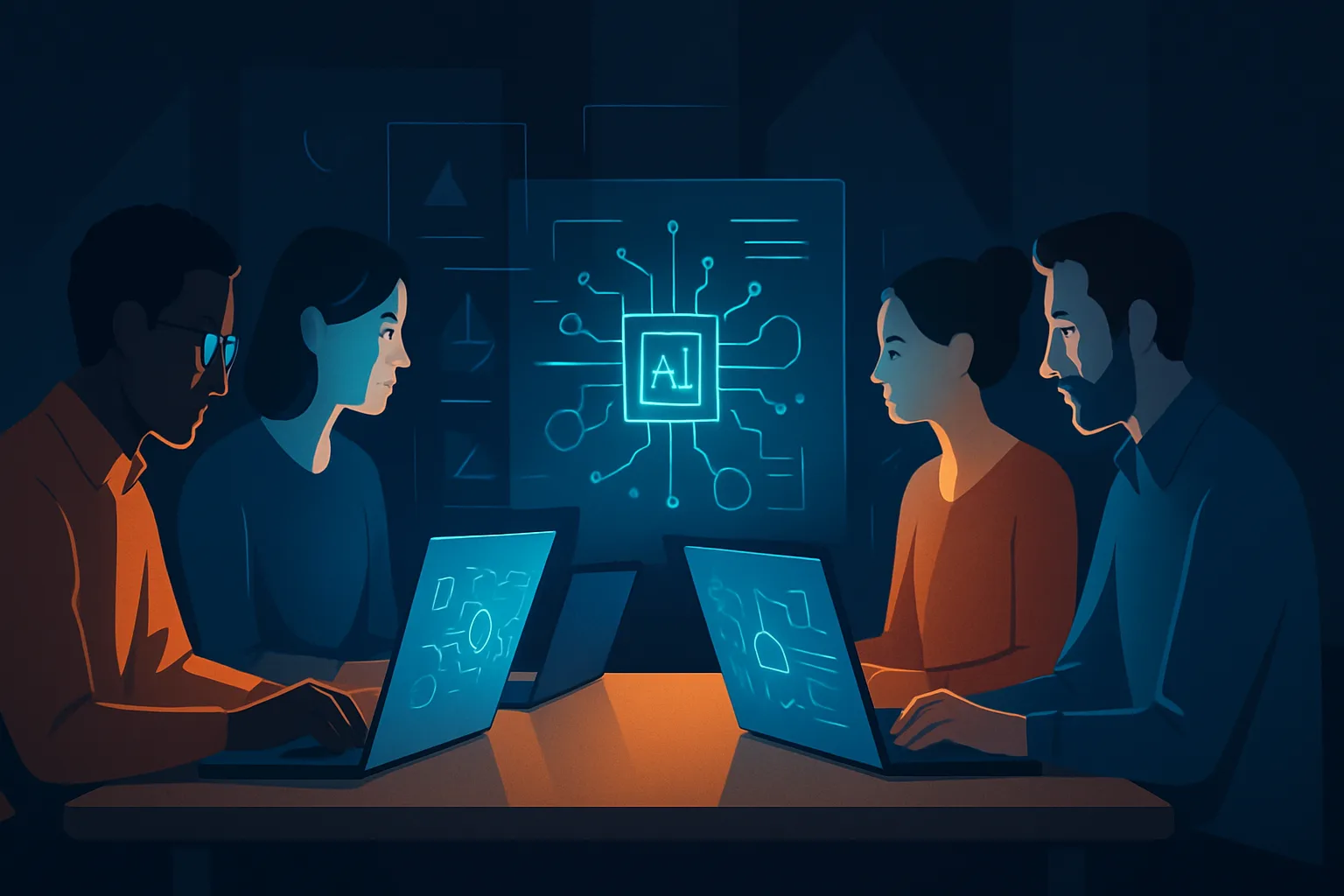
Your team all pays for the same AI subscriptions. Everyone gets the same model, the same interface, the same feature set. And yet, somehow, the outputs look completely different depending on who ran the prompt. One person's AI-assisted report is polished and on-brand. Another's reads like a first draft from a confused intern. Same tool. Different everything.
This is the AI collaboration problem, and it's more common than most teams want to admit. It's not about bad tools or bad people. It's about the absence of shared practice, shared expectations, and shared standards for how AI actually gets used when the work is happening in parallel across a team.
The AI Tool Sprawl Problem gets a lot of attention, and rightly so. But even teams that have consolidated down to a sensible stack still hit this wall. Three people, one tool, three completely different definitions of "done."
What the Collaboration Problem Actually Looks Like
Here's a concrete version of it. You have five people on a content team. All of them use Claude or ChatGPT for first drafts. But one person treats the AI output as a rough scaffold and rewrites heavily. Another treats it as near-final and just does light editing. A third uses it only for outlining. A fourth uses it for everything including research verification. The fifth barely uses it at all because they don't trust the outputs.
The result is five different standards of quality arriving in the same review queue. Your editor is trying to evaluate consistency across a set of documents where the underlying process is completely inconsistent. That's not a quality problem, it's a process problem that creates quality symptoms.
It gets worse when the outputs feed into each other. One person's AI-generated summary becomes the input for another person's AI-generated slide deck. The second person doesn't know the summary was AI-generated, so they don't verify it. The error gets compounded, not caught.
This pattern shows up in every function. In HR, one recruiter might use Manatal to screen candidates based on a careful set of criteria while a colleague uses the same tool with a looser prompt and a different benchmark for what "qualified" means. The hiring decisions end up reflecting different standards depending on who ran the initial screen. That's a compliance problem waiting to happen. The Top 9 AI Tools for HR and Recruiting in 2026 covers how these tools differ in their defaults, but no tool can compensate for a team that hasn't agreed on how to use it.
Why This Happens
Teams adopt AI tools individually before they adopt them collectively. Someone on the marketing team starts using an AI writing assistant. They get good at it. They share the login or the tool gets rolled out to the whole team. But the person who got good at it learned through weeks of trial and error that nobody else goes through. Everyone else starts from scratch, develops their own habits, makes their own mistakes, and lands in their own groove.
The individual learning doesn't transfer. And there's no forcing function that makes it transfer because the outputs still get produced. Slower, worse, less consistent, but produced. The problem is invisible until someone does a quality audit or a process review and realizes the variance is enormous.
There's also a social dimension. People don't want to admit they're not sure how to use a tool effectively. Especially when their colleague seems to be churning out work with it. So they improvise quietly and produce mediocre outputs quietly. No one flags it because no one wants to look like they need help with a tool that's supposed to make work easier.
This connects directly to the AI Ownership Problem, when no one owns the standards for AI use, everyone defaults to their own improvised version. Ownership and collaboration are two sides of the same problem.
The Three Root Causes Worth Fixing
1. No shared prompting standards
This is the biggest one. Two people using the same tool with different prompts get wildly different outputs. Prompting isn't just a skill, it's a set of decisions: how much context to provide, what format to request, how specific to be about tone, what constraints to include. When those decisions are made individually, the outputs diverge.
The fix isn't complicated, but it does require intentional work. Teams need a prompt library, not as a suggestion but as a starting point standard. Something that says: when you're drafting a client proposal, start with this prompt template. When you're summarizing a research document, use this structure. When you're writing a cold email sequence, follow this format.
A good prompt library does two things. It floors the quality of the lowest outputs, which matters more than you'd think. And it gives you a shared language for discussing what's working. When everyone starts from the same place, you can actually compare results and improve the template over time.
2. No shared definition of AI's role in the output
Teams that haven't talked explicitly about this end up with a hidden disagreement. Is AI producing a draft that a human edits into the final product? Is AI providing a structural scaffold that gets rewritten? Is AI doing a first pass that's reviewed before use? Is AI doing the research but not the writing? All of these are valid approaches. The problem is when different people on the same team have different answers without knowing it.
The output quality that lands in review reflects that hidden disagreement. Some people send in AI-polished-but-unverified drafts. Others send in heavily humanized versions. The person reviewing them has no idea which is which, so they can't calibrate their feedback correctly.
Be explicit about this. Decide, as a team, what AI's role is for each type of output. Write it down. Make it part of your handoff process. "This document was AI-drafted, lightly edited, human-reviewed for accuracy." That's four words that change how the reviewer approaches the document.
3. No feedback loop on AI outputs
Individual users improve at using AI through their own iteration. They try something, see it doesn't work, adjust. But that learning stays with them. The team doesn't benefit from it. And if that person leaves, the learning leaves with them.
The fix is building a team-level feedback loop. Not a formal retrospective every quarter. Something lighter and more frequent. A shared Slack thread where people drop examples of prompts that worked unusually well or outputs that missed badly. A monthly fifteen-minute discussion of what the team has learned. A running document where useful prompt variations get logged.
This connects to the broader AI Governance Problem that most teams are sitting on. Governance doesn't mean bureaucracy. It means shared agreements about how tools get used and who's responsible for maintaining those agreements.
What Good AI Collaboration Actually Looks Like
Teams that get this right share a few consistent traits.
They treat AI usage as a workflow, not a personal choice. The tool is integrated into their process the same way a style guide or a template library is. It's not optional and it's not improvised.
They review AI outputs as a category, not case by case. When something comes back wrong or inconsistent, they ask: is this a one-off or is this a pattern? Patterns get addressed at the process level, not the individual level. Blaming the person who got a bad output from a tool that everyone else is also struggling with doesn't fix anything.
They version their prompts. Just like code, prompts that are working should be versioned and shared. When the model updates and behavior changes, you need to know what your baseline was. Teams that don't version their prompts have no way to diagnose why outputs suddenly got worse after a model update.
They test new model versions before rolling them out. This sounds obvious. Almost no one does it. OpenAI's new voice models and Anthropic's Claude updates both shifted output behavior in ways that would have broken established prompting patterns for teams that hadn't locked down their approach. Good AI collaboration practice includes a brief validation step every time a major model update ships.
A Practical Checklist for Teams
Here's what to actually do in the next two weeks:
Audit the variance. Take five recent outputs from five different team members using the same AI tool for the same type of task. Compare them directly. If the quality variance is high, you have a process problem. If it's low, you might be fine. Most teams doing this exercise are surprised by what they find.
Run a prompting sync. Get the team together for ninety minutes. Have everyone share the prompt they currently use for your most common AI task. Collectively identify the best elements from each. Draft a shared starting template. That template immediately becomes the team standard.
Define AI's role by output type. Make a simple table. Column one: output type. Column two: AI's role. Column three: minimum human review required. That's the start of a policy that doesn't require a lengthy governance process to implement.
Build a prompt repository. It doesn't need to be fancy. A shared Google Doc or Notion page with sections by task type works fine. The act of maintaining it is more valuable than the structure it's kept in.
Schedule monthly reviews. Fifteen minutes, once a month, to discuss what's working and what isn't. The cadence matters more than the format.
| Problem | Symptom | Fix |
|---|---|---|
| No shared prompts | High quality variance across team | Build and maintain a prompt library |
| No defined AI role | Unclear what needs human review | Map AI's role per output type |
| No feedback loop | Individual learning doesn't transfer | Monthly team prompt review |
| No versioning | Can't diagnose model update regressions | Version prompts like you version code |
| No validation process | Model updates silently break workflows | Test new versions before rollout |
The Collaboration Layer Is the Missing Layer
Most AI tool discussions focus on the individual. Which model is best. Which interface is cleanest. Which subscription gives you the most value. And those questions matter. But they're secondary to whether your team is using those tools in a coherent, consistent, improvable way.
The AI ROI Problem is often blamed on the wrong variable. Teams assume the tool isn't good enough or the use cases aren't right. Usually the real issue is that five people are using the same tool five different ways and none of them are sharing what they learn. The aggregate output looks mediocre not because the tool is mediocre but because the team practice around it is fragmented.
AI collaboration isn't about everyone doing the same thing in lockstep. It's about shared baselines that let individuals improvise from a common foundation. You want the prompt library to be a starting point, not a cage. You want the output standards to be a floor, not a ceiling. The goal is variance you've chosen, not variance you've inherited from the absence of a plan.
That's a solvable problem. It just needs someone to own it, which is usually the harder half of the solution.
Frequently Asked Questions
Tools & Services Mentioned
infobro.ai Editorial Team
We research every tool from its documentation, pricing pages, product screenshots and public developer discussion, and say plainly what the evidence does and does not show. Drafts are AI-assisted and reviewed by our editors before publication. We revisit each article every 6 months to reflect platform changes. Learn more about our process.