Top 10 AI Trading Bots in 2026: Ranked by What Actually Makes Money
From 3Commas to TradeSanta, these are the 10 best AI trading bots in 2026, ranked by real performance, features, and who they're actually built for.

Most people who try AI trading bots lose money. Not because the bots are broken, but because they pick the wrong one for their strategy, or expect the software to do something it was never designed to do. A DCA bot isn't a scalping bot. An arbitrage scanner isn't a portfolio manager. The category is full of tools that look similar on a landing page and behave completely differently in practice.
This list cuts through that. I've ranked these 10 tools based on what they actually do well, what kind of trader they suit, and where they fall short. The crypto bot space in 2026 is more mature than it was three years ago, but it's also more crowded with mediocre options. These are the ones worth your attention.
Before you automate anything, it's worth reading about the risks of building on AI tools that may change or disappear. The same logic applies to trading bots: your strategy depends on the platform staying alive and stable.
1. 3Commas
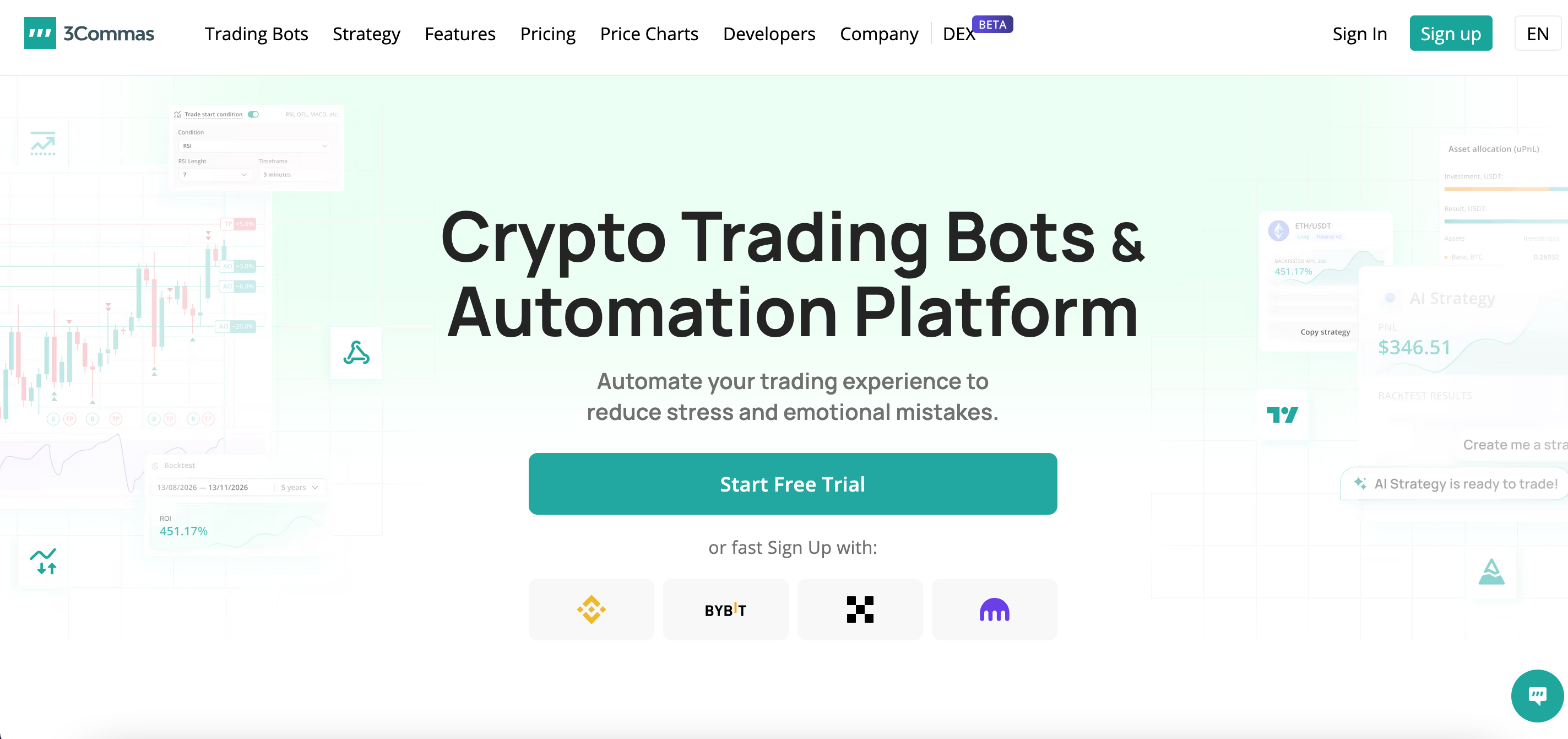
Official website: 3commas.io
3Commas sits at the top of this list for one reason: it's the most complete trading automation platform available for crypto in 2026. It connects to over 15 major exchanges including Binance, Coinbase Advanced, Kraken, and Bybit, and it supports DCA bots, Grid bots, and Options bots within a single interface. The SmartTrade terminal alone is worth the subscription for active traders who want to set take-profit, stop-loss, and trailing stops on a single order without stitching together multiple tools.
The AI signal integration is genuinely useful. You can subscribe to third-party signal providers or connect TradingView alerts directly to trigger bot actions. It's not a "set and forget" magic box, but it's the closest thing to a professional-grade automation layer for crypto traders who actually know what they're doing.
Pricing: Starter plan from $29/month, Advanced at $49/month, Pro at $99/month. Free plan available with limited bots.
Best for: Active crypto traders who want multi-exchange automation with flexible strategy options and real signal integration.
Pros: Multi-exchange support across 15+ platforms, flexible DCA and Grid bot configurations, TradingView signal integration, large community with shared bot presets, SmartTrade terminal adds real value
Cons: Learning curve is real for beginners, some signal providers charge separately, mobile app lags behind the web interface
Try 3Commas →2. ArbitrageScanner
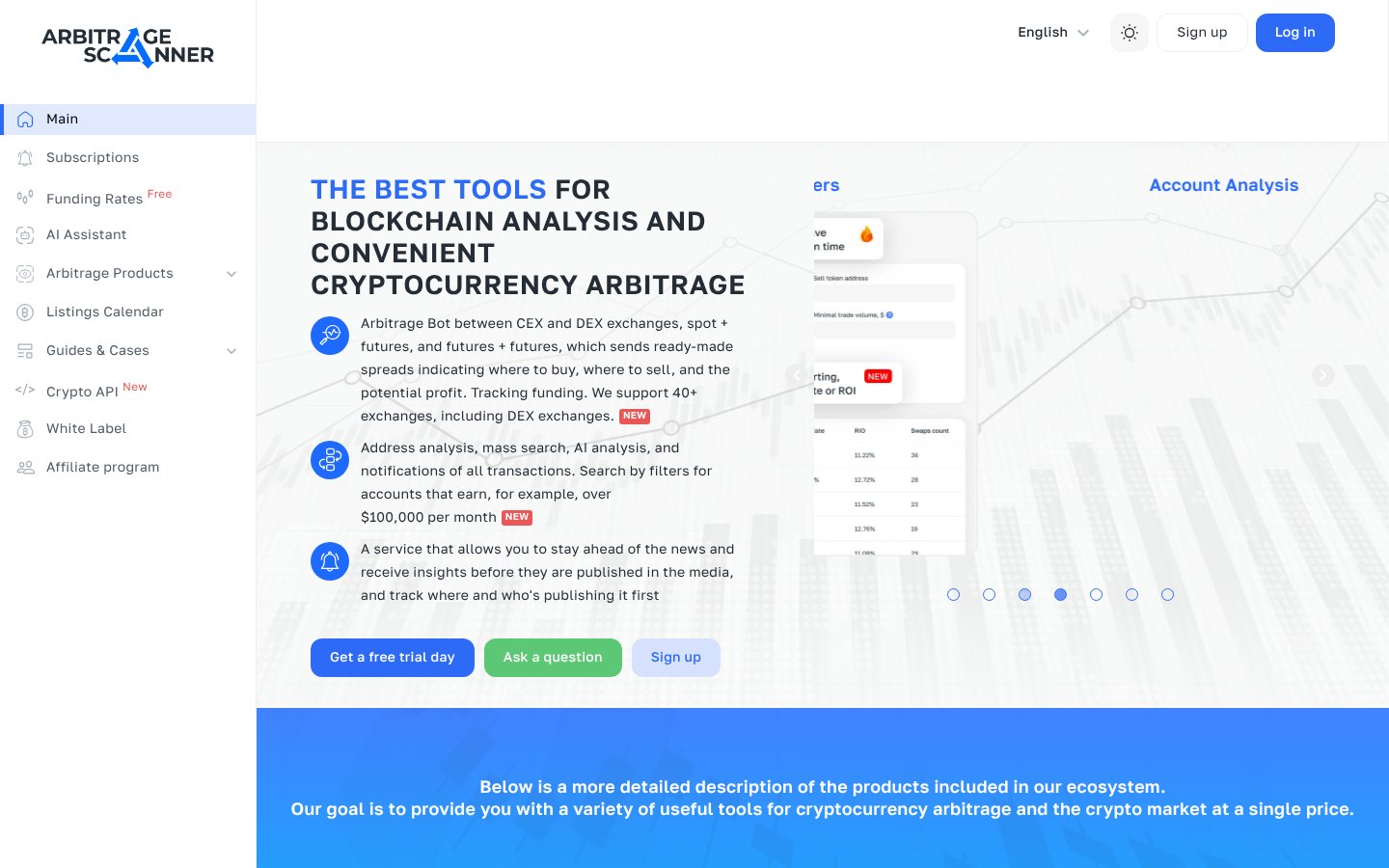
Official website: arbitragescanner.io
ArbitrageScanner does something most bots don't: it focuses exclusively on arbitrage opportunities across centralized and decentralized exchanges. That narrow focus is its biggest strength. Instead of trying to be everything to everyone, it monitors price discrepancies in real time across hundreds of exchanges and surfaces actionable spreads before they close.
In 2026, with DEX liquidity more fragmented than ever across chains like Solana, Base, and Arbitrum, a tool that maps cross-exchange and cross-chain price gaps has real utility. ArbitrageScanner covers both CEX-to-CEX and CEX-to-DEX arbitrage routes, which is unusual. The scanner also covers P2P arbitrage, which adds another layer of opportunity that most competing tools ignore entirely.
It's not a fully automated execution engine. You still need to move fast and have capital ready on multiple exchanges. But for traders who understand arbitrage mechanics and want the best scanning layer available, nothing else comes close in this specific niche.
Pricing: Paid plans starting around $99/month, with higher tiers for more exchange coverage and faster scan intervals.
Best for: Experienced traders who specialize in cross-exchange or cross-chain arbitrage and need a dedicated scanning tool.
Pros: Covers CEX, DEX, and P2P arbitrage, real-time spread detection, multi-chain support, highly specialized focus beats generalist tools for this strategy
Cons: Not an execution bot, requires capital on multiple exchanges simultaneously, high price point for casual traders
Try ArbitrageScanner →3. Cryptohopper

Official website: cryptohopper.com
Cryptohopper has been around since 2017 and it's still one of the better-built cloud-based crypto bots. The platform runs 24/7 in the cloud, so your bot keeps trading even when your laptop is off. That sounds obvious, but a surprising number of competitors require a locally running process or VPS to achieve the same thing.
The strategy designer lets you combine technical indicators, set trailing stops, and configure multiple position sizes without writing a single line of code. There's also a marketplace where you can buy pre-built strategies and signals from other traders, which is useful if you're new and want a starting point rather than building from scratch.
The AI features here are honest about what they are: pattern-based signal generation rather than some mysterious black box. That transparency is actually reassuring compared to competitors that vaguely promise "AI-powered profits" without explaining anything. The paper trading mode is excellent for testing before you put real money at risk.
Pricing: Pioneer (free, limited), Explorer at $19/month, Adventurer at $49/month, Hero at $99/month.
Best for: Intermediate traders who want a cloud-based bot with a visual strategy builder and access to a signal marketplace.
Pros: True cloud execution with no local setup, visual strategy builder, active marketplace for signals and strategies, good paper trading mode, long track record
Cons: Strategy quality on the marketplace varies widely, UI feels dated compared to newer competitors, Hero plan needed for full feature access
Try Cryptohopper →4. Octobot

Official website: octobot.cloud
Octobot is the most interesting open-source option on this list. You can run it locally for free, or use the cloud-hosted version. The open-source codebase means you can inspect exactly what the bot is doing, modify strategies to your own specifications, and contribute to its development. For privacy-conscious traders or developers who want full control, this is a meaningful advantage.
If you care about data ownership and don't want a third-party SaaS company holding your API keys and trade history, Octobot's self-hosted path is worth the setup effort. The AI privacy implications of cloud-based tools are real, and Octobot gives you a genuine alternative.
The strategy library is solid, covering DCA, market making, and technical indicator-based approaches. Backtesting is built in and reasonably fast. The cloud version removes the setup friction and adds a visual interface that makes configuration accessible to non-developers.
Pricing: Open-source self-hosted version is free. Octobot Cloud plans start around $9.99/month.
Best for: Developers and privacy-conscious traders who want full control over their bot's code and data.
Pros: Fully open-source and self-hostable, cloud option available for easier setup, active development community, built-in backtesting, no mandatory API key sharing with a SaaS company
Cons: Self-hosted setup requires technical knowledge, fewer exchange integrations than 3Commas, community support rather than dedicated customer service
Try Octobot →5. Cryptomatic
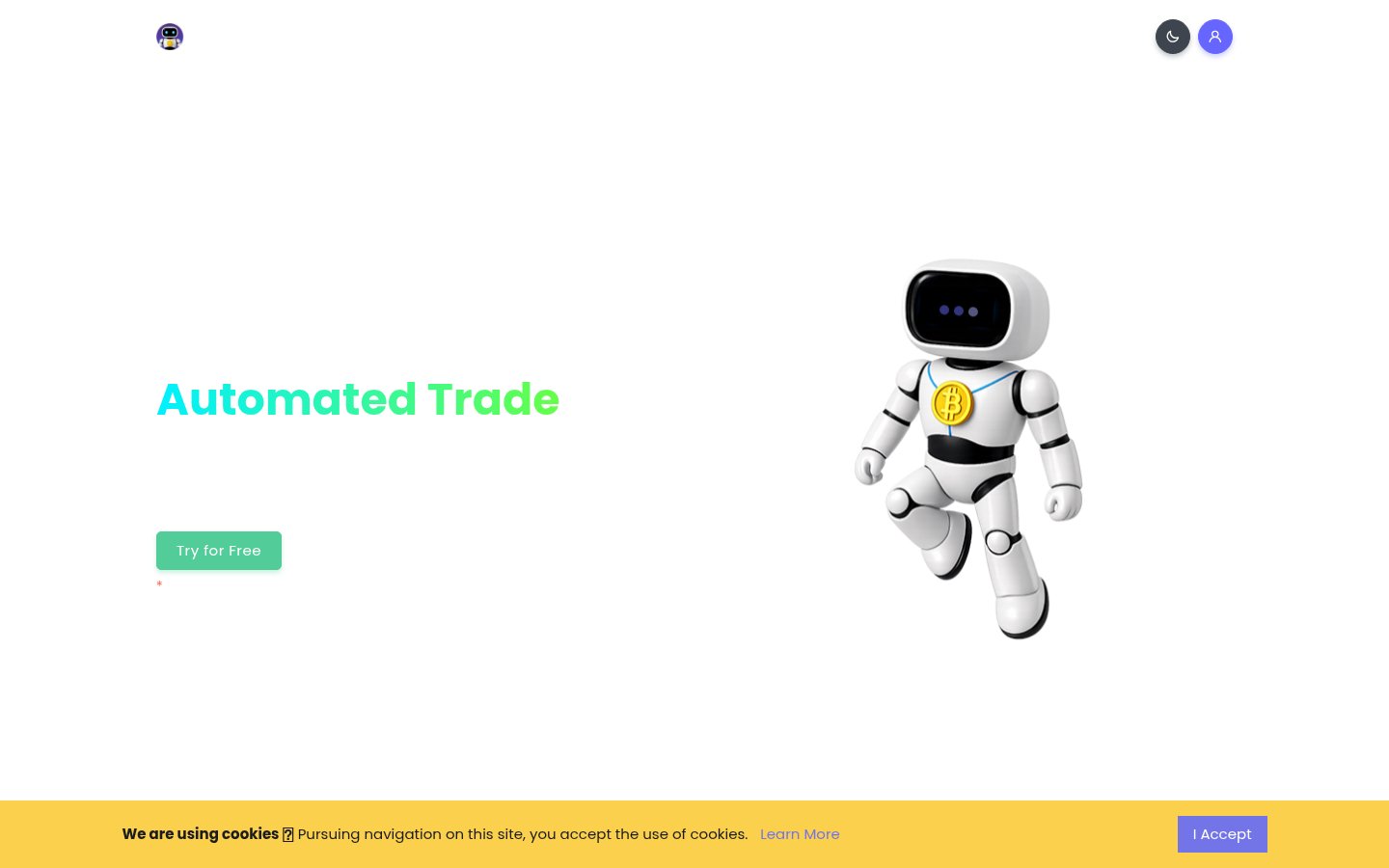
Official website: cryptomatic.bot
Cryptomatic targets traders who want automation without the steep learning curve of platforms like 3Commas. The setup flow is genuinely simpler. You pick an exchange, choose a strategy template, configure your risk parameters, and the bot runs. For someone who wants to automate a basic DCA or grid strategy and doesn't want to spend hours in a settings menu, this hits the right balance.
The bot supports major exchanges including Binance, Bybit, and OKX. Strategy options are more limited than top-tier competitors, but that's partly the point. Fewer options means fewer ways to misconfigure something catastrophically. The platform's signal integration is lighter than Cryptohopper's, but it covers the basics.
Where Cryptomatic shines is in its interface clarity. Charts, positions, and performance metrics are displayed without clutter. For traders who are moving from manual to automated trading for the first time, that clarity reduces the cognitive load of monitoring multiple open positions.
Pricing: Tiered subscription model; entry plans start around $19/month with higher tiers unlocking more active bots and exchange connections.
Best for: Beginners and intermediate traders who want clean automation for standard strategies without advanced configuration complexity.
Pros: Clean and beginner-friendly interface, fast setup for standard strategies, supports major exchanges, sensible defaults reduce misconfiguration risk
Cons: Limited strategy customization compared to 3Commas or Cryptohopper, smaller community and fewer third-party signal options, newer platform with shorter track record
Try Cryptomatic →6. Intellectia

Official website: intellectia.ai
Intellectia takes a different approach from most tools on this list. Rather than purely automating trade execution, it layers AI-generated market analysis and sentiment scoring on top of your trading workflow. Think of it as an AI research assistant that also plugs into your trading activity, not just a bot that fires orders blindly.
The platform aggregates news, social sentiment, on-chain data, and technical indicators, then generates AI-scored signals with confidence ratings. This is genuinely useful for traders who want to understand the "why" behind a signal rather than just following it. The explainability factor sets Intellectia apart from black-box competitors.
It's not the best pure-execution bot on this list. The automation layer is competent but not as mature as 3Commas or Cryptohopper. But if your edge comes from information analysis rather than pure mechanical execution, and you want AI to accelerate your research pipeline, Intellectia earns its place in a serious trader's toolkit.
Pricing: Free tier available with limited AI insights. Pro plans from approximately $29/month.
Best for: Research-driven traders who want AI-powered analysis and sentiment scoring integrated with their automation workflow.
Pros: AI-generated signals with explainability, multi-source sentiment analysis, on-chain data integration, useful free tier for evaluation
Cons: Execution automation less mature than dedicated bot platforms, interface can feel overwhelming with data density, less useful if you purely want mechanical execution
Try Intellectia →7. Bitsgap
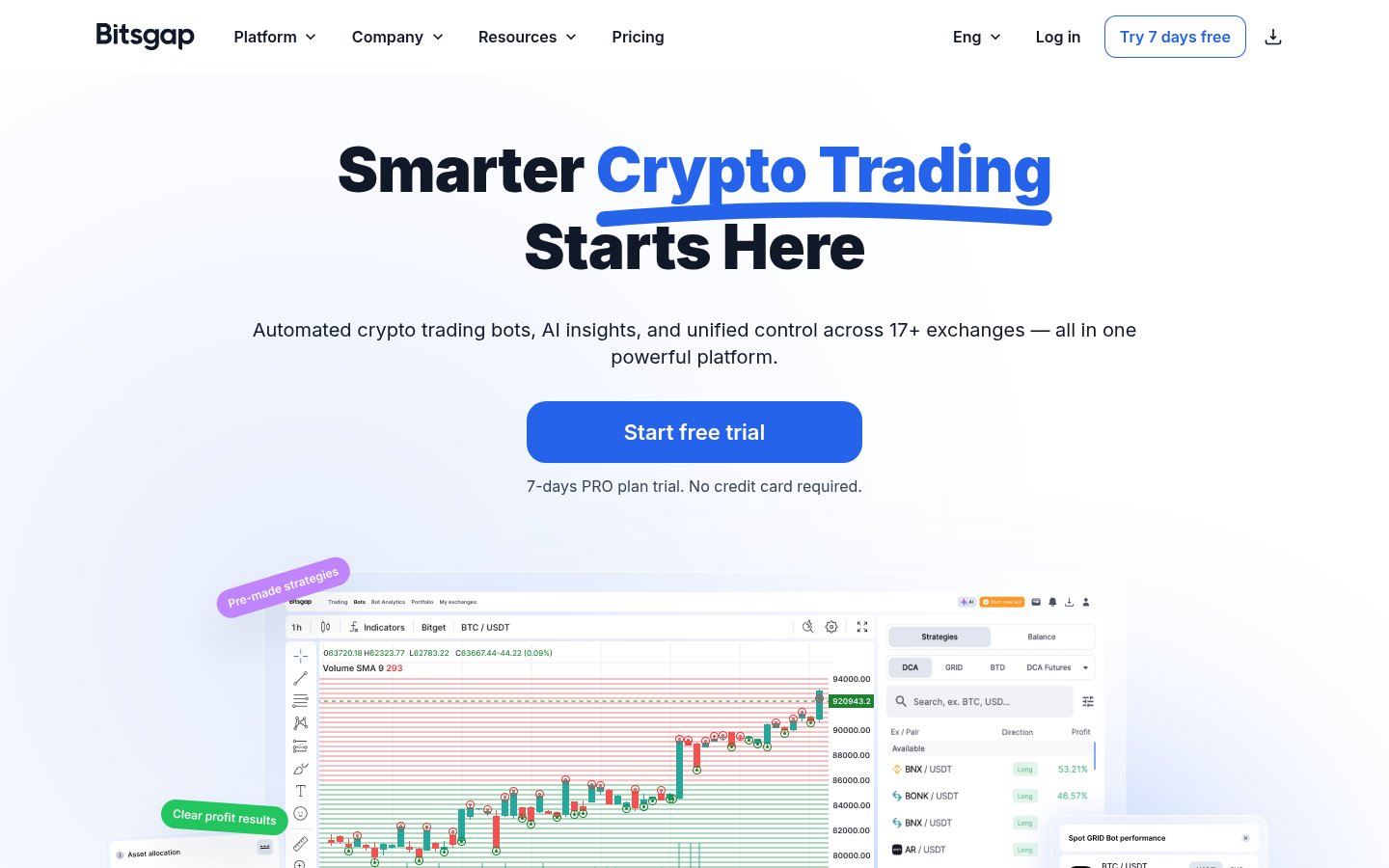
Official website: bitsgap.com
Bitsgap is the grid trading specialist on this list. If your strategy centers on grid bots, specifically profiting from price oscillation within a defined range, Bitsgap's grid implementation is among the best available. The GRID, COMBO, and BTD (Buy The Dip) bot types cover the core range-trading scenarios with solid configurability.
The platform connects to 25+ exchanges through encrypted API keys and presents a unified interface for managing positions across multiple exchanges simultaneously. The Bitsgap demo mode lets you test strategies with simulated funds against real market conditions, which is more honest than backtesting alone since it accounts for current spread and liquidity.
The AI-assisted bot setup feature is worth mentioning. Bitsgap analyzes historical price data for your chosen pair and suggests grid parameters, which is a practical shortcut for traders who aren't sure how to size their grid levels. It's not magic, but it beats starting from scratch.
Pricing: Basic at $23/month, Advanced at $65/month, Pro at $119/month. Annual plans offer significant discounts.
Best for: Grid trading specialists and traders who want multi-exchange portfolio management in a single dashboard.
Pros: Best-in-class grid bot implementation, 25+ exchange connections, demo mode with real market conditions, AI-assisted parameter suggestions, clean multi-exchange dashboard
Cons: Less suited to trend-following or signal-based strategies, Pro plan required for multiple simultaneous bots, annual pricing can feel like a commitment
Try Bitsgap →8. Stoic.ai

Official website: stoic.ai
Stoic.ai makes a specific bet: that long-only, AI-managed crypto portfolio allocation beats manual trading for most retail investors. The platform connects to your Binance account (Binance-only, which is a real constraint) and runs a systematic rebalancing strategy based on quantitative signals. You connect your account, set your risk level, and the AI manages the rest.
The pitch is essentially "managed crypto fund, minus the fund manager fees." For traders who've lost money trying to time the market manually, the systematic approach has genuine appeal. The strategy is transparent about what it does. It isn't hiding behind buzzwords about deep learning and neural networks.
The Binance-only limitation is the biggest reason it lands at number 8 rather than higher. In 2026, with so much liquidity spread across Bybit, OKX, and decentralized venues, locking your automation to a single exchange is a meaningful restriction. But if Binance is your primary exchange and you want genuinely passive portfolio management, Stoic.ai is unusually easy to trust.
Pricing: Free to use. Stoic.ai takes a performance fee on profits (typically 15% of gains).
Best for: Long-term passive investors who use Binance and want systematic AI-managed portfolio rebalancing without active involvement.
Pros: Genuinely passive, transparent strategy logic, performance-based pricing aligns incentives, no monthly subscription fee, easy setup
Cons: Binance-only exchange support, limited customization, performance fees can add up in strong bull markets, not suited to active or short-term trading
Try Stoic.ai →9. Wundertrading

Official website: wundertrading.com
Wundertrading is the strongest option on this list for TradingView-to-execution integration. If you build strategies in TradingView and want to automate their execution without rebuilding everything in a new platform, Wundertrading's webhook integration handles that transition cleanly. Set up your TradingView alert, point the webhook at Wundertrading, and your Pine Script strategy starts firing real orders.
The platform also offers copy trading, which lets you follow signals from verified traders in the Wundertrading community. The vetting for signal providers is more rigorous than some competing platforms, which reduces the risk of following someone who got lucky in a bull market and is now selling a subscription.
It supports major exchanges including Binance, Bybit, Kraken, and OKX. The bot types cover DCA, grid, and TWAP (time-weighted average price) execution. TWAP support is genuinely uncommon at this price point and makes Wundertrading interesting for traders dealing with larger position sizes who need to reduce market impact.
Pricing: Free plan available (limited bots). Basic at $19.95/month, Advanced at $44.95/month, Professional at $84.95/month.
Best for: TradingView strategy builders who want seamless webhook-based execution and traders interested in copy trading with vetted signal providers.
Pros: Best TradingView webhook integration on this list, TWAP execution support, vetted copy trading, supports 4+ major exchanges, solid free tier for testing
Cons: UI less polished than Bitsgap or 3Commas, community smaller than Cryptohopper's marketplace, advanced features locked behind higher plans
Try Wundertrading →10. TradeSanta

Official website: tradesanta.com
TradeSanta rounds out this list as a solid, unpretentious option for traders who want DCA and grid bots without paying a premium. It's been around since 2018 and has maintained a straightforward feature set that covers the basics well. Long and short bots, multiple take-profit targets, trailing stops, and technical indicator triggers are all present.
Exchange support covers Binance, Bitfinex, Bybit, OKX, and a handful of others. The platform doesn't claim to have groundbreaking AI. It offers reliable automation at a competitive price, which is actually refreshing in a space where every tool oversells its intelligence. The Telegram bot integration for monitoring and notifications is a nice practical touch that active traders appreciate.
The reason it's last isn't a fatal flaw. It's that TradeSanta doesn't do anything particularly better than the tools ranked above it. If you've tried the others and found them too complex or too expensive, TradeSanta is a legitimate alternative. It's also worth considering as a secondary bot platform if you're already using 3Commas or Bitsgap and want to diversify your automation stack.
Pricing: Basic at $18/month, Advanced at $30/month, Maximum at $50/month. Free trial available.
Best for: Budget-conscious traders who want reliable DCA and grid automation without advanced features or a steep learning curve.
Pros: Competitive pricing, reliable core bot types, Telegram notifications, free trial available, straightforward setup
Cons: No standout features that beat competitors in any category, smaller development team means slower feature updates, limited signal provider integrations
Try TradeSanta →Comparison Table
| Tool | Best For | Bot Types | Exchange Count | Starting Price | Free Option |
|---|---|---|---|---|---|
| 3Commas | Multi-strategy traders | DCA, Grid, Options | 15+ | $29/month | Free (limited) |
| ArbitrageScanner | Arbitrage specialists | CEX/DEX/P2P scanner | 100+ (scan only) | ~$99/month | No |
| Cryptohopper | Cloud-based automation | DCA, Grid, Scalping | 12+ | Free / $19/month | Yes |
| Octobot | Developers, privacy-focused | DCA, Market Making, Grid | 20+ | Free (self-hosted) | Yes |
| Cryptomatic | Beginners | DCA, Grid | Major exchanges | ~$19/month | No |
| Intellectia | Research-driven traders | Signal/analysis-based | Major exchanges | Free / ~$29/month | Yes |
| Bitsgap | Grid trading | GRID, COMBO, BTD | 25+ | $23/month | Demo only |
| Stoic.ai | Passive long-term investors | Portfolio rebalancing | Binance only | Free + 15% perf. fee | Yes |
| Wundertrading | TradingView users | DCA, Grid, TWAP | 4+ | Free / $19.95/month | Yes |
| TradeSanta | Budget traders | DCA, Grid | 6+ | $18/month | Free trial |
How I Ranked These
The ranking reflects three things: capability ceiling, target-fit clarity, and reliability track record.
3Commas leads because it genuinely does the most for the widest range of serious traders. It's not perfect, but no competitor matches its combination of exchange breadth, strategy flexibility, and signal integration depth. I'd recommend it to anyone who isn't locked into a specific niche strategy.
ArbitrageScanner earns second place despite being the most specialized tool here. When a tool does one thing better than anyone else, that precision deserves recognition. For arbitrage traders specifically, it's not second-best to 3Commas. It's the clear first choice.
Cryptohopper and Octobot take the middle slots because they represent the two most credible approaches to cloud automation: Cryptohopper for its polished marketplace ecosystem, Octobot for its open-source transparency. If you care about understanding what your bot does with your data, Octobot's self-hosted path is the honest answer.
Bitsgap, Intellectia, and Cryptomatic fill specialized roles. Bitsgap owns grid trading. Intellectia owns the research-plus-automation hybrid. Cryptomatic owns simplicity.
Stoic.ai, Wundertrading, and TradeSanta all have legitimate use cases. Stoic.ai's Binance-only constraint caps its ceiling. Wundertrading's TradingView integration is excellent but the platform hasn't fully caught up to the top three in overall polish. TradeSanta is reliable and affordable but doesn't lead any category.
One thing that applies to all of these: the tools are only as good as the strategy behind them. If you're treating a bot as a replacement for market knowledge, you'll lose money faster than you would manually. These platforms accelerate execution and remove emotion. They don't generate edge from thin air.
If you're building more complex workflows around your trading, the Zapier Review 2026 and n8n Review 2026 are worth reading for context on how automation tools have matured, and the same patterns apply to trading bot infrastructure.
Frequently Asked Questions
Tools & Services Mentioned

infobro.ai Editorial Team
Our team of AI practitioners tests every tool hands-on before writing. We update our content every 6 months to reflect platform changes and new research. Learn more about our process.