Top 10 AI Trading Bots in 2026: Ranked by What Actually Makes Money
Nine crypto trading bots compared on features, fit, risk controls and pricing: 3Commas, Coinrule, TradeSanta, ArbitrageScanner, Cryptohopper, Bitsgap, Octobot, Wundertrading and Stoic.ai. Returns weren't measured.
 Stanislav VovchykMay 10, 202618 min readUpdated Oct 28, 2026
On this page · 12 sections
In short
- 3Commas is the top pick for most crypto traders, running DCA, Grid and Options bots across 15+ exchanges from one dashboard, with paid plans from $29/month.
- Coinrule is the easier no-code choice with 350+ templates and on-chain execution, but its Trustpilot score is 3.8 and it lacks a portfolio-wide risk cap.
- Pick Bitsgap for grid trading from $23/month, Wundertrading for TradingView webhooks from $19.95/month, and ArbitrageScanner for arbitrage at around $99/month with no free plan.
- The ranking does not measure returns, no bot guarantees profit, and Stoic.ai only makes sense on larger balances since $24/month is 57.6% of a $500 balance yearly.
Quick summary
6 picks- 13
 3CommasFrom $15/moVisit
Active crypto traders who want multi-exchange automation with flexible strategy options and signal integration.
- 2C
 CoinruleFree · from $29.99/moVisit
Traders who want rule-based automation without code, especially across both centralized exchanges and on-chain venues.
- 4A
 ArbitrageScannerFrom $99/moVisit
Experienced traders who specialize in cross-exchange or cross-chain arbitrage.
- 5CCryptohopperFrom $24.16/moVisit
Intermediate traders who want a cloud bot with a visual strategy builder and a signal marketplace.
- 6B
 BitsgapFrom $23/moVisit
Grid traders and anyone who wants multi-exchange management in one dashboard.
- 7O
 OctobotPricing unknownVisit
Developers and privacy-minded traders who want control over code and data.
3Commas is our top pick for most crypto traders. It runs DCA, Grid and Options bots across more than 15 exchanges from one dashboard. Coinrule is the easier no-code route, Bitsgap is the grid specialist, and ArbitrageScanner is the dedicated arbitrage scanner.
This ranking rests on published features, target fit, risk controls and pricing. We haven't measured returns, and no bot guarantees a profit. Nothing here is financial advice. You can lose every dollar you connect to a bot.
1. 3Commas
Official website: 3commas.io
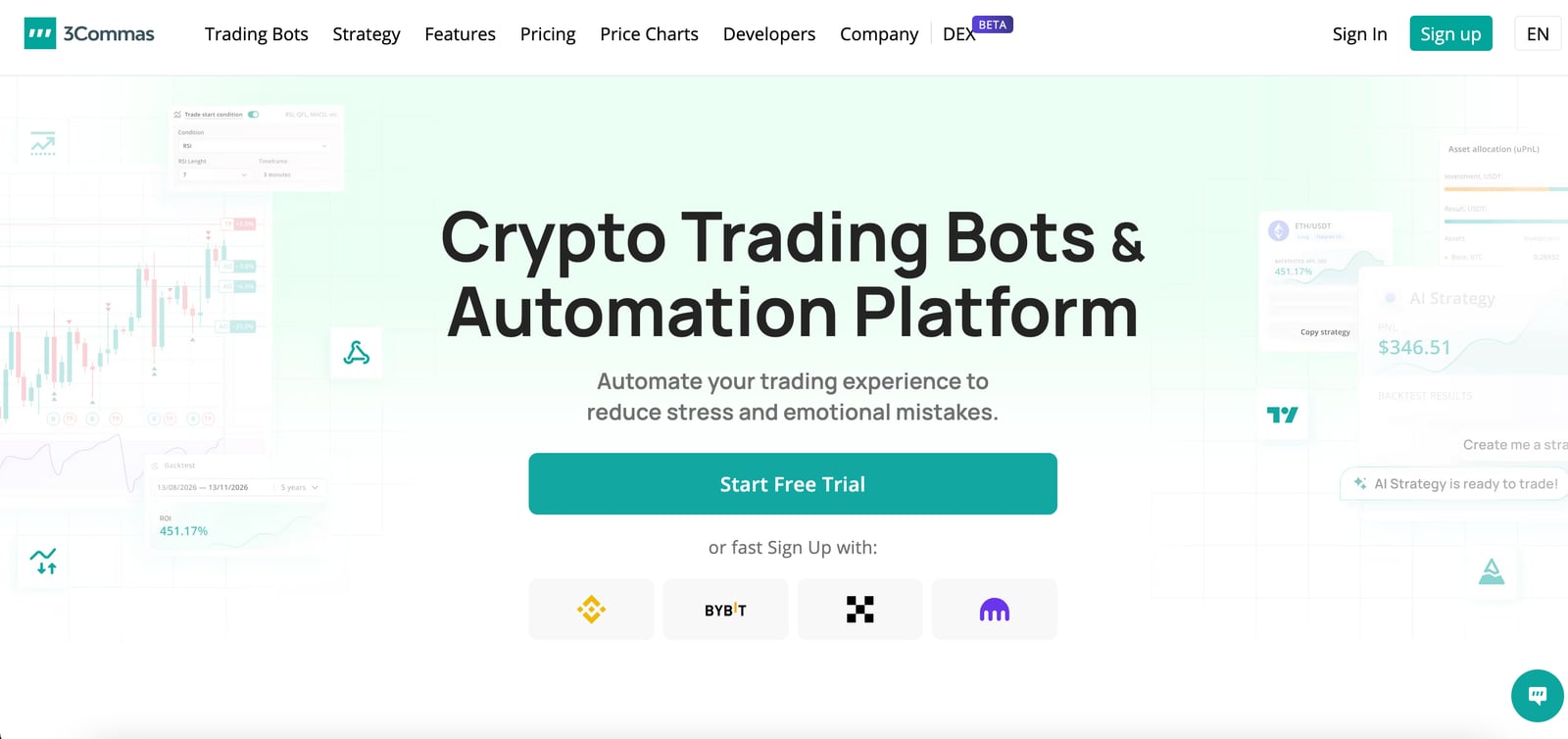
3Commas takes the top spot because it covers the most strategy types in one place. It connects to more than 15 exchanges, including Binance, Coinbase Advanced, Kraken and Bybit. DCA, Grid and Options bots share one interface. The SmartTrade terminal lets you attach take-profit, stop-loss and trailing stops to a single order, which saves you from stitching tools together.
Signal handling is the other strength. You can subscribe to third-party signal providers or send TradingView alerts to trigger bot actions. Deal-start conditions can filter entries on indicators such as RSI, volume spikes and moving average crossovers, which cuts down on false entries in sideways markets. A strategy marketplace gives you pre-built presets to start from.
The dense interface is the cost. Expect to spend time learning deal parameters before you run anything with real money. Use the paper trading mode first.
Pricing (as of October 2026): Paid plans start at $29/month. A free plan exists with limited functionality, so check the current limits before you rely on it.
Best for: Active crypto traders who want multi-exchange automation with flexible strategy options and signal integration.
Pros: 15+ exchanges, DCA, Grid and Options bots, TradingView signal integration, SmartTrade terminal, shared bot presets
Cons: Steep learning curve for beginners, some signal providers charge separately, mobile app lags the web interface
2. Coinrule
Official website: coinrule.com
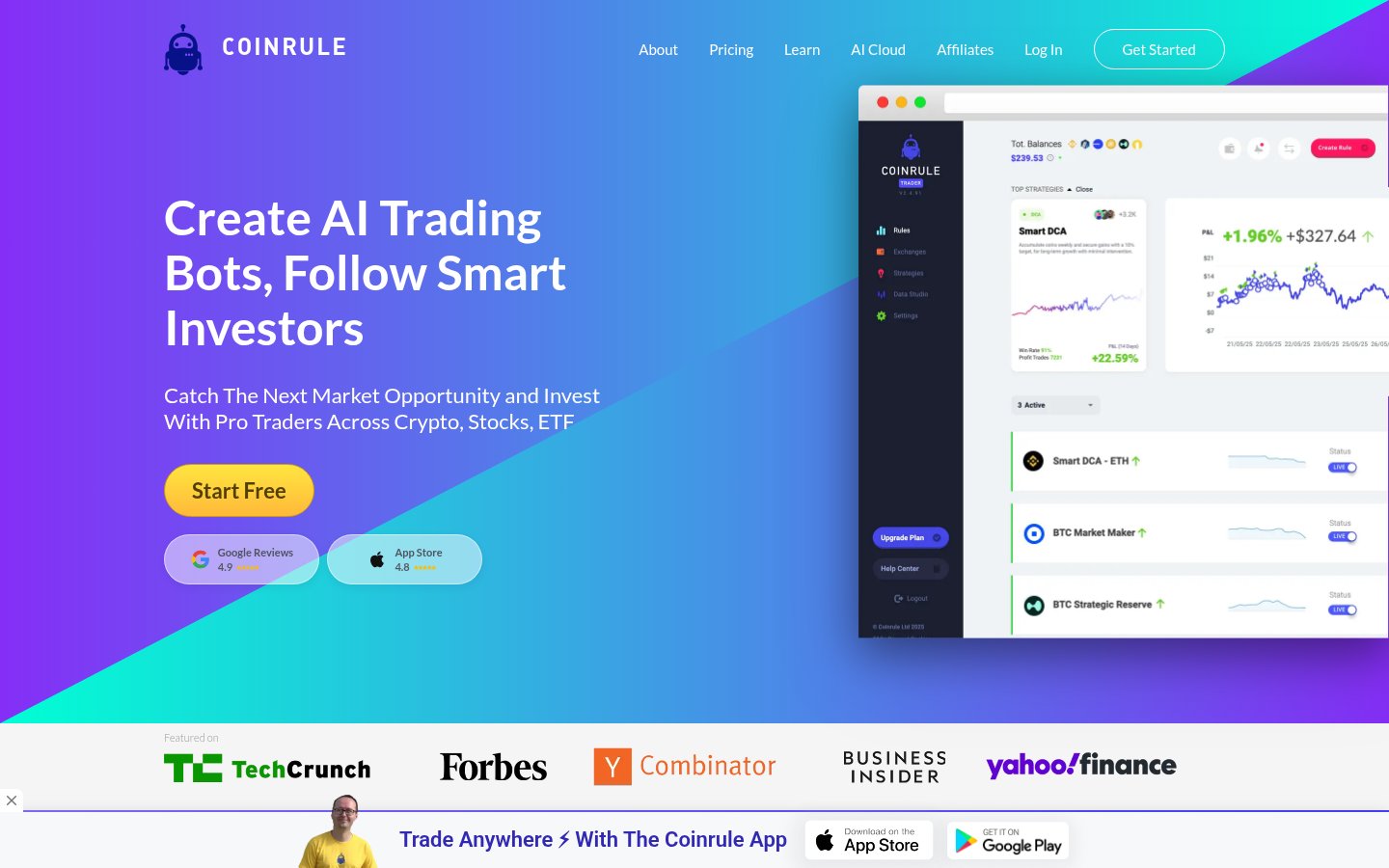
Coinrule takes the opposite approach to 3Commas. Instead of exposing every deal parameter, it reduces automation to an if-this-then-that rule. You pick a trigger (BTC drops 5% in 24 hours, RSI crosses 30, a moving average flips), attach an action (buy $200 on Binance, set a trailing stop, scale out half a position) and stack extra conditions if the strategy needs them. There's no scripting. A library of 350+ templates means most people start from a working rule instead of a blank page.
Reach is what lifts it to second. Coinrule runs on 20+ exchanges and brokers, including Binance, Coinbase Advanced, Kraken, OKX, Bybit, Bitget and KuCoin. It also executes on-chain through Base, Arbitrum, BNB Smart Chain and Hyperliquid. Most bots on this list are centralized-exchange only, so running the same rule logic on a CEX and a perps venue is a real advantage.
An MCP integration lets Claude, ChatGPT, Gemini and Grok connect to your account, draft rule logic from a plain-English description, run a backtest and push the rule live. Almost no competitor offers that. Think hard before you give an LLM agent write access to live positions.
The caveats matter. Coinrule is an execution engine, not a prediction engine. Its Trustpilot score is 3.8, with recurring complaints about execution reliability. There's no portfolio-level exposure cap across rules, so correlated rules can compound a drawdown that per-rule stop-losses never see.
Pricing (as of October 2026): Free at $0/month with 2 live rules, Investor at $29.99/month, Trader at $59.99/month, Fund at $749/month. It's a flat fee with no percentage of trading volume.
Best for: Traders who want rule-based automation without code, especially across both centralized exchanges and on-chain venues.
Pros: 350+ templates, on-chain execution alongside CEX support, MCP integration for LLM-assisted strategy building, flat-fee pricing
Cons: Free tier caps you at 2 live rules, user reviews flag inconsistent execution, no portfolio-wide risk ceiling, big jump from the $59.99 tier to $749
3. TradeSanta

Official website: tradesanta.com
TradeSanta suits traders who want to move from manual to automated without a long configuration session. It supports long and short DCA bots, grid bots and combo bots, and it connects to Binance, Bybit, OKX, Huobi and Kraken.
TradingView alerts trigger bot actions through a webhook. If you already run a Pine Script setup, TradeSanta can execute on it without a rebuild. The template library gives beginners pre-configured starting points, and the extra order system lets you set DCA step sizes and multipliers in more detail than most bots at this price tier.
It won't replace 3Commas for power users, because there are no options bots and the signal marketplace is smaller than Cryptohopper's. For standard DCA or grid strategies across a handful of pairs, it's the pick I'd make for a beginner who has outgrown manual trading. The pricing page didn't give us tier figures we can quote, so check the vendor's page for current prices. A free plan with limited bots is available.
Pricing: Free plan with limited bots. Paid tiers are listed on the vendor's pricing page.
Best for: Intermediate traders who want DCA and grid automation with TradingView webhooks.
Pros: TradingView webhook integration, long and short bots, granular DCA step and multiplier settings, template library
Cons: Less strategy depth than 3Commas, smaller signal marketplace than Cryptohopper, no options bots
4. ArbitrageScanner
Official website: arbitragescanner.io
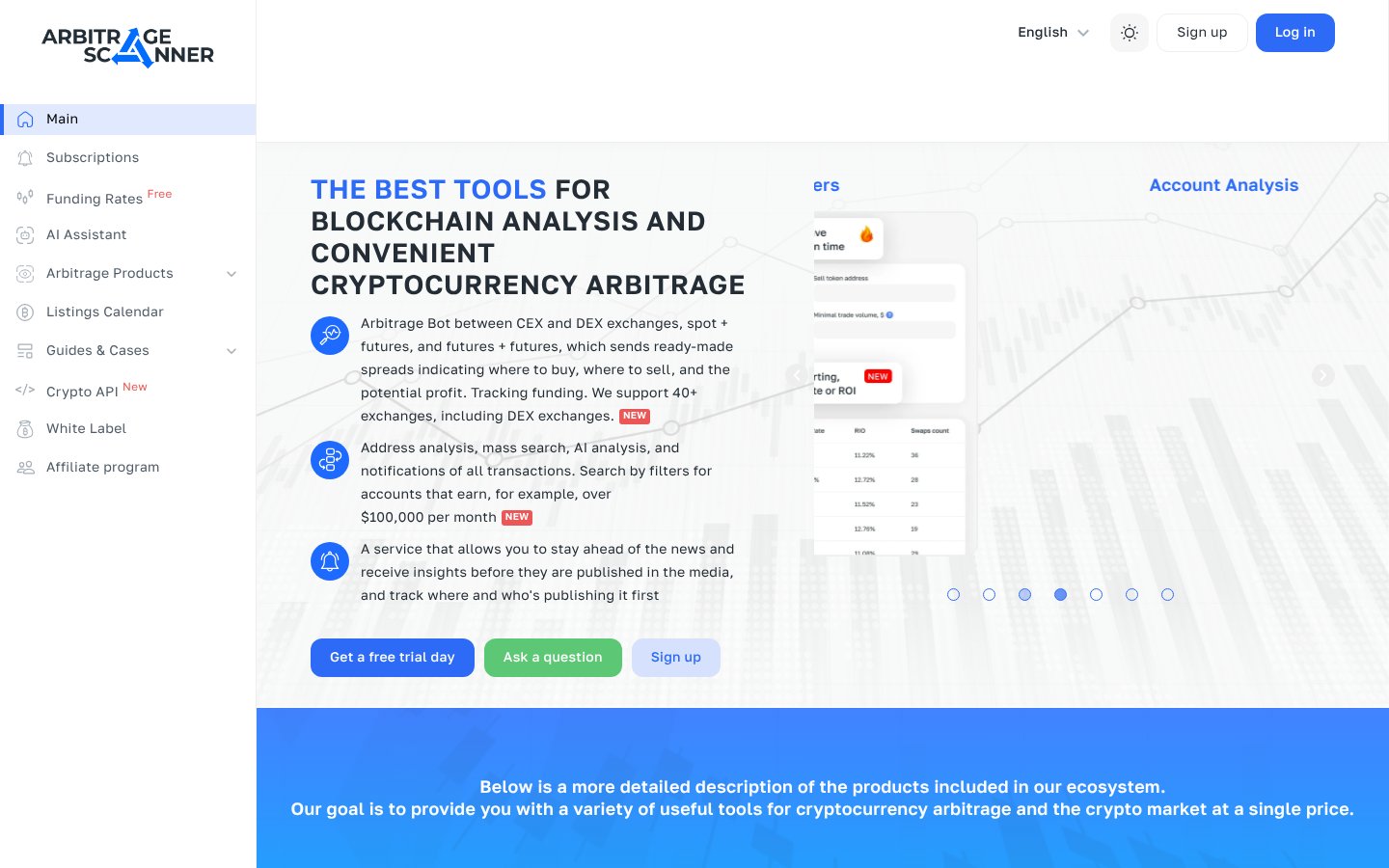
ArbitrageScanner does one job: it scans for price gaps across centralized and decentralized exchanges. It monitors spreads in real time across 100+ exchanges and surfaces them before they close. It covers CEX-to-CEX, CEX-to-DEX and P2P routes. Few competitors cover all three.
That matters because DEX liquidity is fragmented across chains such as Solana, Base and Arbitrum. A tool that maps cross-exchange and cross-chain gaps has a clear use.
It isn't an execution engine. You move the funds yourself and need capital sitting on several exchanges at once. Withdrawal times and fees can erase a thin spread, so beginners should skip it. Entry pricing was around $99/month as of October 2026, with higher tiers for more exchange coverage and faster scan intervals, and there's no free plan. Confirm the current figure on the vendor's page.
Pricing: Paid plans only, entry tier around $99/month as of October 2026.
Best for: Experienced traders who specialize in cross-exchange or cross-chain arbitrage.
Pros: CEX, DEX and P2P coverage, real-time spread detection, multi-chain support
Cons: Scanner only, needs capital on multiple exchanges, high price for casual traders, no free plan
5. Cryptohopper
Official website: cryptohopper.com
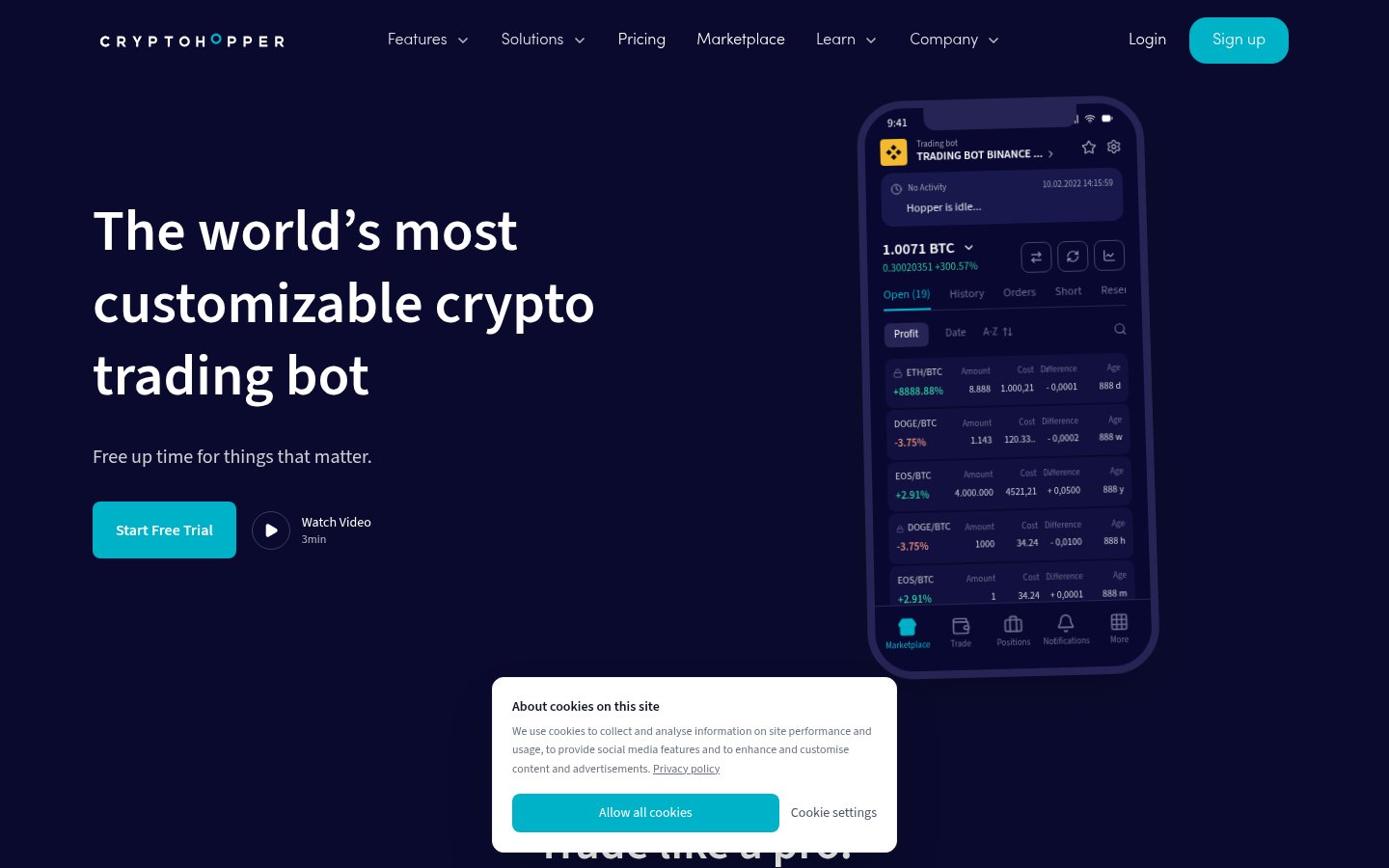
Cryptohopper has run since 2017 and executes in the cloud 24/7, so your bot keeps trading when your laptop is off. No local process or VPS is needed.
The Strategy Designer combines technical indicators, trailing stops and multiple position sizes without code. A marketplace sells pre-built strategies and signals from other traders, and you can clone top performers. An AI Strategy Advisor, added in late 2025, reviews your portfolio, trading history and market conditions and recommends bot configuration changes such as stop-loss and trailing-stop placement. The paper trading mode lets you test before you risk money.
Marketplace quality varies widely, so check a seller's track record before you pay for anything. The interface looks dated next to newer rivals.
Pricing (as of October 2026): Pioneer (free, limited), Explorer at $19/month, Adventurer at $49/month, Hero at $99/month.
Best for: Intermediate traders who want a cloud bot with a visual strategy builder and a signal marketplace.
Pros: Cloud execution, visual strategy builder, AI Strategy Advisor, signal and strategy marketplace, paper trading, operating since 2017
Cons: Uneven marketplace quality, dated UI, Hero plan needed for full feature access
6. Bitsgap
Official website: bitsgap.com
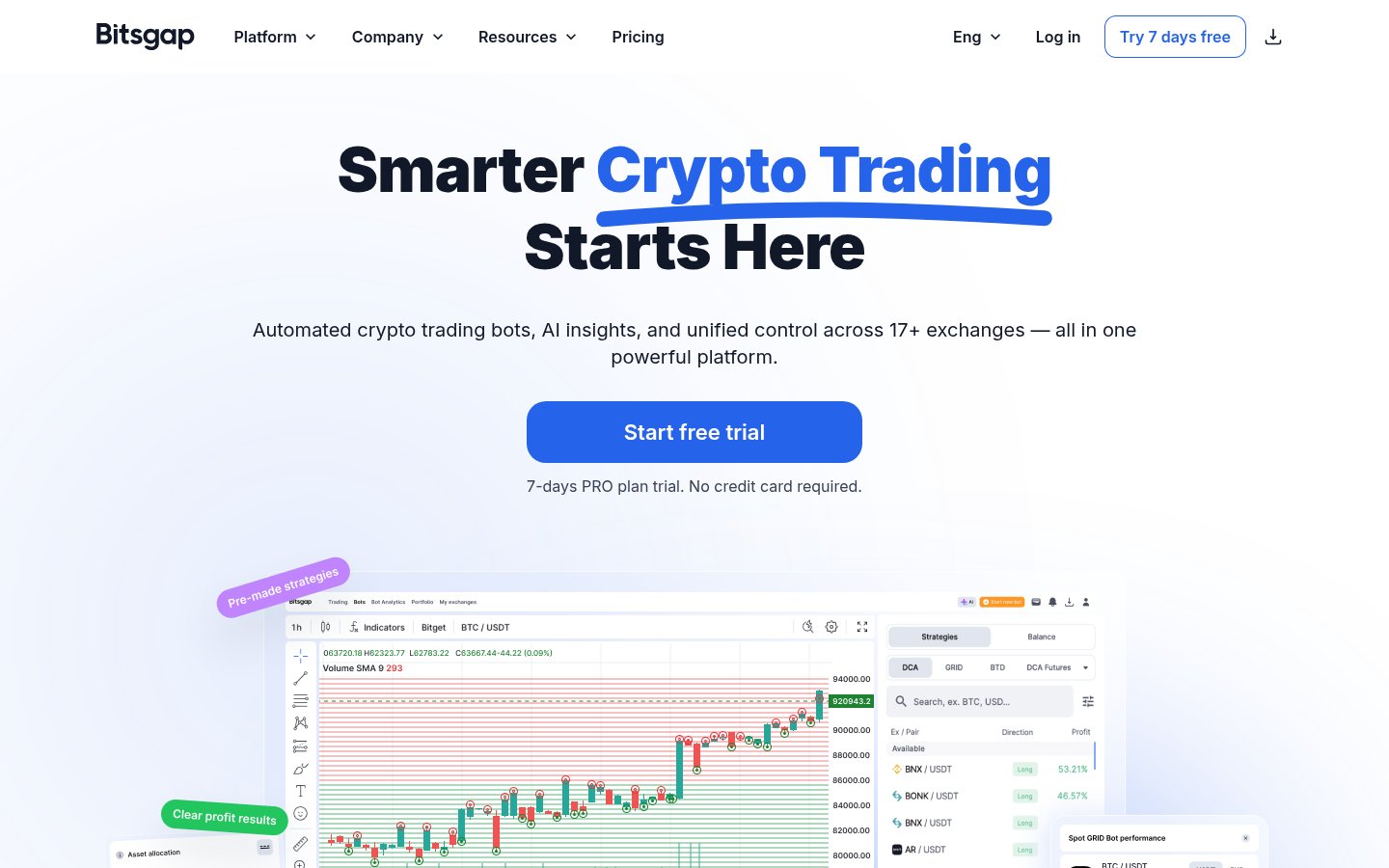
Bitsgap is the grid trading specialist. Its GRID, COMBO and BTD (Buy The Dip) bots cover the core range-trading cases. If your strategy is profiting from oscillation inside a defined range, this is the tool I'd start with.
It connects to 25+ exchanges through encrypted API keys and manages positions across them in one dashboard. Demo mode trades simulated funds against live market conditions, which tells you more than a backtest because it reflects current spread and liquidity. An AI-assisted setup analyzes historical price data for your chosen pair and suggests grid parameters, a useful shortcut when you aren't sure how to size grid levels.
It's a poor fit for trend-following or signal-driven strategies. Annual billing offers discounts, but it's a commitment.
Pricing (as of October 2026): Basic at $23/month, Advanced at $65/month, Pro at $119/month.
Best for: Grid traders and anyone who wants multi-exchange management in one dashboard.
Pros: GRID, COMBO and BTD bots, 25+ exchanges, demo mode on live conditions, AI-assisted grid parameters
Cons: Weak for trend-following or signal strategies, Pro plan needed for multiple simultaneous bots, annual plans lock you in
7. Octobot

Official website: octobot.cloud
Octobot is the open-source option. You can self-host it for free or pay for the cloud-hosted version. With the source open, you can inspect what the bot does, modify strategies and keep your API keys and trade history off a third party's servers. That's the reason to choose it.
Strategies cover DCA, market making and technical-indicator approaches, and backtesting is built in. The cloud version removes setup friction and adds a visual interface for non-developers.
Self-hosting needs technical skill, you get community support instead of a support desk, and it lists fewer exchange integrations than 3Commas. Cloud plan prices are on the vendor's page.
Pricing: Self-hosted version is free. Cloud plans are paid; see the vendor's pricing page.
Best for: Developers and privacy-minded traders who want control over code and data.
Pros: Open source and self-hostable, cloud option, built-in backtesting, DCA and market-making strategies
Cons: Technical self-hosted setup, fewer exchanges than 3Commas, community-only support
8. Wundertrading

Official website: wundertrading.com
Wundertrading is the best fit here for TradingView users. Set up an alert, point the webhook at Wundertrading and your Pine Script strategy sends real orders without a rebuild.
It also offers copy trading from verified signal providers in its community. Vetting is stricter than on some rivals, which lowers the odds of paying someone who only got lucky in a bull market. Bot types cover DCA, grid and TWAP (time-weighted average price). TWAP is rare at this price and helps traders with larger positions reduce market impact. Supported exchanges include Binance, Bybit, Kraken and OKX.
The UI is less polished than Bitsgap's or 3Commas', and advanced features sit behind higher plans.
Pricing (as of October 2026): Free plan (limited bots), Basic at $19.95/month, Advanced at $44.95/month, Professional at $84.95/month.
Best for: TradingView strategy builders and copy traders.
Pros: TradingView webhook execution, TWAP support, vetted copy trading, free tier
Cons: Less polished UI, smaller community than Cryptohopper's marketplace, advanced features on higher plans
9. Stoic.ai
Official website: stoic.ai
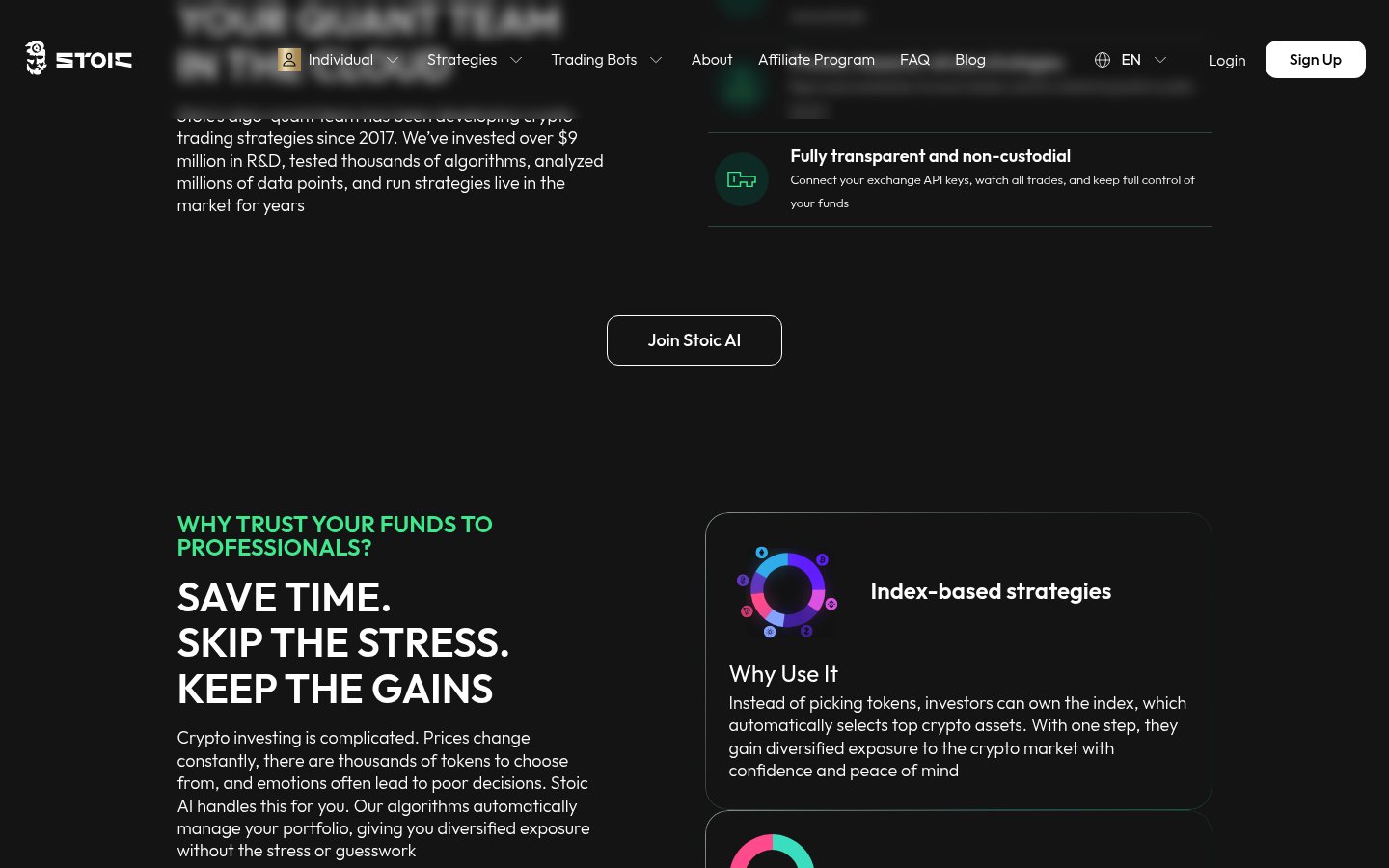
Stoic.ai is a different product from the rest. It runs long-only, AI-managed portfolio allocation with systematic rebalancing instead of letting you build bots. You connect an exchange account through API keys that carry trading permission but never withdrawal access, set a risk level and the system manages the rest. It supports Binance Global, Binance US, Bybit, Coinbase, KuCoin, Crypto.com and Hyperliquid.
It sits last because of the cost curve. Plans are banded by portfolio size and start at $24/month for balances up to $2,500, with no free plan and no trial. The strategy needs a $500 minimum. Paid monthly, $24 comes to $288 a year, which is 57.6% of a $500 balance and still 11.5% of $2,500. The maths only works once you manage four figures.
Pricing (as of October 2026): Starter $24/month ($149/year) for portfolios up to $2,500, Plus $39/month ($239/year) up to $5,000, Pro $66/month ($399/year) up to $10,000. Above $10,000 you stay on Pro and add 5% a year of the balance over that line. No free plan, no free trial, no performance fee or profit share.
Best for: Passive long-term investors on Binance, Bybit, Coinbase, KuCoin, Crypto.com or Hyperliquid who want hands-off rebalancing.
Pros: Passive, no performance fee, seven supported exchanges including Hyperliquid, API keys never get withdrawal access
Cons: No free plan or trial, small balances pay a high effective rate, $500 minimum, little customization, not for short-term trading
Comparison Table
| Tool | Best For | Bot Types | Exchanges | Starting Price | Free Option |
|---|---|---|---|---|---|
| 3Commas | Multi-strategy traders | DCA, Grid, Options | 15+ | $29/month | Yes (limited) |
| Coinrule | No-code rule builders, CEX plus on-chain | Rule-based (350+ templates) | 20+ plus on-chain | $29.99/month | Yes (2 live rules) |
| TradeSanta | DCA and grid with TradingView | DCA, Grid, Combo | Binance, Bybit, OKX, Huobi, Kraken | See vendor page | Yes (limited) |
| ArbitrageScanner | Arbitrage specialists | CEX/DEX/P2P scanner | 100+ (scan only) | ~$99/month | No |
| Cryptohopper | Cloud automation | DCA, Grid, Scalping | Major exchanges | $19/month | Yes (limited) |
| Bitsgap | Grid trading | GRID, COMBO, BTD | 25+ | $23/month | Demo only |
| Octobot | Developers, privacy | DCA, Market Making, Technical | Major exchanges | Free (self-hosted) | Yes |
| Wundertrading | TradingView users | DCA, Grid, TWAP | Binance, Bybit, Kraken, OKX | $19.95/month | Yes (limited) |
| Stoic.ai | Passive investors | Portfolio rebalancing | 7 | $24/month | No |
How I Ranked These
I scored each tool on four things: strategy range, fit for a clear type of trader, risk controls (stop-losses, paper or demo modes, API keys without withdrawal rights, portfolio-level limits) and cost against what you get. Nobody here has measured returns, so none of this ranking predicts profit.
Two placements invite argument. Coinrule sits above TradeSanta because of its on-chain reach and flat pricing, though its 3.8 Trustpilot score and missing portfolio-wide risk cap pull the other way. Stoic.ai is last on cost, not on quality.
A bot executes your strategy with more discipline than you'll have at 2 AM, but it doesn't create an edge. Some tools here carry affiliate links, which only break ties between near-equal options. Prices change often, so confirm them on each vendor's site.
Related reading
Tools in this article 6
Written by
Stanislav Vovchyk
Founder and editor of infobro.ai
I run infobro.ai: I decide what it covers and how tools are evaluated.
I research every tool from its documentation, pricing pages, product screenshots and public developer discussion, and say plainly what the evidence does and does not show.
More best of