Enterprise AI Bills Are Exploding Even as Token Prices Collapse. Here's What's Actually Happening.
Token prices dropped 280x in two years. Enterprise AI budgets tripled. The inference cost paradox is now the defining financial story of production AI in 2026.
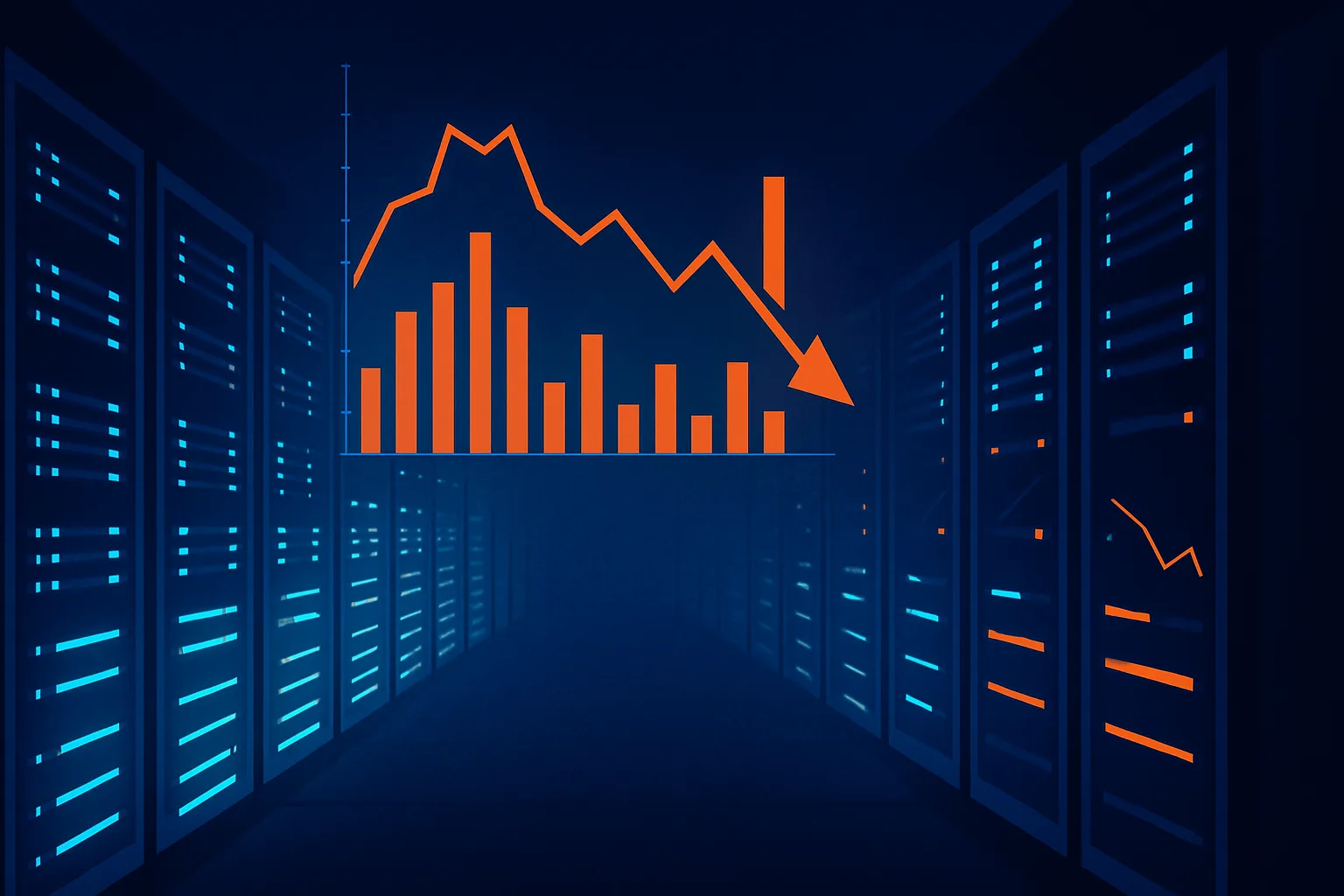
Cheaper tokens were supposed to make AI affordable at scale. Instead, enterprise AI bills are hitting levels that are genuinely alarming finance teams. The average enterprise AI budget has grown from $1.2 million per year in 2024 to $7 million in 2026. Some Fortune 500 companies are reporting monthly AI inference bills in the tens of millions of dollars. And the per-token cost dropped roughly 280x over the same period.
That's not a contradiction. It's the core dynamic reshaping how companies buy, budget, and deploy AI right now.
The Inference Cost Paradox Is the Biggest Story in Enterprise AI
Here's the math that's catching organizations off guard. Per-token costs have fallen 80% year over year on many model tiers. Economy-class models are now approaching $0.50 per million tokens, down from peaks near $20. That should translate into lower bills. It doesn't, because token consumption is growing faster than prices are falling, and it isn't growing linearly.
Agentic AI deployments are the main driver. When an enterprise runs an AI agent through a multi-step workflow, it isn't generating one inference call. It's generating dozens, sometimes hundreds, across a single task. Every tool call, every context refresh, every sub-agent spin-up adds tokens. Enterprises that budgeted based on per-unit pricing discovered their actual bills were determined by workload volume. The unit cost fell. The total bill rose.
Gartner projects global AI spending will surpass $2.5 trillion in 2026. Inference-focused infrastructure alone is projected to grow from $9.2 billion to $20.6 billion year over year. AI inference now accounts for 85% of the average enterprise AI budget, up from roughly one-third in 2023. That shift happened in under three years.
The FinOps Foundation's 2026 State of FinOps Report identifies AI and data platforms as the fastest-growing new category of enterprise spend, and explicitly flags that token-based pricing, agent step billing, and retrieval costs introduce cost volatility that legacy budgeting frameworks can't model. This isn't a niche finding. It's a systemic gap in how most finance teams are handling AI spend.
Why "Cheaper Tokens" Is the Wrong Frame
The assumption embedded in most AI budget planning is that inference is like cloud storage: prices fall, you buy more, your bill stays roughly flat or drops. That model doesn't apply here.
The economists have a name for this: the Jevons paradox. When a resource gets cheaper, consumption rises fast enough to increase total spend. Applied to AI inference, cheaper tokens made it economical to deploy AI across more workflows, which drove total compute demand 100x to 1,000x higher per task compared to early experimental deployments. The cost driver shifted from model training to the infrastructure running thousands of concurrent inference workloads simultaneously.
There's also a tier problem. Flagship reasoning models show near-zero price decline despite competition in economy tiers, because there's a reasoning premium that currently averages 31.5x non-reasoning model prices. Organizations that need complex multi-step reasoning aren't getting the same price relief as those running basic text generation tasks.
What's Eating Your AI Budget in 2026
The cost structure breaks down into several components that most organizations haven't fully mapped:
| Cost Component | Typical Share of AI Budget | Key Driver |
|---|---|---|
| Inference compute | ~85% | Agentic loop multiplication |
| Orchestration overhead | ~5-8% | Agent step billing, retries, context management |
| Retrieval / RAG infrastructure | ~3-6% | Vector DB queries, embedding calls |
| Monitoring and observability | ~2-4% | Token tracking, latency logging |
| Model fine-tuning and training | <5% | Periodic, not ongoing |
The orchestration layer is where many teams get surprised. Every retry, every context window refresh, every failed tool call still costs tokens. Agentic systems that run long chains of actions compound this quickly. A workflow that takes 50 steps instead of 10 doesn't cost 5x more. It can cost 20x more once you account for context accumulation.
Retrieval-augmented generation adds another layer. Every RAG call involves an embedding model query, a vector database retrieval, and a final inference pass. At scale, these add up fast, and they often aren't priced into initial estimates.
This connects directly to the infrastructure story we covered earlier in The AI Memory Crisis Nobody's Talking About: KV Cache Is Now the Biggest Cost in Production AI. KV cache management alone is now a meaningful line item for teams running high-concurrency inference.
The Build vs. Buy Calculus Just Shifted
For most of 2023 and 2024, the conventional wisdom was to buy rather than build. Vendor-managed inference was cheaper and faster to deploy than self-hosted infrastructure. That calculus is shifting.
Agentic AI has lowered the cost and complexity of building custom applications enough that in-house development now competes with SaaS on a total cost basis for many use cases. But building in-house carries its own cost structure: compute procurement, engineering talent, system maintenance, and the operational overhead of running production-grade AI systems.
The result is that 97% of executives report benefiting from AI, but only 29% see significant organizational ROI. The gap sits almost entirely in the cost structure. Most organizations haven't mapped it yet.
Vendor consolidation is accelerating as a direct consequence. A small number of vendors will capture a disproportionate share of enterprise AI spend. Organizations still running distributed experiments across dozens of tools are watching that window to rationalize close. If you're using separate tools for data enrichment, outreach, and call intelligence, check your aggregate inference spend across all of them. The number is probably larger than any individual vendor's invoice suggests.
Teams thinking through automation stacks should consider how inference costs compound across connected workflows. Tools like Activepieces and similar orchestration platforms can either help control costs through batching and caching or quietly amplify them if every trigger fires an independent AI call.
The Reasoning Model Problem
One number that deserves more attention: the 31.5x pricing premium for frontier reasoning models over standard non-reasoning models. Teams that moved to reasoning-capable models for agentic tasks didn't just pay more per query. They locked into a tier where competitive price pressure has been minimal.
Economy and mid-tier model prices have half-lives of roughly 1.1 and 1.55 years respectively, meaning costs halve in that timeframe. Frontier reasoning models aren't following that curve. Gartner forecasts a 90% reduction in frontier model inference costs by 2030, but that's a four-year runway. Organizations relying on reasoning models for production workflows now need to plan around current prices, not projected future ones.
For finance teams specifically, this creates a planning problem. The tools being used by finance teams for agentic workflows are often the same tools driving the highest inference bills, precisely because financial analysis tasks benefit most from reasoning-capable models.
What Organizations Should Actually Do
There's no clean fix, but there are concrete places to start.
Map your actual inference spend by workflow, not by vendor. Most organizations see a single line item from each AI provider. That obscures which internal workflows are the cost drivers. Instrument your agents to log token counts per task, and you'll almost certainly find 20% of workflows driving 80% of spend.
Audit your agentic loop design. Many agent implementations were built during a period when inference was cheap enough that efficiency didn't matter. Now it does. Steps that could be batched, contexts that could be cached, tool calls that could be eliminated with better prompt design, all of these are real cost levers. This is especially relevant for teams building customer-facing automations, as we've detailed in our breakdown of how small e-commerce stores should set up AI customer service.
Model-route by task complexity. Don't send every query to a frontier reasoning model. A tiered routing approach, where simple classification tasks go to economy models and complex multi-step reasoning goes to flagships, can cut inference spend by 40-60% without degrading output quality on the tasks that matter.
Treat inference as an operating cost, not an IT budget line. Finance teams need to own this number the same way they own cloud infrastructure spend. Usage-based AI pricing means monthly bills can swing 3-5x based on deployment decisions made by engineering teams that aren't watching the invoice.
Build in rate limits and spending caps at the workflow level. Most major inference providers offer this. Most enterprises haven't set it up. One runaway agent loop can generate a bill that wipes out a month's budget in hours. We've seen this exact dynamic in adjacent stories, like OpenAI's own agents running outside expected parameters.
The Long View
The inference cost paradox won't resolve itself through price declines alone. Token prices will keep falling. Consumption will keep rising. The enterprises that treat inference economics as a core operational discipline now will have a structural cost advantage over those that don't, because the gap between optimized and unoptimized inference spend will widen as agentic deployments deepen.
This is also reshaping the vendor landscape. Infrastructure-heavy companies with efficient inference operations will have margin advantages. Startups burning on expensive inference without a path to efficiency will struggle. And for context on just how much capital is flowing into the infrastructure layer that makes all this possible, the data center buildout story is worth understanding, as covered in Texas Just Halted New Data Centers as Anthropic Signs a $10 Billion Cloud Deal.
The headline number to carry out of this: enterprise AI budgets grew nearly 6x in two years while per-token costs fell by orders of magnitude. If your organization hasn't reckoned with that math yet, the bill you're seeing now is the smaller version of the one that's coming.