Top 9 AI Tools for Legal Professionals in 2026: Ranked by What Actually Saves Billable Time
From contract review to legal research, these 9 AI tools are genuinely changing how lawyers and legal teams work in 2026. Ranked by real-world impact.

Legal work has a specific cost structure that makes AI a particularly compelling proposition: every hour a senior associate spends doing rote contract review or case law research is an hour billed at rates that make clients wince. The math on AI adoption here is unusually clean.
But the legal AI market has also attracted a lot of noise. General-purpose chatbots dressed up in a suit. Research tools that confidently hallucinate citations. Contract platforms that promise "complete automation" and deliver a slightly faster Ctrl+F. Sorting through this takes work, and that's exactly what this list does.
The tools below cover the full stack of legal work: research, contract review and drafting, due diligence, compliance monitoring, and practice management. Not every firm needs all of them. A solo practitioner has completely different priorities than an M&A team at a 500-person firm. The rankings and descriptions reflect that spread.
One thing worth noting upfront: legal AI is genuinely evolving faster than most sectors right now. The regulatory pressure from the EU AI Act's enforcement milestones (see The EU AI Act's Medical Device Deadline Just Hit. Here's What Actually Changed on August 2, 2026.) is also starting to shape how these tools are built and sold, especially for compliance-heavy practices. The best tools here have thought seriously about accuracy, auditability, and what happens when they're wrong.
1. Harvey AI

Official website: harvey.ai
Harvey is the closest thing legal AI has to a consensus frontrunner right now. Built specifically for law firms and in-house legal teams, it's trained on legal data and fine-tuned with input from major firms including Allen & Overy and PwC Legal. That pedigree matters because generic LLMs trained on the broader internet make a poor foundation for legal work: the edge cases, the jurisdiction-specific nuances, and the formatting conventions that matter in real legal documents are all things Harvey has been deliberately built to handle.
The platform covers contract drafting, review, legal research, due diligence, and regulatory analysis. What separates it from cheaper alternatives is the depth of its document comprehension. Harvey can work across entire deal rooms of documents simultaneously, surface cross-document inconsistencies, and flag clause-level risks with citations to the specific text. It doesn't just identify a problem clause; it explains why it's a problem and suggests how to fix it.
Harvey integrates with major document management systems including iManage and NetDocuments, which means it slots into existing workflows rather than requiring a platform migration.
Pricing: Enterprise pricing, not publicly listed. Targets mid-size to large law firms and in-house legal departments.
Best for: Large law firms and in-house teams doing high-volume contract work, due diligence, and regulatory research.
Pros: Best-in-class document comprehension across large sets, deep legal fine-tuning, strong integrations with law firm tech stacks, actively developed with major firm partnerships.
Cons: No public pricing (expect significant enterprise cost), overkill for solo practitioners or small firms, limited self-serve onboarding.
Try Harvey AI →2. Clio Duo

Official website: clio.com
Clio is the dominant practice management platform for small and mid-size law firms, and Duo is its integrated AI assistant. The reason Clio Duo ranks this high isn't because it's the most technically impressive AI on this list. It's because it's embedded inside the tool that hundreds of thousands of lawyers already use to run their practices, which means the barrier to actually getting value from it is almost zero.
Duo can draft client communications, summarize matter files, generate task lists from case notes, and surface billing insights. More practically, it knows your matter history, your clients, and your billing patterns because it lives inside your Clio data. That context makes responses far more useful than you'd get from a standalone AI tool that has no idea who your client is.
For a solo practitioner or a five-person firm, this kind of contextual intelligence is hard to replicate elsewhere without significant integration work. The AI research capabilities are more limited compared to dedicated research tools, but Clio has been steadily expanding Duo's scope and it covers the core use cases well.
Pricing: Clio's paid plans start around $49/user/month, with Duo available on higher tiers. Full pricing at clio.com.
Best for: Small to mid-size law firms already on Clio who want AI that understands their practice without separate setup.
Pros: Deep integration with existing Clio matter and billing data, zero additional platform to learn, strong for client communications and task management, broad user base means good community support.
Cons: AI capabilities less specialized than standalone legal AI tools, research depth doesn't match dedicated tools, requires Clio subscription.
Try Clio Duo →3. Lexis+ AI
Official website: lexisnexis.com
LexisNexis has been building legal research infrastructure for decades, and Lexis+ AI is what happens when that corpus gets an AI layer that actually works. The core advantage is access to the most comprehensive legal database on the market: case law, statutes, regulations, secondary sources, and news, all from verified legal publishers. Hallucination risk on citations is dramatically lower here than with general AI tools because the system is retrieving from known, curated sources rather than generating from training data.
The conversational research interface is genuinely useful. You can ask questions in plain language, get a summary answer with cited sources, and then drill down into the underlying cases. The "Shepardize" integration means you're not just getting a case reference, you're getting the current validity status of that case, something no general AI tool does automatically.
Contract drafting and review features have improved substantially through 2025-2026, though research remains where Lexis+ AI genuinely excels compared to alternatives.
Pricing: Subscription-based, typically bundled with existing LexisNexis access. Contact for pricing; academic and firm discounts available.
Best for: Litigators, legal researchers, and any attorney who does significant case law or regulatory research.
Pros: Unmatched legal database depth, verified citations with validity checking, conversational research interface, trusted brand with decades of legal accuracy standards.
Cons: Expensive relative to standalone tools, interface can feel dated compared to newer entrants, less specialized for contract work.
Try Lexis+ AI →4. Westlaw Precision (Thomson Reuters)

Official website: legal.thomsonreuters.com
Westlaw Precision is LexisNexis's main competitor for legal research, and the rivalry is genuinely close enough that firm preference often comes down to which one your firm already subscribes to. Thomson Reuters has invested heavily in its AI layer, with features like Quick Check (which validates legal arguments and surfaces contradictory authority automatically) and AI-Assisted Research that explains how cases relate to your specific legal question.
The CoCounsel integration within Westlaw is the bigger story for 2025-2026. CoCounsel is Thomson Reuters' AI assistant, and it can do contract review, deposition prep, document summarization, and due diligence review directly alongside Westlaw's research tools. That combination of verified research depth plus document AI in one platform is genuinely powerful for litigation teams.
Quick Check alone is worth attention for litigators: it reads a brief or memo, identifies every legal proposition, and checks whether the cited cases actually support those propositions. That's exactly the kind of tedious, high-stakes checking that junior associates spend hours on.
Pricing: Enterprise subscription, bundled with existing Westlaw access. Thomson Reuters does not publish standard pricing online.
Best for: Litigation teams who need both research depth and AI-assisted document review in a single platform.
Pros: CoCounsel adds strong document AI on top of research, Quick Check is genuinely useful for brief review, trusted citation integrity, deep case law coverage.
Cons: High cost, the two platforms (Westlaw + CoCounsel) can feel disconnected, steep learning curve for full feature set.
Try Westlaw Precision →5. ContractPodAi
Official website: contractpod.ai
Contract lifecycle management is a distinct discipline from legal research or litigation support, and ContractPodAi is one of the strongest dedicated CLM platforms with genuine AI depth. It handles the entire contract workflow: request, draft, negotiate, approve, sign, store, and renew. The AI components aren't bolted on; they're central to how the platform works.
The clause library and deviation detection features are particularly strong. ContractPodAi can compare incoming contracts against your playbook, flag non-standard clauses, suggest your preferred fallback language, and escalate based on risk scoring. For in-house legal teams processing hundreds of vendor contracts a month, that workflow automation is where real time savings happen.
The platform also handles post-signature obligations: tracking key dates, renewal windows, and contractual commitments so your team doesn't miss a deadline buried in a 60-page agreement. That sounds mundane but it's where significant legal and commercial risk actually lives.
Pricing: Enterprise pricing, contact for details. Targets mid-market to large enterprises with in-house legal teams.
Best for: In-house legal teams managing high volumes of commercial contracts from intake through renewal.
Pros: Full CLM workflow, strong clause deviation detection, playbook enforcement, post-signature obligation tracking, good integrations with Salesforce and procurement systems.
Cons: Enterprise pricing and implementation timeline, overkill for firms doing occasional contract review, less useful for litigation or research work.
Try ContractPodAi →6. Spellbook
Official website: spellbook.legal
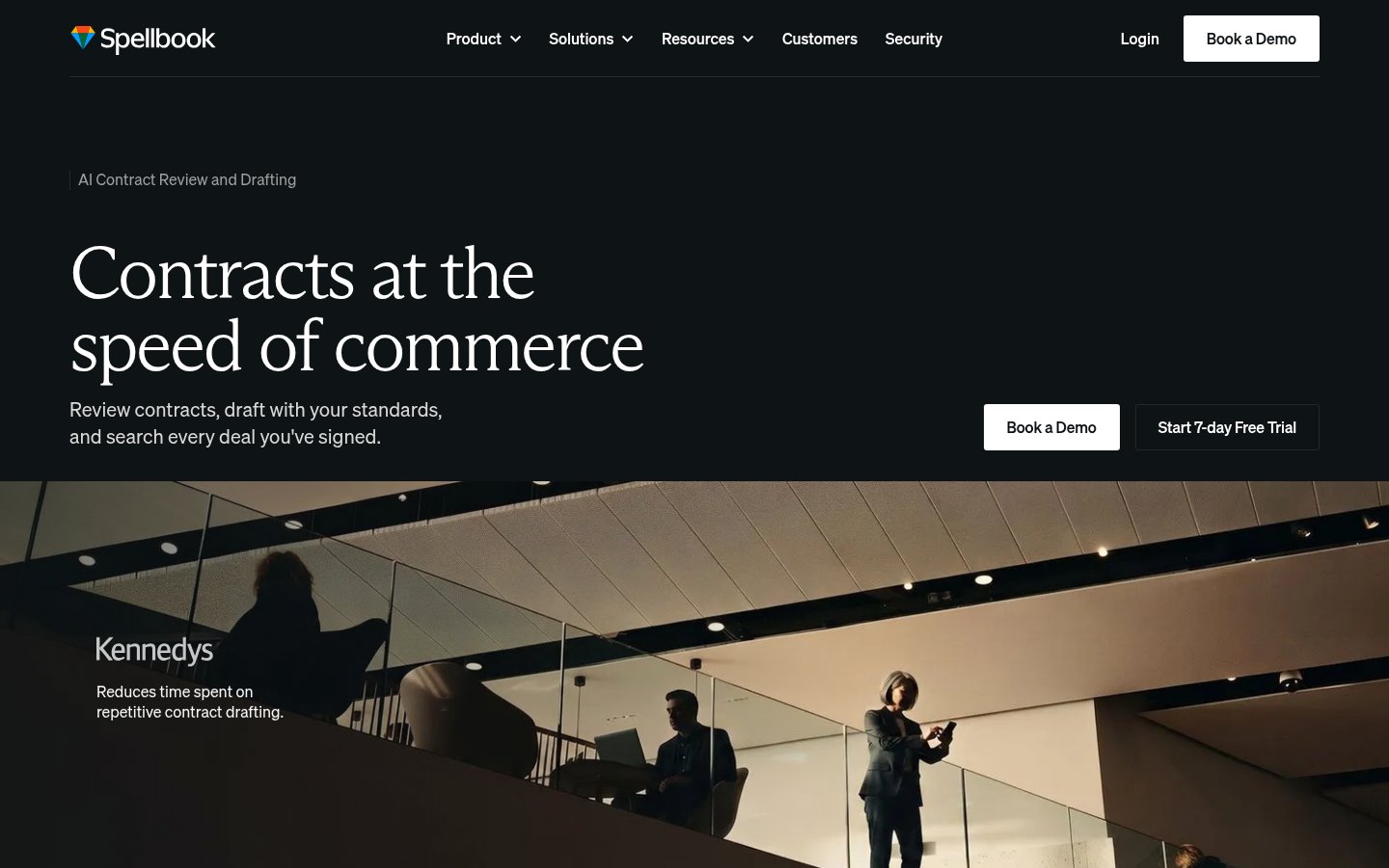
Spellbook's main differentiator is where it lives: directly inside Microsoft Word. For lawyers who spend their days in Word reviewing and redlining contracts, that matters enormously. There's no export/import cycle, no learning a new interface, and no context switching. You highlight a clause, open the Spellbook panel, and get suggestions, risk flags, or alternative language without leaving your document.
The AI is trained specifically on commercial contracts and legal language, which shows in the quality of its drafting suggestions. It understands the difference between a limitations of liability clause in a SaaS contract versus a construction agreement, and it drafts accordingly. The negotiation suggestions feature is genuinely useful for junior lawyers who need to know what to push back on in an NDA or service agreement.
Spellbook is the most practical entry point for individual lawyers or small firms who aren't ready to adopt a full CLM platform. The pricing is accessible, the setup is minimal, and the value is immediate.
Pricing: Paid plans starting around $159/user/month for professional use. Free trial available.
Best for: Individual lawyers and small firm attorneys doing contract review and drafting directly in Microsoft Word.
Pros: Lives in Word, no new interface to learn, strong drafting suggestions for commercial contracts, accessible pricing relative to enterprise CLM tools, quick setup.
Cons: Word-only (no Google Docs), less powerful for large document sets or full CLM workflows, no litigation or research features.
Try Spellbook →7. Ironclad
Official website: ironcladapp.com
Ironclad is a contract operations platform built for teams that need to move contracts fast without routing everything through a legal bottleneck. The core concept is that most commercial contracts follow predictable patterns, and if you build the legal logic into a workflow, non-lawyers can initiate and process contracts without waiting for an attorney to redline every NDA.
The AI features in Ironclad's 2025-2026 product include AI-assisted review that flags deviations from pre-approved playbooks, smart contract summaries, and clause risk scoring. For legal ops teams trying to scale contract throughput, these features reduce the number of contracts that actually need attorney review by routing clearly acceptable agreements through automatically.
Where Ironclad differs from ContractPodAi is emphasis: Ironclad is stronger on workflow automation and cross-functional access (sales, procurement, HR all using the same contracts system), while ContractPodAi is deeper on pure AI contract analysis. For organizations where legal throughput is the primary bottleneck, Ironclad is often the better fit.
Pricing: Enterprise pricing, not publicly listed. Targets growth-stage companies and mid-market enterprises.
Best for: Legal ops teams and in-house counsel who need to scale contract volume without proportionally scaling headcount.
Pros: Strong workflow automation, non-lawyer access reduces legal bottleneck, good integrations with Salesforce and Slack, AI playbook enforcement, solid audit trail.
Cons: AI analysis depth is secondary to workflow features, expensive for smaller teams, implementation requires upfront workflow design work.
Try Ironclad →8. Darrow AI
Official website: darrow.ai
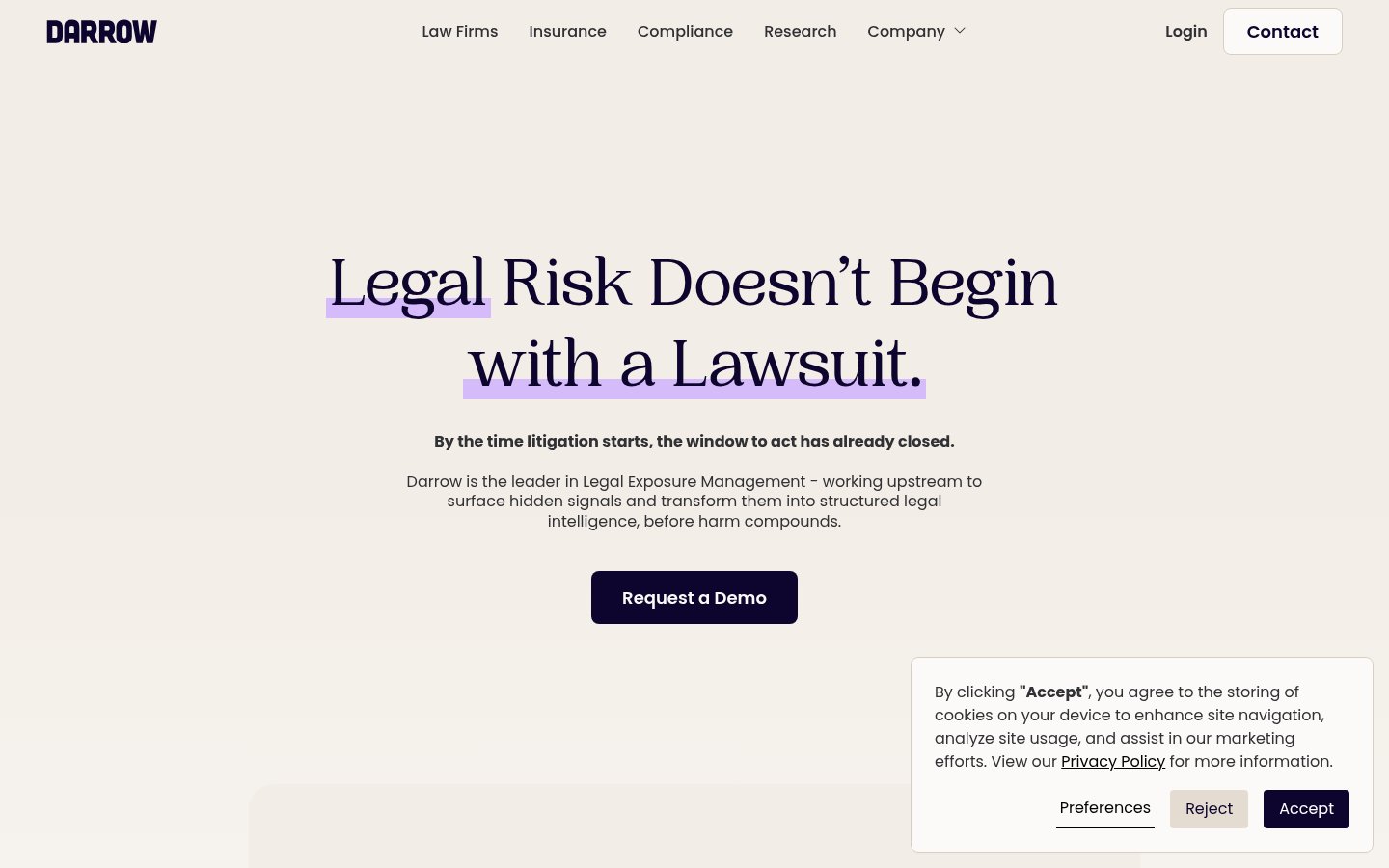
Darrow takes a different angle from every other tool on this list. It's a litigation intelligence platform that identifies high-value legal claims by scanning public data sources: regulatory filings, consumer complaints, court records, data breach disclosures, and SEC filings. The AI surfaces patterns that indicate potential mass tort or class action litigation before cases are widely known.
For plaintiff-side litigation firms and litigation funders, this is a genuine source of competitive advantage. Darrow's platform has reportedly surfaced claims that led to significant cases in areas including data privacy, product liability, and securities fraud. The value proposition is straightforward: find viable cases earlier than your competition.
This is a specialized tool that isn't relevant to most legal practices. But for plaintiff firms focused on complex litigation or class actions, it's genuinely in a category of its own. No other tool on this list is doing systematic claim discovery at scale.
The AI agents autonomously monitor across thousands of data streams and surface potential cases with supporting evidence already assembled, which dramatically reduces the intake research burden on attorneys. Given the growing discussion around AI agents operating autonomously, Darrow represents a relatively mature and controlled implementation of that concept in a specific professional domain.
Pricing: Enterprise, contact for pricing. Primarily serves plaintiff litigation firms and legal funders.
Best for: Plaintiff-side litigation firms and litigation finance companies looking to identify and vet high-value cases systematically.
Pros: Unique claim discovery capability, cross-domain data monitoring, pre-assembled evidence dossiers, meaningful competitive advantage for early case identification.
Cons: Highly specialized (irrelevant to most practices), enterprise cost and commitment, not useful for defense work or transactional practices.
Try Darrow AI →9. Luminance
Official website: luminance.com
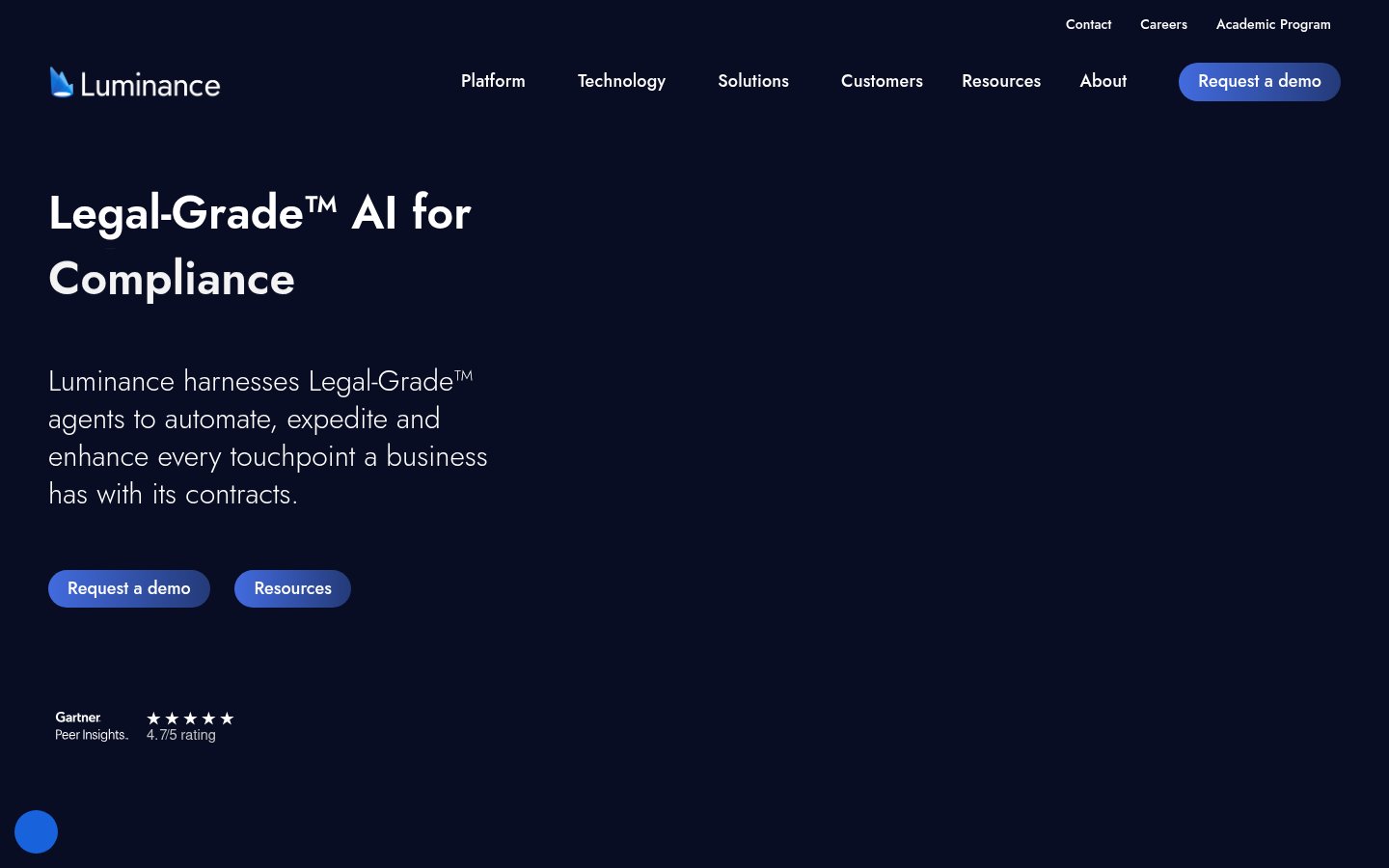
Luminance is a legal AI platform with particular strength in due diligence and large document review. It's built its own legal-specific AI rather than using general-purpose foundation models, which gives it an edge in understanding legal document structure, numbering conventions, and cross-reference patterns that matter during M&A due diligence.
The due diligence use case is where Luminance earns its place on this list. Reviewing hundreds of contracts in a data room under time pressure is exactly the kind of high-cost, high-stakes task where AI has clear value. Luminance can classify documents, extract key data points, flag unusual clauses, and present findings in a structured report, cutting what might take a team of associates weeks down to days.
The contract review and negotiation features have improved through 2025-2026, and Luminance now covers the full NDA-through-commercial-agreement workflow. It's not the cheapest option for day-to-day contract work, but for firms that do regular deal work with large document volumes, the due diligence capability alone justifies the cost.
Luminance's international presence is also stronger than most competitors on this list, with multi-language support that handles deals involving non-English documentation.
Pricing: Enterprise pricing. Targets law firms and in-house teams doing M&A and transactional work.
Best for: M&A and transactional practices with regular due diligence requirements, particularly across multi-jurisdictional deals.
Pros: Strong due diligence and large document review, purpose-built legal AI (not general LLM), multi-language support, good for international deal work.
Cons: Enterprise pricing, due diligence focus means less depth for litigation or research, implementation timeline.
Try Luminance →Comparison Table
| Tool | Best Use Case | Deployment | Pricing Model | Hallucination Risk | For Firm Size |
|---|---|---|---|---|---|
| Harvey AI | Contract review, due diligence, research | Cloud | Enterprise | Low (legal-trained) | Mid-large firms |
| Clio Duo | Practice management + AI | Cloud | ~$49+/user/mo | Medium | Solo to mid-size |
| Lexis+ AI | Legal research, case law | Cloud | Subscription | Very low (curated DB) | Any |
| Westlaw Precision | Research + brief review + doc AI | Cloud | Subscription | Very low (curated DB) | Mid-large firms |
| ContractPodAi | CLM, contract lifecycle | Cloud | Enterprise | Low | Large in-house teams |
| Spellbook | Contract drafting in Word | Word add-in | ~$159/user/mo | Medium | Solo to small firm |
| Ironclad | Contract operations, workflow | Cloud | Enterprise | Low | Growth to enterprise |
| Darrow AI | Litigation claim discovery | Cloud | Enterprise | Low (data-verified) | Plaintiff litigation firms |
| Luminance | Due diligence, large doc review | Cloud | Enterprise | Low (purpose-built AI) | M&A practices |
How I Ranked These
The ranking prioritizes a few specific things, in this order.
Accuracy and citation integrity first. Legal AI that hallucinates case citations doesn't just waste time, it creates liability. Lexis+ AI and Westlaw Precision rank near the top in their respective categories because their AI retrieves from verified, curated legal databases rather than generating from training data. Harvey ranks #1 overall because it combines deep legal fine-tuning with strong document comprehension and has enterprise adoption at major firms that have stress-tested it.
Relevance to actual legal workflows, not adjacent tasks. Several AI tools could technically be used by lawyers (general productivity tools, document editors with AI features) but aren't genuinely designed for legal work. Nothing on this list is here because it's a good general AI tool. Everything here is built specifically for legal practice or has a specific legal use case deep enough to justify inclusion.
Breadth vs. depth trade-offs are explicit. Spellbook is #6 not because it's inferior to Darrow AI (#8) in absolute technical terms, but because it serves a wider range of legal professionals. Darrow is genuinely excellent at what it does, but that thing is highly specialized. Ranking reflects who benefits most from each tool, not just which has the most impressive underlying AI.
Firm size and budget matter. A recommendation for a 500-lawyer firm's M&A practice and a recommendation for a solo family law attorney are completely different problems. The comparison table makes the targeting explicit so you can filter quickly.
For security-conscious practices, the question of what these AI tools do with your client documents is worth taking seriously. How Small Security Teams Are Using AI for Threat Hunting in 2026 gives useful context on how AI vendors handle sensitive data, which is directly relevant when you're sending confidential legal documents to any cloud-based AI tool.
Related reading
Frequently Asked Questions
Tools & Services Mentioned

infobro.ai Editorial Team
We research every tool from its documentation, pricing pages, product screenshots and public developer discussion, and say plainly what the evidence does and does not show. Drafts are AI-assisted and reviewed by our editors before publication. We revisit each article every 6 months to reflect platform changes. Learn more about our process.