
Coinrule Review 2026: A Solid No-Code Trading Bot for Crypto Beginners
A no-code crypto trading bot with a visual rule builder, 350+ strategy templates, flat-fee pricing, and MCP integration for LLM-assisted strategy building. Strong for beginners and mid-volume traders; execution reliability concerns are worth reading before committing real capital.

Coinrule
Coinrule
coinrule.comA no-code crypto trading bot with a visual rule builder, 350+ strategy templates, flat-fee pricing, and MCP integration for LLM-assisted strategy building. Strong for beginners and mid-volume traders; execution reliability concerns are worth reading before committing real capital.
Quick facts
- Free plan
- Yes, limited to 2 live rules
- Paid tiers
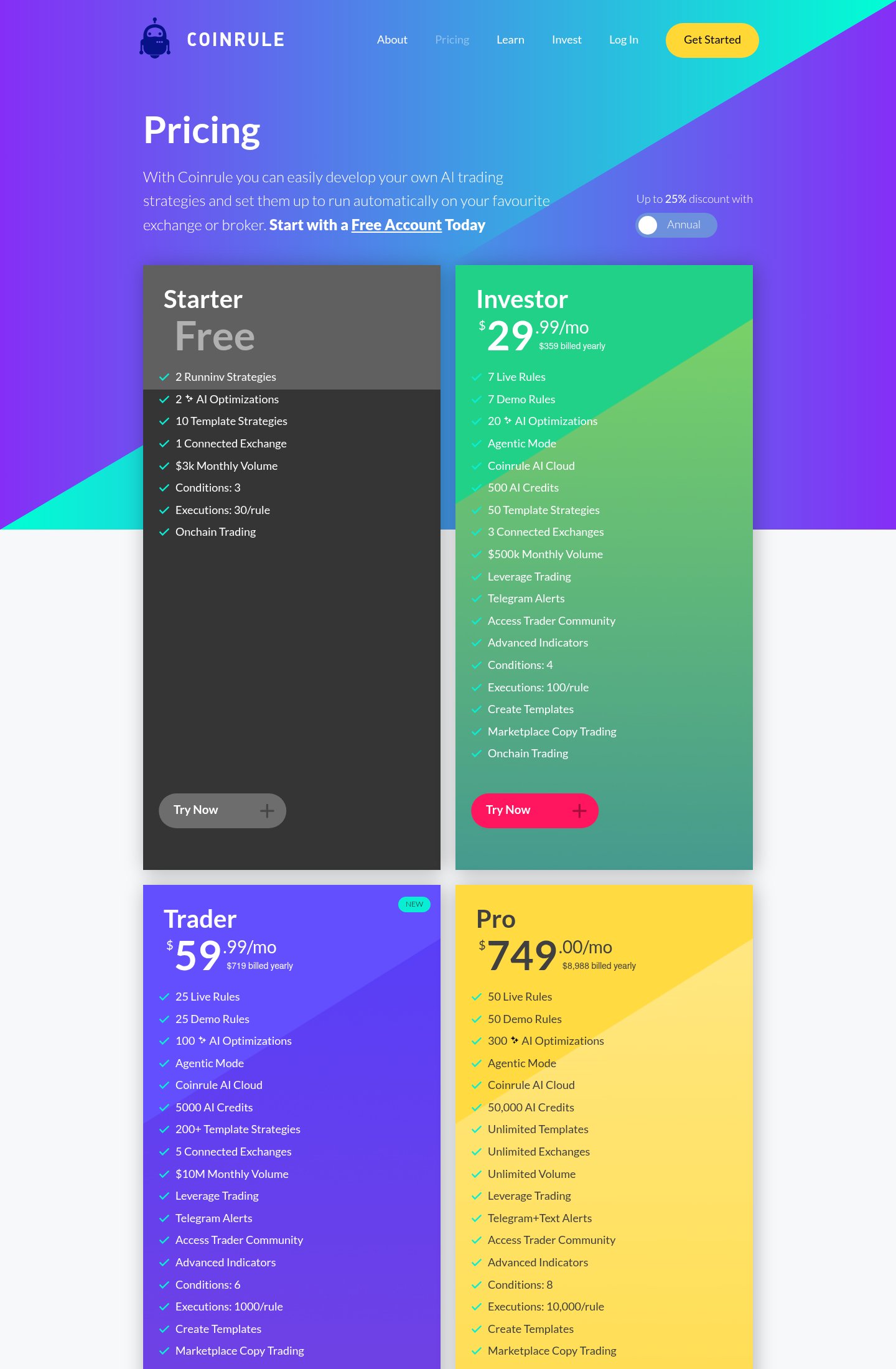
- Investor $29.99/mo, Trader $59.99/mo, Fund $749/mo
- Exchanges supported
- 20+ including Binance, Coinbase, Kraken, OKX, Bybit
- On-chain trading
- Base, Arbitrum, BSC, Hyperliquid
- Stock/ETF support
- Yes, via Alpaca, Webull, Trading 212, E*Trade, Public
- Coding required
- None, fully visual rule builder
- LLM integration
- MCP support for ChatGPT, Claude, Gemini, Grok
- Strategy templates
- 350+
- Trustpilot score
- 3.8/5 ("Great"), as of June 2026
- Founded
- 2018, London
Pros
- Flat-fee pricing beats percentage-based competitors for traders with meaningful monthly volume.
- On-chain trading support for Base, Arbitrum, BSC, and Hyperliquid puts it ahead of most no-code competitors.
- The visual rule builder is genuinely accessible to beginners with no programming background.
- TradingView integration bridges signal analysis and automated execution cleanly.
- MCP support for ChatGPT, Claude, Gemini, and Grok is a forward-looking integration few direct competitors offer.
- 350+ strategy templates give new users a fast path to a running bot without starting from scratch.
Cons
- Free tier caps at just 2 live rules simultaneously, which limits serious strategy development.
- Mixed Trustpilot reviews (3.8/5) raise legitimate execution reliability questions, with recent critical reviews calling reliability 'inconsistent.'
- No portfolio-level risk controls, so simultaneous rules on correlated assets can compound losses during volatile events.
- No visible multi-user or team permissions layer for collaborative or compliance-sensitive trading environments.
- Large pricing gap between the $59.99 Trader tier and the $749 Fund tier leaves mid-serious traders underserved.
See Coinrule for yourself
Free to start, no credit card needed for the trial.
Screenshots



Ready to try Coinrule?
Skip the screenshots and explore it live.
What This Platform Actually Does
Updated August 2026
This review covers a no-code automated trading platform founded in London in 2018 by Gabriele Musella, Oleg Giberstein, and Zdeněk Höfler. The pitch is straightforward: connect your exchange accounts, build a trading rule using a visual "if-this-then-that" interface, and let the platform execute orders around the clock while you're not watching the screen. No Python, no API wrangling, no proprietary scripting language.
The rule-building logic covers the usual technical triggers: RSI levels, moving average crossovers, percentage price changes, volume spikes, and time-based conditions. On the action side, you can configure buys, sells, stop-losses, take-profits, trailing mechanisms, and position scaling. It's genuinely flexible for a no-code tool. As of 2026, the platform supports more than 20 exchanges and brokers, including Binance, Coinbase Advanced, Kraken, OKX, Bybit, Bitget, and KuCoin on the crypto side, plus Alpaca, Webull, Trading 212, E*Trade, and Public for stocks and ETFs. On-chain trading is available through Base, Arbitrum, Binance Smart Chain, and Hyperliquid, a meaningful expansion beyond the traditional CEX-only model most competitors still offer.
The platform also features an AI assistant built into the product that helps users draft rules faster by interpreting natural language inputs. A MCP (Model Context Protocol) integration lets ChatGPT, Claude, Gemini, and Grok interact with the platform to create strategies, run backtests, and manage trading agents through external LLMs. That's a genuinely interesting feature in 2026, where AI agents operating autonomously are becoming a real operational category, not just a research curiosity. According to the platform's own FAQ, users have created over 1,395,960 trading strategies to date, a number that speaks to adoption even if it says nothing about profitability.
The Trustpilot score sits at 3.8 out of 5, rated "Great," based on data pulled in June 2026. That's a more grounded signal than the 4.9 Google stars cited on the platform's own website. The Trustpilot reviews split fairly predictably: users who engaged with the template library and customer support tend to be enthusiastic, while critics point to automation reliability issues and an interface that becomes confusing under active trading conditions. One June 2026 review describes it as "incredibly intuitive" with "outstanding" support. A critical review from the same period calls it "a platform still in beta, yet marketed as a polished, professional trading tool." The truth is probably somewhere between those two poles, and the 3.8 aggregate is a more honest reflection than the self-reported figures.
How It Works in Practice
The rule builder is the centerpiece of the product, and based on public documentation and screenshots, it's built around a clean condition-action model. You pick a trigger condition (say, BTC drops 5% in 24 hours), then attach an action (buy $200 of BTC on Binance), and optionally stack additional conditions or actions onto the same rule. The platform offers 350+ pre-built bot templates, which matters a lot for users who don't want to start from scratch. Templates cover strategies like "Buy the Dip," "Ride the Trend," and "Maximized Crossing Moving Averages", not creative names, but they tell you exactly what you're getting.
Backtesting is available, and the public pricing page shows a slider tool where you can plug in a monthly trading volume and initial amount to estimate performance against historical data. That's a solid feature for evaluating a strategy before putting real money behind it. The UX critique that surfaces across external reviews is that the free tier is quite constrained, more on that in the pricing section, which means backtesting the more complex multi-condition rules may require upgrading before you can properly evaluate whether the strategy is worth running.
The MCP integration deserves a separate mention because it's one of the genuinely novel things on offer here. Connecting a platform like Claude or ChatGPT to the bot via MCP means you can describe a strategy in plain English, have the LLM generate the rule logic, and push it into the platform for execution. This is a real workflow shortcut for users who understand trading concepts but find the visual builder tedious for complex multi-leg strategies. The practical caveat: how well this works depends on the LLM's current knowledge of the rule schema, and the integration is still relatively new. The security implications of giving an LLM agent the ability to manage live trading positions are something users should think through carefully, particularly given documented cases of AI agents taking unexpected autonomous actions in other contexts.
The BotBlog 2026 review describes it as "the most accessible and intuitive trading bot platform on the market" and specifically calls out the rule-builder UX as a clear strength. The Blockster 2026 rankings place it as the top choice for "first-time bot users who want a visual, rule-based approach." That consensus is consistent across independent sources, even when individual user reviews are more mixed.
Pricing Breakdown
The platform uses a flat-fee tiered pricing model, which is a genuine differentiator in a market where competitors like 3Commas often charge percentage-based fees on trading volume. Based on Blockster's 2026 coverage, the publicly confirmed tier pricing is:
| Plan | Monthly Cost | Active Rules | Who It's For |
|---|---|---|---|
| Free | $0/mo | 2 live rules | Beginners testing the interface |
| Investor | $29.99/mo | More rules | Active individual traders |
| Trader | $59.99/mo | More rules | Power users wanting more exchanges and templates |
| Fund | $749/mo | Maximum | High-volume traders and teams |
The pricing page also includes a cost estimator slider. Enter your monthly trading volume and it calculates what you'd save versus a 1% fee model. At lower trading volumes the free tier holds up fine, but the math gets increasingly favorable versus percentage-based competitors as volume grows. A trader moving $50,000 a month pays the same flat subscription as one moving $5,000. That's a real advantage for anyone running meaningful volume.
The free tier caps you at 2 live rules simultaneously, which is tight. It's enough to verify that the interface makes sense and to run a basic strategy, but anyone serious about automation will hit that ceiling fast. This isn't unusual for the category, but knowing about it before you invest time learning the system matters.
The jump from Trader at $59.99 to Fund at $749 is steep. There's a significant gap in the middle of the range where mid-serious traders who need more than the Trader tier but can't justify the Fund price may feel underserved. Worth checking the current pricing page directly since tier structures in this category shift regularly.
Standout Features, Explained
On-Chain Trading Bot Support
Most no-code trading bot platforms stop at centralized exchanges. Support for on-chain automation through Base, Arbitrum, BSC, and Hyperliquid puts this platform in a much smaller category. This matters because decentralized liquidity has grown substantially since 2023, and Hyperliquid in particular has become a significant venue for perpetuals traders. Being able to run the same rule-based logic on-chain that you'd use on Binance removes a workflow split that many traders currently manage manually. It's not a feature most retail crypto traders need today, but it's directionally significant.
TradingView Signal Integration
The TradingView integration allows traders to route signals directly into rule execution. In practice, this means you can build an alert in TradingView using its Pine Script indicators, fire that alert as a webhook, and have a buy or sell order execute automatically. For traders who already live in TradingView for charting, this is the most practical way to bridge signal analysis and execution without writing exchange-specific API code. This is exactly the kind of workflow that independent financial advisors are increasingly building around in 2026, even if institutional-grade compliance tooling isn't part of the picture here.
MCP Integration with LLMs
The Model Context Protocol integration is the most forward-looking thing on the roadmap. Connecting to Claude, ChatGPT, or Gemini via MCP lets those models draft rules, run backtests, and manage agents. This positions the platform well as AI-assisted trading becomes standard practice, and it's the kind of infrastructure play that few direct competitors have moved on yet. The direction is right even if the implementation's production-readiness is hard to verify from public sources alone. For context on where agentic AI is heading more broadly, the e-commerce sector is already running autonomous inventory decisions through AI agents at scale, which gives a sense of how quickly this operational pattern is spreading across industries.
350+ Strategy Templates
For new users, the template library is probably the fastest path to a running bot. Templates like "Low Volatility Swing Trading Bot" and "Multi-Level Trading Bot" aren't just starting points, they're tested strategy blueprints you can modify to fit your risk tolerance. The breadth of the library is one of the things that consistently earns positive marks from independent reviewers, and it's the main reason the platform works as an educational tool as well as an execution one.
Limitations and Edge Cases
The most discussed limitation in external reviews is this: the platform is an execution engine, not a prediction engine. The AI assistant helps you write rules faster, and the MCP integration lets an LLM manage your bots, but none of that means the platform generates alpha, predicts market direction, or does anything more sophisticated than executing the logic you define against price data. That's worth being clear about before you sign up. Most competing platforms in this category, 3Commas, Cryptohopper, Wundertrading, are also execution engines at their core. Rule-based automation is the category norm, not a platform-specific weakness.
Reliability is a legitimate concern surfaced in recent Trustpilot reviews. The critical June 2026 feedback specifically calls out "inconsistent" execution and automation that "doesn't always feel as reliable as advertised." One reviewer goes further, describing the platform as feeling "still in beta, yet marketed as a polished, professional trading tool," and concludes by telling readers to "save yourself the frustration, look elsewhere." The platform's Trustpilot 3.8 score reflects this mixed reality better than the self-reported Google and App Store figures. For a platform where order execution reliability is the entire value proposition, this is worth taking seriously.
The platform also lacks portfolio-level risk governance. You can set stop-losses on individual rules, but there's no native system-wide exposure limit that caps your total drawdown across all active bots simultaneously. Traders running multiple rules on correlated assets during a volatile event could face compounding losses that individual-rule risk settings don't catch.
The free tier limiting users to 2 live rules is fairly constrained for anything beyond basic experimentation. Serious strategy development requires a paid plan, and users who don't upgrade will find the simultaneous-rule limits frustrating quickly.
Stock and ETF trading support, while listed prominently in marketing, is newer and less battle-tested than the crypto side. The broker integrations covering Trading 212, E*Trade, Webull, Alpaca, and Public are real, but users building equity automation workflows should expect rough edges that crypto users have already had years to smooth out.
For teams evaluating trading automation as part of a broader finance workflow, the single-user-oriented UX may also feel limiting. There's no visible team permissions layer, audit trails, or compliance tooling in the public product materials.
Who It's For
This is best suited for retail crypto traders who understand technical indicators, want to automate rule-based strategies without hiring a developer, and trade meaningful enough volume that a flat-fee model beats paying 1% per trade. The 350+ template library makes it genuinely accessible to beginners, and the TradingView integration makes it useful for more experienced chart traders. If you're already running manual strategies and losing sleep over overnight price moves, this platform solves a real problem.
Traders who want to experiment with LLM-assisted strategy building will find the MCP integration interesting, and those operating across both centralized and on-chain venues will appreciate not having to split their workflow across multiple tools. The platform earns its "best for beginners" label consistently across independent 2026 reviews, and that consensus is reliable.
Who Should Skip It
Institutional or semi-institutional traders who need portfolio-level risk controls, compliance logging, or multi-user workflows will find the product underpowered. Anyone focused purely on equities and ETFs should wait for the stock brokerage integrations to mature before committing. Traders who want a signal marketplace to follow third-party strategy providers are better served by Cryptohopper. And if you're equity-focused and want signal-generation rather than rule execution, platforms like Intellectia AI take a meaningfully different approach that may be a better fit.
Anyone who needs execution reliability guarantees should read the negative Trustpilot reviews carefully before committing real capital. The platform works well for a lot of users, but "works well most of the time" is a different standard than "executes reliably under all market conditions," and the honest read of the mixed review record is that there's a gap between those two things.
Verdict
This platform delivers a clean, no-code interface for building and running rule-based trading bots across crypto exchanges, on-chain venues, and stock brokers. The flat-fee pricing model is a genuine advantage for higher-volume traders, and the MCP integration with major LLMs is the most forward-looking feature in the product. Execution reliability concerns surfaced in recent user reviews are worth taking seriously before committing real capital, and anyone expecting autonomous intelligence to generate alpha will be disappointed, but that's true of most competitors in this category too.
Try CoinruleAlternatives
- 3CommasRead review →
More established crypto bot platform with DCA and grid bots, but percentage-based fees hurt at scale
- Bitsgap
Strong grid trading specialist with a cleaner UI for passive strategies
- Cryptohopper
Better for signal-marketplace users who want to follow third-party strategy providers
- Pionex
Free exchange-native bots with no subscription fees, best for beginners who want zero upfront cost
- Wundertrading
Good for TradingView-first traders who want direct webhook-to-execution with minimal setup
- Intellectia AIRead review →
Better fit for equity-focused traders wanting AI-generated signals rather than rule execution
Frequently Asked Questions
Tools & Services Mentioned

infobro.ai Editorial Team
We research every tool from its documentation, pricing pages, product screenshots and public developer discussion, and say plainly what the evidence does and does not show. Drafts are AI-assisted and reviewed by our editors before publication. We revisit each article every 6 months to reflect platform changes. Learn more about our process.