AI Trading Bot for Robinhood: What's Official and What's Live
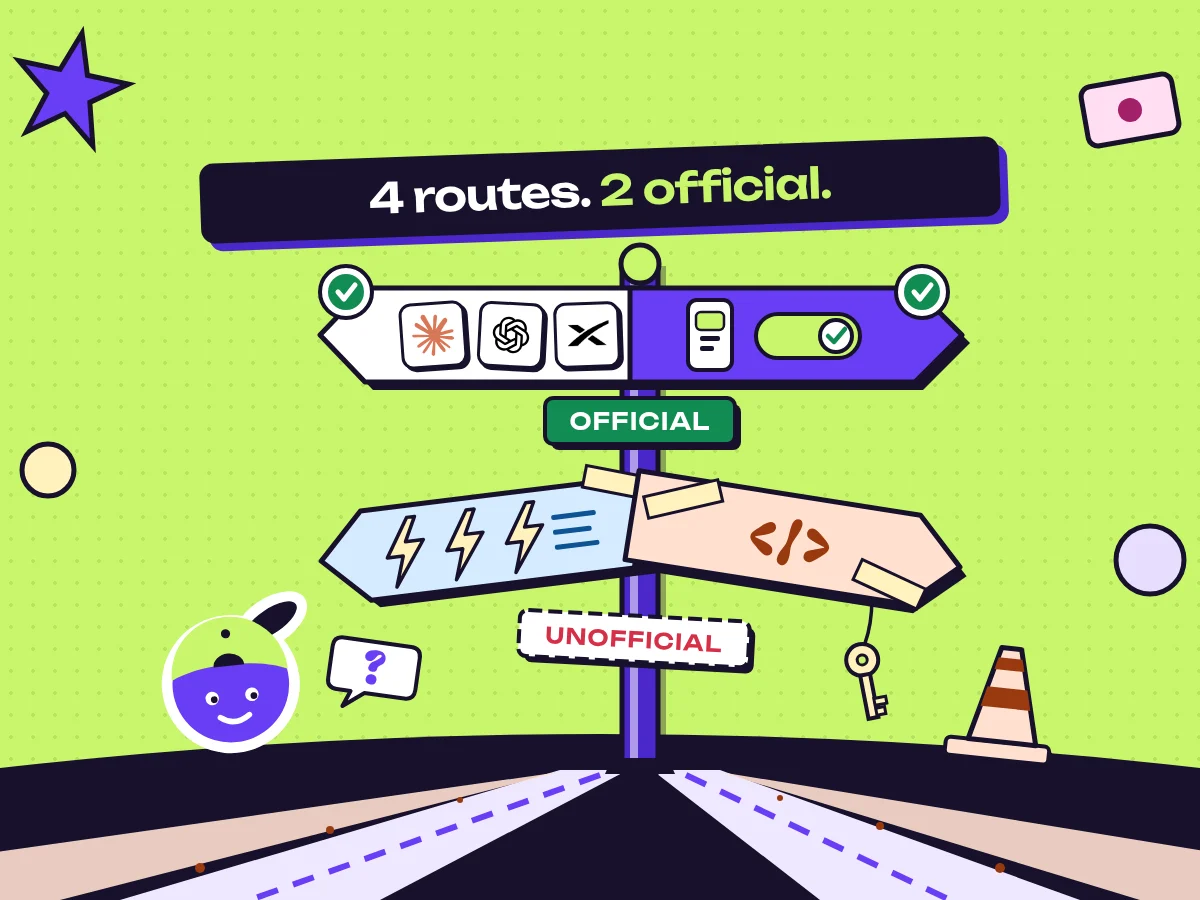
Robinhood's live official AI route is agentic trading: your own AI client over MCP, launched in May 2026. Robinhood Agents, the in-app agent announced in September, is official but still rolling out, and crypto traders also have the non-AI Crypto Trading API. Unofficial scripts and bridges such as TradersPost sit outside all three. Here is what is live, who each route suits and where the risk sits.
 Stanislav VovchykNov 1, 202612 min readUpdated Nov 4, 2026
On this page · 10 sections
- 1. The four routes side by side
- 2. Route 1: your own AI client over MCP (live now)
- 3. Route 2: Robinhood Agents inside the app (announced, rolling out)
- 4. Route 3: an open-source script that logs in as you
- 5. Route 4: a signal bridge such as TradersPost
- 6. Account rules that limit an agent trading several times a day
- 7. Robinhood Chain bots are a different product
- 8. Can an AI bot make $100 a day on Robinhood?
- 9. Safety checklist before the first order
- 10. FAQ
In short
- The official AI trading bot live on Robinhood today is agentic trading, launched in May 2026, which lets Claude or ChatGPT place stock orders over MCP in a separate funded account.
- Robinhood Agents, the in-app agent announced on 29 September 2026, is official but still rolling out to eligible US customers with no general-availability date as of November 2026.
- Open-source scripts like siropkin log in with your credentials and can get your account flagged, while bridges like TradersPost are unofficial and keep firing bad rules until you notice.
- No AI bot reliably makes $100 a day, which would mean 10% a day on $1,000, so fund only what you can lose and keep per-trade approval on.
AI Trading Bot for Robinhood: What's Official and What's Live
Updated November 2026.
The official AI trading bot that is live on Robinhood now is agentic trading, launched in May 2026 (Firstpost America, 28 May). It lets an outside AI client such as Claude or ChatGPT place stock orders over MCP in a separate account you fund. Robinhood Agents, an in-app agent announced at HOOD Summit on 29 September 2026, is official too but still rolling out. Crypto traders also have Robinhood's Crypto Trading API, a non-AI route. Unofficial options include open-source scripts that log in as you and bridges such as TradersPost that turn chart alerts into orders. For a first try, use MCP and keep per-trade approval on.
The four routes side by side
| Route | Official? | Live today? | Cost | Skill needed | Guardrail outside the model | Main risk |
|---|---|---|---|---|---|---|
| Your own agent over MCP | Yes | Launched May 2026 (Firstpost America, 28 May); stocks only; trades in a separate AI trading account | Your AI client's plan (Claude Pro or ChatGPT Plus, $20/mo) | Medium | Separate account, spending limits, manual approvals (Firstpost America) | A longer chain to supervise |
| Robinhood Agents (in-app) | Yes | Announced 29 Sept 2026; rolling out to eligible US customers (CoinDesk); no general-availability date as of November 2026 | Reported for the new agentic accounts (Yahoo), applicability to Agents unconfirmed: Robinhood bills model usage; OpenAI's Luna free for the rest of 2026. Add-ons such as Unusual Whales' Options Trader announced | Low | Reported for the new agentic accounts (Yahoo), applicability to Agents unconfirmed: separate agentic account; approvals on by default | Switching approvals off |
| Open-source script (siropkin) | No | Yes, if you run it | Free code plus OpenAI usage | High | None beyond what you code | Handing over your login |
| Third-party bridge (TradersPost) | No | Yes | TradersPost plan plus a signal tool (TradingView from free) | Medium | Rules you write | A bad rule firing repeatedly |
Robinhood has one more official route, and it involves no AI: the Crypto Trading API. TradingBotExperts lists it next to agentic trading as an official path and calls it a conventional integration for crypto traders. It suits a crypto bot you write yourself, not an AI agent trading stocks.
This guide relies on Yahoo Finance, CoinDesk and WSJ reporting from HOOD Summit, the Firstpost America segment, guides from TradingBotExperts and aistocktradingbots, tutorials by Andrew Black and Miles Deutscher, the script's GitHub page, and our catalogue prices re-read in November 2026. None of it reflects our own use of these routes.
Route 1: your own AI client over MCP (live now)
Agentic trading is the connection itself, running on Robinhood's own MCP servers. MCP is the open standard that lets an AI client take actions inside another app, and our MCP explainer covers what can go wrong with that kind of link. Andrew Black's YouTube tutorial describes it as a beta that handles stocks only for now, with options, crypto and futures to follow. Firstpost America adds prediction markets to that list.
Who can use it today? The Firstpost America segment said customers could already create separate AI trading accounts, limited to stock trading, with spending limits and manual approvals built in. The new agentic accounts Yahoo described in late September, rolling out at random over several weeks, were announced together with the in-app agent. The reporting doesn't say whether those are the accounts May's MCP users opened or a wider rollout of something new. If your app doesn't show an AI trading account, ask Robinhood which one you'd be getting before you plan around either route.
Creator Miles Deutscher's guide on X shows the connection for Claude Code, Claude Desktop and ChatGPT Desktop. In Claude Code you add the Robinhood server, then authenticate through the /mcp menu. In Claude Desktop you add a custom connector, and in ChatGPT Desktop you turn on Developer Mode and add the server under MCPs. He says Codex, Cursor and Grok work too. These are the clients he names, with our listings: Claude, ChatGPT, OpenAI Codex, Cursor and Grok.
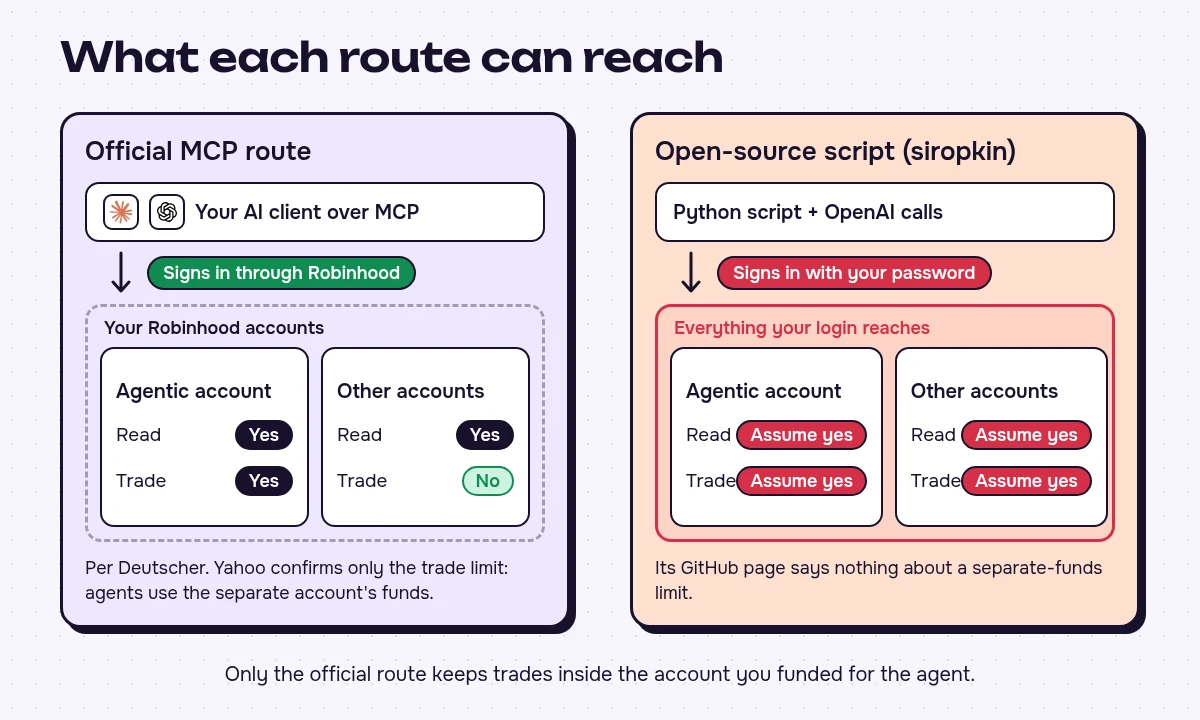
On permissions, Deutscher writes that your agent can read across all your Robinhood accounts but can place trades only in the agentic one. Yahoo confirms only the second half: agents use the separate account's funds. Assume the agent can see your other holdings.
Black's tutorial shows the kind of work involved: ask for your portfolio and what is overweight, pull research on a ticker, and stage a $100 S&P 500 ETF buy with an instruction to review it without placing it.
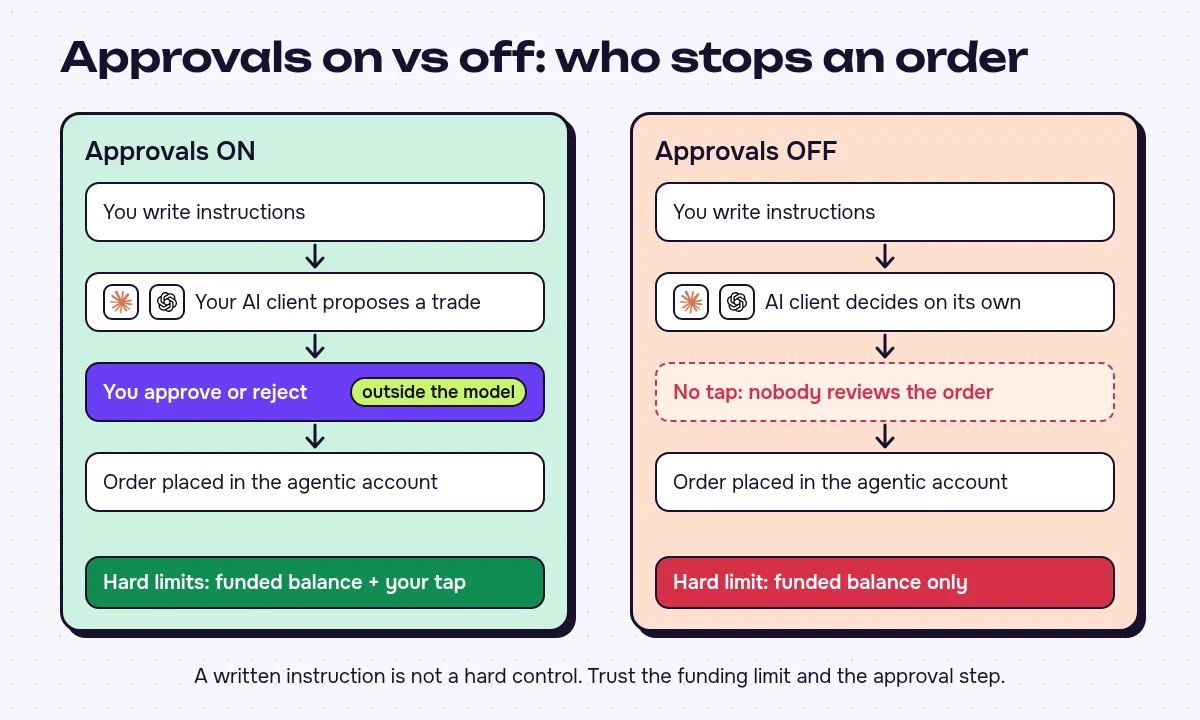
Is this agent trading or just autopilot? While approvals are on, the agent proposes trades and waits for your tap, so it works as a reviewer you can overrule. Once approvals are off, it acts on its own reading of your instructions, and a written instruction is not a hard control. The funding limit and the approval step sit outside the model, so trust those most.
No independent comparison shows which model trades best, so the best AI for agentic trading is the one you already pay for and know. Claude Pro is $20 a month ($17 billed yearly) and ChatGPT Plus is $20. SuperGrok costs $30, with no evidence that it trades better. Our Grok review covers whether its top plan earns the price.
MCP suits you if you already work in an AI client and want it to read other data before it proposes a trade. It asks more of you, because a fault could sit in the model, your client or the connection.
Route 2: Robinhood Agents inside the app (announced, rolling out)
CoinDesk reported that Robinhood announced Agents on Tuesday 29 September at HOOD Summit in Houston. The agent is built into the app and can research markets, build strategies and place trades within limits you set, and it is still rolling out to eligible US customers. WSJ described it as able to answer market questions, build a strategy from scratch and "eventually" place trades while you sleep.
Yahoo Finance reported the terms of the new agentic accounts announced the same week; its report doesn't say whether the in-app agent runs under them. Under those terms, trade-by-trade approval is on by default, though you can switch it off and let the agent trade on its own. Agents can use only funds you move into the separate agentic account. Anthropic and OpenAI models come first, and Robinhood bills model usage through its platform, with OpenAI's Luna free for the rest of 2026. None of our sources gives per-model rates or a Luna price after 2026, so read the rate in the app before you pick a paid model. Houston attendees got access straight away; everyone else gets it at random over the following weeks.
Reported add-ons for the in-app agent include Options Trader from Unusual Whales. Like the agent, it can't be switched on until Agents reaches your account.
CoinDesk's 30 September report said Loops, which turns a strategy into a standing instruction the agent runs day and night, was "coming soon". We have seen no announcement that it is live, so headlines about bots trading around the clock are ahead of the product.
Setup: once the app offers you an agentic account, fund it, keep approvals on and write a strategy file (see the checklist below). Pass on it if you want a model other than the Anthropic and OpenAI ones Robinhood offers. If you don't pay for an AI client yet, this is the simpler start once it reaches you.
Route 3: an open-source script that logs in as you
siropkin/robinhood-ai-trading-bot is a Python script that Robinhood does not endorse. According to its GitHub page, it logs into OpenAI and Robinhood, pulls the stocks in your portfolio and watchlist, and scores them on RSI, VWAP, 50-day and 200-day moving averages and Robinhood analyst ratings. It then asks OpenAI for buy, sell or hold calls, executes them automatically depending on the mode you select, and repeats the cycle as the market moves. The author calls it an experiment to see whether AI can outperform human traders, "or at least me".
The code is free, but you pay for the OpenAI calls. Because the loop keeps running, the bill grows with the number of tickers and how often it cycles. Trim the watchlist and set a monthly spend limit in your OpenAI account before the first run.
The security difference is in the first step. On the official MCP route you authenticate through Robinhood, and trading is confined to the agentic account. The script logs in with your own credentials. Nothing on its page says it respects a separate-funds limit, so assume it can reach whatever your login reaches. Crypto bot users face the same credential question with exchange API keys, covered in our 3Commas alternatives guide.
Is it against Robinhood's terms? Robinhood does not sanction it. Aistocktradingbots notes that Robinhood does not publish or support the unofficial libraries scripts like this depend on, and that they can break without notice. TradingBotExperts adds that reverse-engineered access of this kind could break or get an account flagged without warning. In practice, running it puts your account at risk, and when the script breaks mid-loop, nobody at Robinhood will fix it.
Setup outline: clone the repository, add your OpenAI key and Robinhood login, choose the mode, and start with a trimmed watchlist. Avoid this route if you can't read Python and secure the machine it runs on.
Route 4: a signal bridge such as TradersPost
TradersPost takes alerts from TradingView or TrendSpider and turns them into orders in your Robinhood account. It is an independent company, and Robinhood does not endorse it. TradingBotExperts describes bridge platforms like it as filling the gap for TradingView-based strategies today. Execution here follows rules; AI comes in only if a model generates your signal.
The sources this guide draws on, checked in November 2026, give neither its plan prices nor how it authenticates to Robinhood. Get both in writing before you pay:
- Whether it connects through an authorisation step Robinhood controls or asks for your username and password. Walk away if it wants your password.
- Which of your accounts it can trade in, and how you revoke its access.
- What happens to an alert when its link to Robinhood fails: whether the order is dropped, queued or retried, and whether you are told.
For the signal side, TradingView starts with a free Basic plan. TrendSpider starts at $51.30 a month (a sale price; regular range $56.05, $84.55/mo) with a free trial. Of the 15 tools in our investing and stock research category, 9 have a free plan, and the median cheapest paid plan is $30.50 a month. A bridge plus a paid signal tool adds up quickly against a small account.
A bridge behaves more predictably than a model deciding afresh each time. When a rule is wrong, though, it keeps firing wrong orders until you notice. Skip it if you don't already have a rule set you've tested.
Account rules that limit an agent trading several times a day
An agent that trades often runs into account rules before it runs into its own logic, and none of the routes above lifts them.
- Margin accounts: FINRA's pattern day trader rule caps same-day round trips in smaller margin accounts. Before you let an agent run, ask Robinhood support for the equity threshold and day-trade count that apply to your account today, write them down with the date, and put a lower daily day-trade maximum in the agent's strategy file. An agent with approvals off can hit the cap far faster than you would.
- Cash accounts: sale proceeds must settle before you can spend them again. Tom Grek ran into this with his own Robinhood bot in 2019 and kept adding cash because money from sales wasn't available until the trades went through. An agent that sells and rebuys in one session will stall or leave you short.
- Order types: Firstpost America describes agents buying a stock at a target price, and Deutscher's exit rules use a stop level, a profit target or a time limit. Say in the strategy file which order types the agent may use, and whether it may place market orders at all.
Robinhood Chain bots are a different product
Robinhood Chain is an on-chain network, not your brokerage account. GoPlus Security, a blockchain security firm, published a risk report on X describing how Robinhood Wallet handles perpetual futures: a two-layer model with the trading experience in the app and settlement on Lighter, a ZK rollup built on Robinhood Chain. A bot there works with wallets and smart contracts. The separate funded account and per-trade approval belong to the brokerage product, so don't assume they carry over to on-chain bots. Exchange-focused tools are listed in our crypto trading bots category.
Can an AI bot make $100 a day on Robinhood?
Nobody has shown that any AI bot does this reliably, so there is no "most successful" bot to name. OpenClaw Direct, which sells an agent runtime, calls most "best AI trading bot" lists "affiliate fiction with unverifiable returns." StockHero's pricing page advertises a 95% win rate for September 2026. That is the vendor's own claim, and a win rate says nothing about profit once losses are counted.
The anecdotes are thin too. Grek's Medium experiment ran for one week in January 2019, trading on an AI he built and connecting through the robin_stocks Python library, the same kind of login-based access the script route relies on. He recorded a loss of nearly $50 in a single day.
$1,000 gives no reliable income. Making $100 a day from it would mean 10% a day, so treat any promise like that as a sales pitch.
Safety checklist before the first order
CoinDesk reported that Robinhood's own disclosures make clear the customer carries the risk. A model can misread what you asked or act on stale information, and autonomous mode or the script's automatic mode removes the person who would have stopped a runaway loop. Never paste your Robinhood password into a chat window or a tool you don't know.
- Fund the agentic account with an amount you could lose without changing any other financial plan. That balance is your hard limit.
- Keep per-trade approval on, and set the length of the trial before you start.
- Write the strategy in a file, as Deutscher suggests: allowed tickers, maximum position size, maximum orders and day trades per day, allowed order types, an exit rule, and what the agent must never touch, including options and crypto.
- Limit it to a few tickers you already understand, and tell the agent not to trade until you confirm the connection works.
- Learn how to pause or disconnect the agent before its first order.
- Log every proposal, including the ones you reject, with the agent's reason. Reject any order you can't explain.
- Track model charges and fees next to profit and loss, and compare the result with holding a broad index fund over the same period.
- Decide in advance which result makes you stop, and don't scale up after one good week.
If you want passive long-term investing, a recurring index-fund buy does that job without a model. Hold off on all four routes if losing the funded amount would hurt, or if you know you'd switch approvals off on day one. This is general information, not financial advice.
FAQ
What is the difference between agentic trading and Robinhood Agents? Agentic trading connects an AI client you choose, such as Claude or ChatGPT, to a separate Robinhood account over MCP. Robinhood Agents is the agent built into the app, using models Robinhood offers.
When will Robinhood Agents launch? It was announced on 29 September 2026 and is reaching eligible US customers in stages. Robinhood had given no date for full availability as of November 2026.
Can I connect ChatGPT or Claude to Robinhood? Yes, through agentic trading over MCP, which Robinhood opened in May 2026, once your app gives you an AI trading account. Deutscher's guide covers the steps for both.
Is there a free AI trading bot for Robinhood? The siropkin script's code is free, but its OpenAI calls are not. Yahoo reported that OpenAI's Luna model carries no charge for the rest of 2026 on the new agentic accounts.
Tools in this article 5




Written by
Stanislav Vovchyk
Founder and editor of infobro.ai
I run infobro.ai: I decide what it covers and how tools are evaluated.
I research every tool from its documentation, pricing pages, product screenshots and public developer discussion, and say plainly what the evidence does and does not show.
More guides

Guide
What Is MCP? How ChatGPT and Claude Connect to Your Apps, and What Can Go Wrong
Nov 3, 2026 · 10 min read