Grok Review: When Grok 4.7 Is Worth $30 a Month
Grok 4.7's live X and web data justify the $30 plan for news-driven work. Everyone else should start on the free tier or compare Claude and ChatGPT.
Grok 4.7's live X and web data justify the $30 plan for news-driven work. Everyone else should start on the free tier or compare Claude and ChatGPT.
Quick facts
- Current model
- Grok 4.7 (October 2026)
- Free plan
- Yes, within usage limits
- Paid plan
- SuperGrok, $30/mo as of October 2026
- API
- Usage-based, billed per token and separately from subscriptions
- SDK examples
- Python, TypeScript, OpenAI SDK, cURL
- Organization plans
- Business and Enterprise tiers
- Enterprise controls
- SSO, audit logging and data residency options through sales
Key features
Live data grounding
Answers draw on real-time X posts, news and web search.
Unified developer API
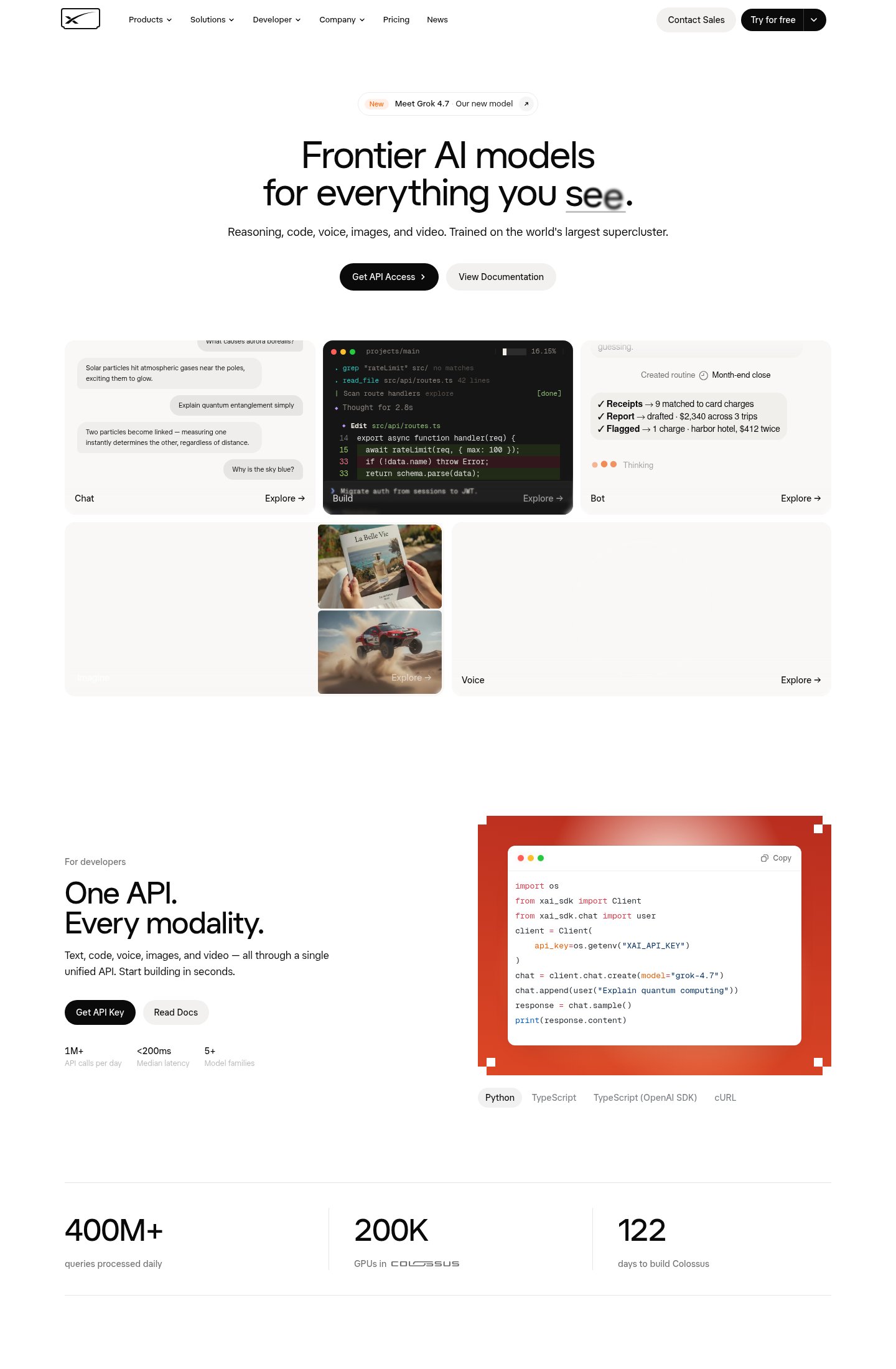
One API covers text, code, voice, images and video.
Grok Build
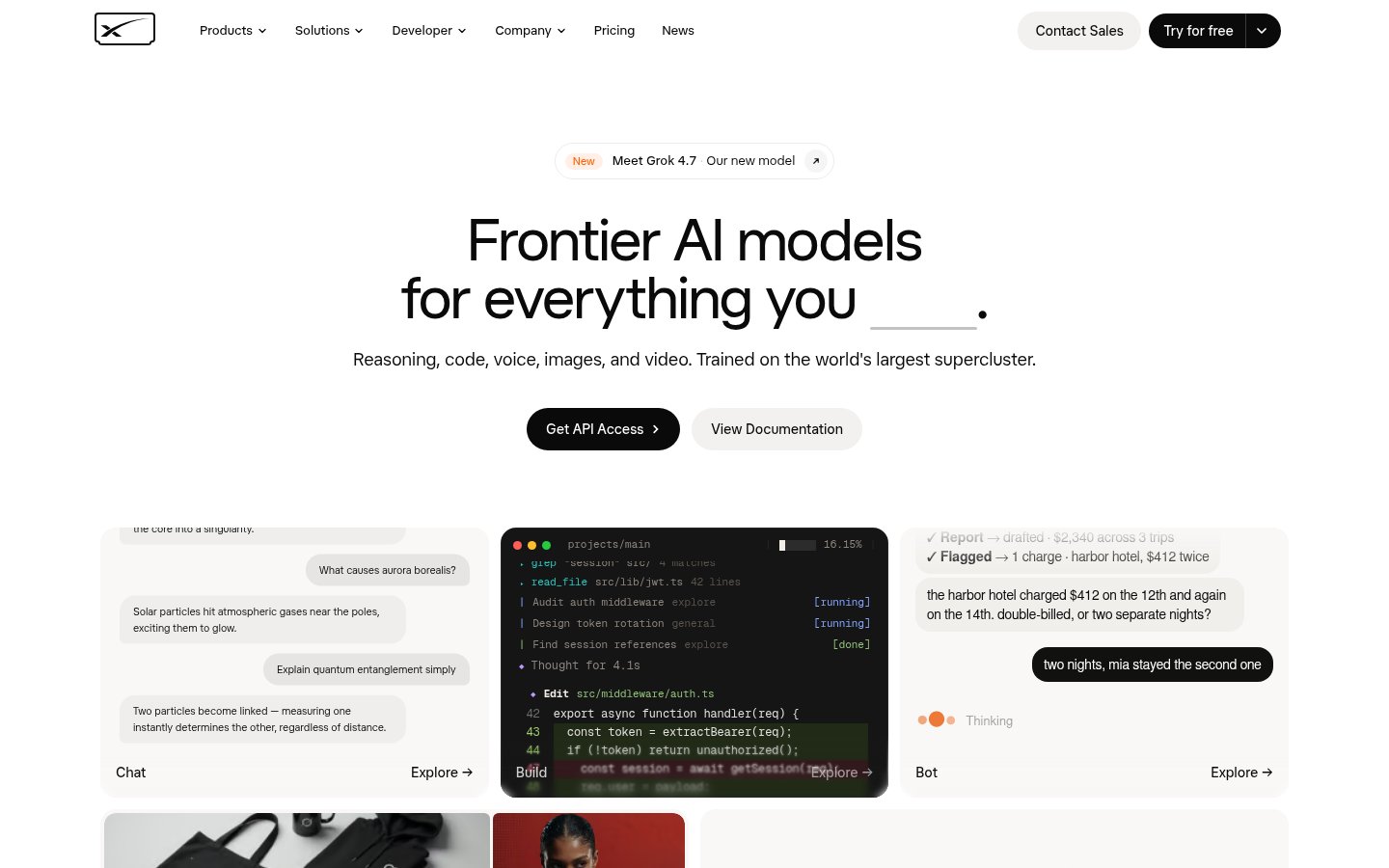
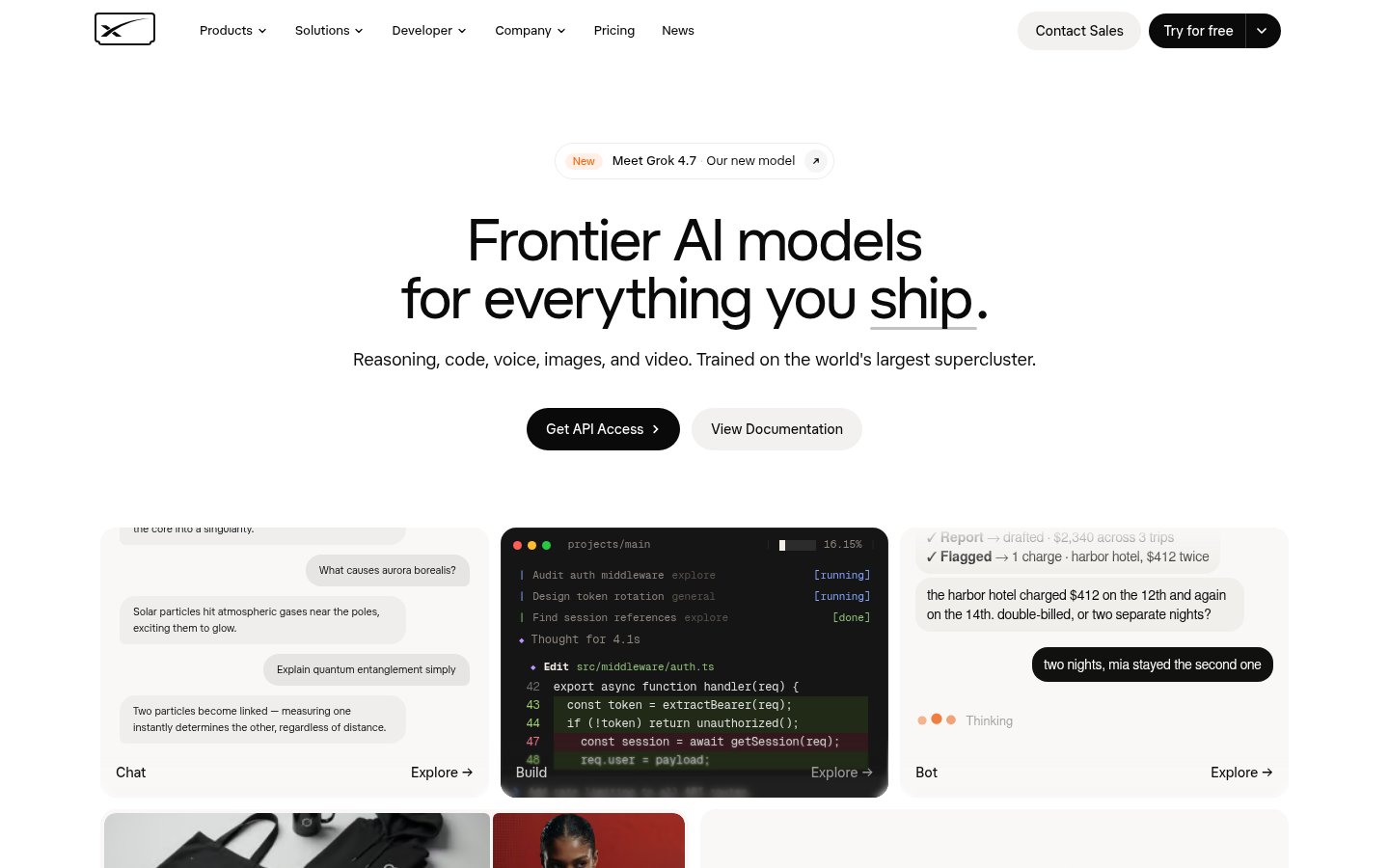
A coding agent that reads files, greps code, runs subagents and makes edits.
Grok Bot
A workplace agent xAI pitches for sales work and incident response.
Grok Voice 3.0
xAI's voice release, announced October 14, 2026.
Grok Imagine
xAI's product line for generated media.
Sales-led controls
Custom rate limits, monthly invoicing, SSO, audit logging and data residency options.
Pros
- Real-time access to X posts and the web gives it a clear edge over assistants working from a fixed cutoff.
- A free tier lets you check whether live data helps before paying.
- A single API spans text, code, voice, images and video.
- Code examples include an OpenAI SDK route, which should ease switching for existing OpenAI client users.
- Business and Enterprise options add SSO, audit logging and data residency options.
Cons
- Plan descriptions give no exact usage caps, and users report restrictive limits and weak continuity across chats.
- API usage is billed separately, so a $30 subscription won't offset token costs.
- A public August 2026 glitch produced gibberish replies on Grok Lite.
- xAI's homepage doesn't explain conversation training or opt-out, so buyers must check the privacy terms themselves.
- It drafts but won't hold brand templates, schedule posts or publish content.
See Grok for yourself
Free to start, no credit card needed for the trial.
Screenshots
Ready to try Grok?
Skip the screenshots and explore it live.
Verdict. This Grok review covers Grok 4.7, with sources checked on October 31, 2026.
Pay for it if live X and news data would change your answers several times a week: news monitoring, market sentiment, brand tracking.
Pick ChatGPT or Claude if you want a general assistant, your main work is coding or long-form writing, or you need dependable long-term memory.
Skip it for now if you handle confidential or regulated data and haven't reviewed xAI's training terms and sales-led controls.
Sourcing. We haven't used Grok or signed up for it. Everything below comes from xAI's public pages and the dated third-party sources named inline.
Value for money: plans and prices by tier
The text we captured from xAI's site covers API and sales options but no consumer plan prices. Consumer figures below therefore come from dated third-party sources, so confirm yours at checkout.
Aibuzz says xAI restructured its pricing on October 12, 2026, and calls the $30 plan "Premium". SuperGrok was the name attached to $30 in Jeemtools' June review, and we couldn't confirm that the two are the same plan. Reviews from earlier in the year, such as Shiori's in July, quoted $30-40, so older figures may not match what you see today.
At $30, you pay $360 a year. That's fair if live data feeds your work and a poor deal for general chat, since AIComparison puts the standard paid tiers of ChatGPT and Claude at about $15 to $20 a month.
Teams hit the math quickly. Five individual subscriptions cost $150 a month, and SSO and audit logging appear only on xAI's sales-led path, so ask for a quote before adding seats. Developers should budget separately because API usage is billed by consumption. If you already pay for X Premium, find out what Grok access it includes before upgrading. Everyone else can start free and see whether live data helps.
How it works in practice
The version you get depends on the client. xAI shipped Grok 4.7 on September 21, 2026, with a 500,000-token context window, according to Tech Insider. It reached the API, Cursor and Grok Build first, then rolled out to consumer apps through October, and some consumer surfaces were still on Grok 4.6 when Tech Insider published. Check which model you're on before judging the output. Reviews of Grok 4.1, including Shiori's, describe an older model.
You can reach it four ways: at grok.com, in the iOS and Android apps, inside X, or through the API. xAI also sells several products under the Grok name, including Chat, Build, Bot, Imagine and Voice, and a verdict on one doesn't transfer to the others.
Core features, and what we could confirm:
- Live search: answers draw on X posts, news and the web.
- Images and video: Grok Imagine handles both. Image 2.0 arrived as a "Quality Mode" on web and mobile on August 7, 2026, per Tech Insider.
- Voice: xAI announced Grok Voice 3.0 on October 14, 2026.
- Coding: xAI's Build demo shows an agent migrating auth from sessions to JWT. It's a marketing demo, so it proves nothing about success rates on your codebase.
- DeepSearch and Think modes: these come up in coverage of Grok, but the xAI pages we captured don't document them, so we can't say which tier unlocks them on 4.7.
- File handling: we found no published chat upload limits. Shiori rated long documents a "maybe", citing unclear context limits on Grok 4.1.
Developers get a simple path. xAI's sample code reads a key from XAI_API_KEY, opens a chat with model="grok-4.7" and samples a response. Its examples include TypeScript through the OpenAI SDK, which should lower the switching effort for teams already on that library.
What stands out
Live grounding is the reason to choose Grok. Kompozy's August 2026 review calls real-time grounding in X and the open web a genuine edge over rivals working from a fixed cutoff, and AIComparison names real-time X access as the one everyday task where ChatGPT and Claude don't match or beat it. It pays off for journalists, traders and PR teams tracking a story as it breaks. The edge shrinks when your sources are papers or filings, and our guide to Perplexity AI alternatives for research matches tools to those source types.
The API price is low against Claude's flagship. Grok 4.7's $2 in and $6 out compares with $5 and $25 per million tokens for Claude Opus 4.8, as ToolChase reported in June 2026. AIToolsRecap doesn't state the unit for Grok; we read it as per million tokens. It also describes 4.7's benchmark spread as worth reading closely, so test your own workload as well as the price.
One API covers text, code, voice, images and video. A team building a voice product with generated visuals can keep those workloads under one vendor and one SDK. Treat the headline numbers carefully. xAI advertises under 200ms median latency on its homepage without saying which model or measurement it means, so a chat completion and a video job can't both be assumed to fit that figure. Anyone putting voice on a phone line should measure full round-trip delay first, for the reasons covered in what to expect from an AI voice agent on a business line.
Where it falls short
Usage limits and memory (reported by users). The most common complaints on forums and review sites are restrictive usage limits and poor continuity across conversations. These are user reports, not measurements. The limits complaint is hard to check because we found no published cap for any consumer tier, so look up the current allowance in your own account before building a daily routine on it. For memory, compare before you switch: Fabric, a competitor, describes ChatGPT's own memory as limited notes on otherwise stateless conversations.
Cost. Shiori called $30-40 a month a hard sell for one model, and that criticism holds at $30 if you also want GPT-5 or Claude.
Reliability. In August 2026, some users got gibberish replies on Grok Lite, which xAI called a rare, temporary glitch, according to Kompozy. That wouldn't decide a consumer purchase, but anything piping Grok output straight to customers needs its own validation step.
Coding evidence is thin. Shiori, a multi-model chat vendor with a commercial reason to send you elsewhere, placed Grok 4.1 behind Claude for coding in July 2026. Its 4.22% hallucination rate and #1 LMArena ranking also describe 4.1, and we found no comparable test against 4.7. Run one of your own bugs through both before paying.
Scope. Kompozy notes that Grok drafts, reasons and codes, but it won't hold a brand template, schedule posts or publish anything. Content teams will still need their existing tools.
Grok Bot: a separate purchase
Grok Bot is a workplace agent, while the chatbot is an assistant you question directly. Vellum, which sells a competing assistant, describes it as handling delegated work through a cloud computer and named Bots. xAI's own posts pitch it for incident detection and response (October 20, 2026) and as a "sales teammate" (October 27, 2026).
Three things separate it from the chatbot:
- Price: a figure of roughly $200 circulates in third-party coverage, while Fabric listed $300 a month in September 2026. The xAI text we captured shows no Bot price. That works out to $2,400 or $3,600 a year, so get the price and inclusions in writing.
- Model: Tech Insider reports that Bot now runs on Claude Opus 5.5 instead of xAI's own model. If that holds, our Grok 4.7 verdict doesn't carry over to it.
- Buying test: compare the cost with the staff hours the agent would replace.
It isn't worth paying for without a sales, incident or similar recurring workflow to hand over. For lighter consumer tasks such as booking and scheduling, Fabric lists Meta Muse at $20 to $100 a month, though it was US-only at launch.
Trust, privacy and training data
Accuracy. Grok's strongest claim is fresh information, but fresh doesn't mean verified, and Jingrey reports occasional hallucinations on niche topics. Check anything important against the original source.
Bias and moderation. Reviews describe Grok's style as unfiltered, which suits some users and is a liability for customer-facing or regulated work. In July 2025, Simon Willison documented Grok running the X search "from:Elonmusk (Israel or Palestine or Hamas or Gaza)". That predates 4.7, but it's a fair prompt to test contested topics yourself. The BBC has also reported that X's offices were raided in France as the UK opened a fresh investigation into Grok.
Training and opt-out. Aibuzz describes consumer data controls as opt-out by default, and Fabric cites X data being used for training by default. So assume your data may be used unless you change the setting. xAI's homepage doesn't explain this, and our sources don't give current opt-out steps, so read the privacy terms and check your account's data settings before pasting in anything confidential.
Enterprise and regulated use. Aibuzz names active GDPR investigations, governance questions from the SpaceX acquisition and no enterprise data processing agreement for EU organizations. It's one source, so ask xAI's sales team to confirm each point. Compliance teams can't rely on the self-serve route, since SSO, audit logging and data residency options sit on the sales-led path.
Grok vs ChatGPT and Claude
Grok isn't better than ChatGPT overall, but it is better for live X data. For writing and coding, the evidence favors Claude: Jingrey rates Grok weaker at creative writing, and Oreate describes Claude 4.8 Opus as a top choice for nuanced writing and long-context reasoning. On coding benchmarks, Oreate has GPT-5.6 Sol ahead on SWE-Bench Pro as of Q3 2026. None of these sources tests Grok 4.7 head to head, so treat this as a direction.
Who should pick it, who should skip it
Use this rule:
- Your work depends on what people are saying right now: choose Grok, starting free and moving to the $30 plan when you regularly hit the limits.
- You want one general assistant: choose ChatGPT.
- You mostly write long documents or work through large amounts of context: choose Claude.
- You need sourced research rather than social signal: AIComparison picks Perplexity.
- You want text, voice, image and video under one SDK: try the Grok API, particularly if you already use OpenAI's client library.
- You handle client or regulated data, or need reliable long-term memory: don't choose Grok until you've reviewed xAI's training terms and sales-led controls, and tested continuity yourself.
Setup notes
Pin the model string in API code, as xAI's sample does with grok-4.7, so a later release doesn't change behavior without a deliberate decision. Self-serve accounts get "automatically increasing" rate limits, with no thresholds on the homepage. If a launch could bring a sudden traffic spike, talk to xAI's sales team about custom limits beforehand.
Verdict
Pay $30 for SuperGrok if your work depends on what's happening on X and the web today, because live grounding is the clearest reason to choose Grok 4.7. If it wouldn't change your answers, start with ChatGPT or Claude instead. Keep client or regulated data out until you've read xAI's training terms and priced its sales-led controls.
Try GrokAlternatives
- Claude
Try it first if coding is your main use, and compare it with Grok 4.7 on your own code.
- ChatGPT
A sensible first trial if live X data wouldn't change your answers.
- Perplexity
Pick it for cited web research rather than tracking what's being said on X.
- Gemini
Consider it for a free tier with real-time Google search.
Frequently Asked Questions
Tools & Services Mentioned
How we made this review
- We went through Grok's public website, pricing page and documentation, last checked on October 31, 2026, plus public user discussion where we found it.
- The 3 screenshots above were captured from the live site by our own tooling.
- We did not buy a paid plan for this review. Anything about day-to-day use comes from the vendor or from users, and the text says so where it matters.
- The draft was written with AI assistance under our editorial rules.

Founder and editor of infobro.ai
We research every tool from its documentation, pricing pages, product screenshots and public developer discussion, and say plainly what the evidence does and does not show. Drafts are written with AI assistance under our editorial rules, and we revisit articles to reflect platform changes. Learn more about our process.