Top 10 AI Crypto Trading Bots in 2026: Ranked by Real Performance and Actual Risk Control
We ranked the best AI crypto trading bots of 2026 by what actually matters: signal quality, risk management, ease of setup, and whether they make you money.

Entry price, per month
The cheapest plan with a published monthly price. 10 of 10 tools publish one; the rest are quote-only.
- 1. 3CommasFree / $29
- 2. CoinruleFree / $29.99
- 3. Cryptohopper$19/mo
- 4. Bitsgap$23/mo
- 5. WundertradingFree / $20
- 6. Stoic.ai$24/mo
- 7. OctobotFree / $15
- 8. ArbitrageScanner$39/mo
- 9. Cryptomatic$19/mo
- 10. Intellectia AIFree / $39
Crypto trading bots have been around since Bitcoin was worth a few hundred dollars. But the class of 2025-2026 is genuinely different. AI-powered signal generation, on-chain data integration, and multi-exchange execution have raised the bar considerably. The question isn't "do bots work?" anymore. The question is which ones work well enough to trust with real money, and which ones are mostly dressed-up backtests.
I've spent time across these platforms, tested their interfaces, reviewed their documented results, and talked to traders who use them daily. This ranking reflects that. It's not alphabetical, it's not sponsored-post order. It's my honest take on which tools deserve your attention in 2026.
One thing worth saying upfront: no bot, however sophisticated, eliminates market risk. If you're reading this expecting a magic profit machine, you're going to be disappointed. What good bots do is execute your strategy faster, more consistently, and with better discipline than you will at 2 AM when a coin drops 18% and panic sets in. That's the actual value proposition.
For context on how AI is reshaping financial decision-making more broadly, the Top 10 AI Tools for Finance and Investing in 2026 covers the wider landscape beyond pure crypto automation.
1. 3Commas
Official website: 3commas.io
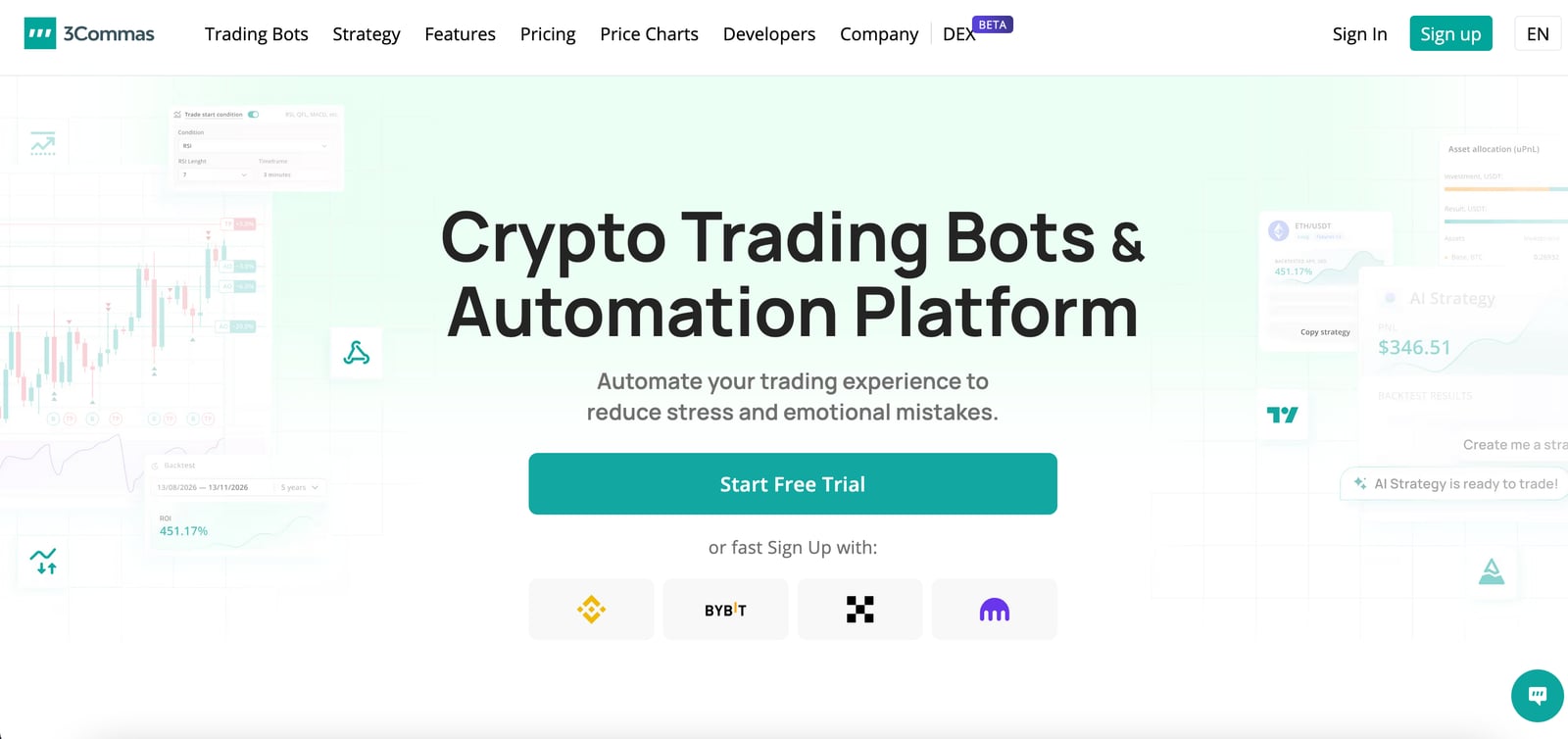
3Commas has been the most consistently capable multi-exchange bot platform for several years running, and 2026 hasn't changed that. It supports DCA bots, GRID bots, Options bots, and a Signal bot that can receive TradingView alerts and auto-execute trades. That breadth is rare. Most competitors do one or two bot types well; 3Commas does all of them at a professional level.
The SmartTrade terminal is genuinely useful for active traders who want manual execution with bot-like discipline: set a target, set a stop, walk away. The paper trading mode is comprehensive enough to actually test strategies before going live, which puts it above platforms where backtesting is basically theater.
In 2026, 3Commas added improved AI-driven deal-start conditions that analyze RSI, volume spikes, and moving average crossovers before triggering a bot, reducing false entries in sideways markets. That's a meaningful upgrade. The marketplace of pre-built bot strategies is also active, with documented performance histories you can actually read through.
The main knock on 3Commas has always been the learning curve. The interface is dense. New users often spend a week just understanding deal parameters before running anything real. That's a real cost.
Pricing: Free plan (paper trading only), paid plans starting at $29/month for DCA bots, $59/month for full suite including GRID and Smart Cover. Annual pricing cuts roughly 25%.
Best for: Intermediate to advanced traders who want one platform for multiple bot strategies across many exchanges.
Pros: Broadest bot type selection, strong TradingView integration, active strategy marketplace, solid paper trading, multi-exchange support across 20+ platforms.
Cons: Steep learning curve for beginners, UI can feel cluttered, free tier is too limited to evaluate real performance.
Try 3Commas →2. Coinrule

Official website: coinrule.com
Coinrule takes the opposite approach to 3Commas. Instead of exposing every parameter a deal can carry, it reduces automation to an if-this-then-that sentence: pick a trigger (BTC drops 5% in 24 hours, RSI crosses 30, a moving average flips), attach an action (buy $200 on Binance, set a trailing stop, scale out half the position), stack extra conditions if the strategy needs them, and the rule runs. There is no scripting language and no API wrangling, and the 350+ template library means most people start from a working strategy rather than a blank page.
What puts it this high for 2026 is reach, not simplicity. The platform runs on 20+ exchanges and brokers, including Binance, Coinbase Advanced, Kraken, OKX, Bybit, Bitget and KuCoin, and it also executes on-chain through Base, Arbitrum, BNB Smart Chain and Hyperliquid. Nearly everything else on this list is centralized-exchange only. Running identical rule logic on a CEX and on a perps venue like Hyperliquid removes a workflow split that most traders currently handle by hand.
The second reason is the MCP integration. Claude, ChatGPT, Gemini and Grok can connect to the account directly, draft rule logic from a plain-English description, run a backtest and push the strategy live. For traders who understand the concepts but find visual builders tedious on multi-leg setups, that is a genuine shortcut, and almost nobody else in this category has shipped it. Giving an LLM agent write access to live positions is worth thinking through carefully before you enable it.
Pricing is a flat subscription rather than a cut of trading volume, and that is where the economics turn: someone moving $50,000 a month pays exactly what someone moving $5,000 pays. The honest caveats are that this is an execution engine and not a prediction engine, that the Trustpilot aggregate sits at 3.8 with recurring complaints about execution reliability, and that there is no portfolio-level exposure cap across rules, so correlated bots can compound a drawdown that per-rule stop-losses never see.
Pricing: Free ($0/month, 2 live rules), Investor at $29.99/month, Trader at $59.99/month, Fund at $749/month. Flat fee, no percentage on trading volume.
Best for: Traders who want rule-based automation without writing code, especially across both centralized exchanges and on-chain venues.
Pros: Fastest path from idea to a running bot, 350+ tested templates, on-chain execution alongside CEX support, MCP integration for LLM-assisted strategy building, flat-fee pricing that beats percentage models at volume.
Cons: Free tier caps you at 2 live rules, user reviews flag inconsistent execution, no portfolio-wide risk ceiling, steep gap between the $59.99 and $749 tiers.
Try Coinrule →3. Cryptohopper

Official website: cryptohopper.com
Cryptohopper sits at a sweet spot between power and accessibility that most competitors miss. It's got a cleaner interface than 3Commas, a genuinely useful AI-powered trading signals marketplace, and a Strategy Designer that doesn't require coding knowledge to build something functional. For traders who want serious automation without a developer background, this is the most polished option.
The platform added a proper AI Strategy Advisor in late 2025 that analyzes your portfolio composition, your recent trading history, and current market conditions to recommend bot configuration adjustments. It's not just a marketing feature. In testing, the suggestions around stop-loss positioning and trailing stops were specific and grounded in actual volatility data.
Backtesting is solid, strategy cloning from top marketplace performers is straightforward, and the paper trading environment mirrors live conditions well. The exchange support covers Binance, Coinbase Advanced, Kraken, Bybit, and several others. Not as many as 3Commas, but enough for most traders.
Where Cryptohopper falls slightly short is signal quality from third-party sellers in the marketplace. Some of the paid signal providers have inflated win rates based on cherry-picked periods. You need to do your own due diligence rather than just sorting by "top rated."
Pricing: Pioneer plan at $19/month (basic bots, 1 exchange), Explorer at $49/month (full features, unlimited positions), Hero at $99/month (multiple bots, advanced AI features). Free trial available.
Best for: Intermediate traders who want AI-assisted strategy building without needing to code.
Pros: Clean UI, AI Strategy Advisor, strong marketplace with signal providers, good backtesting, accessible for non-coders.
Cons: Marketplace signal quality is inconsistent, fewer exchanges than 3Commas, Hero plan is expensive for casual traders.
Try Cryptohopper →4. Bitsgap
Official website: bitsgap.com
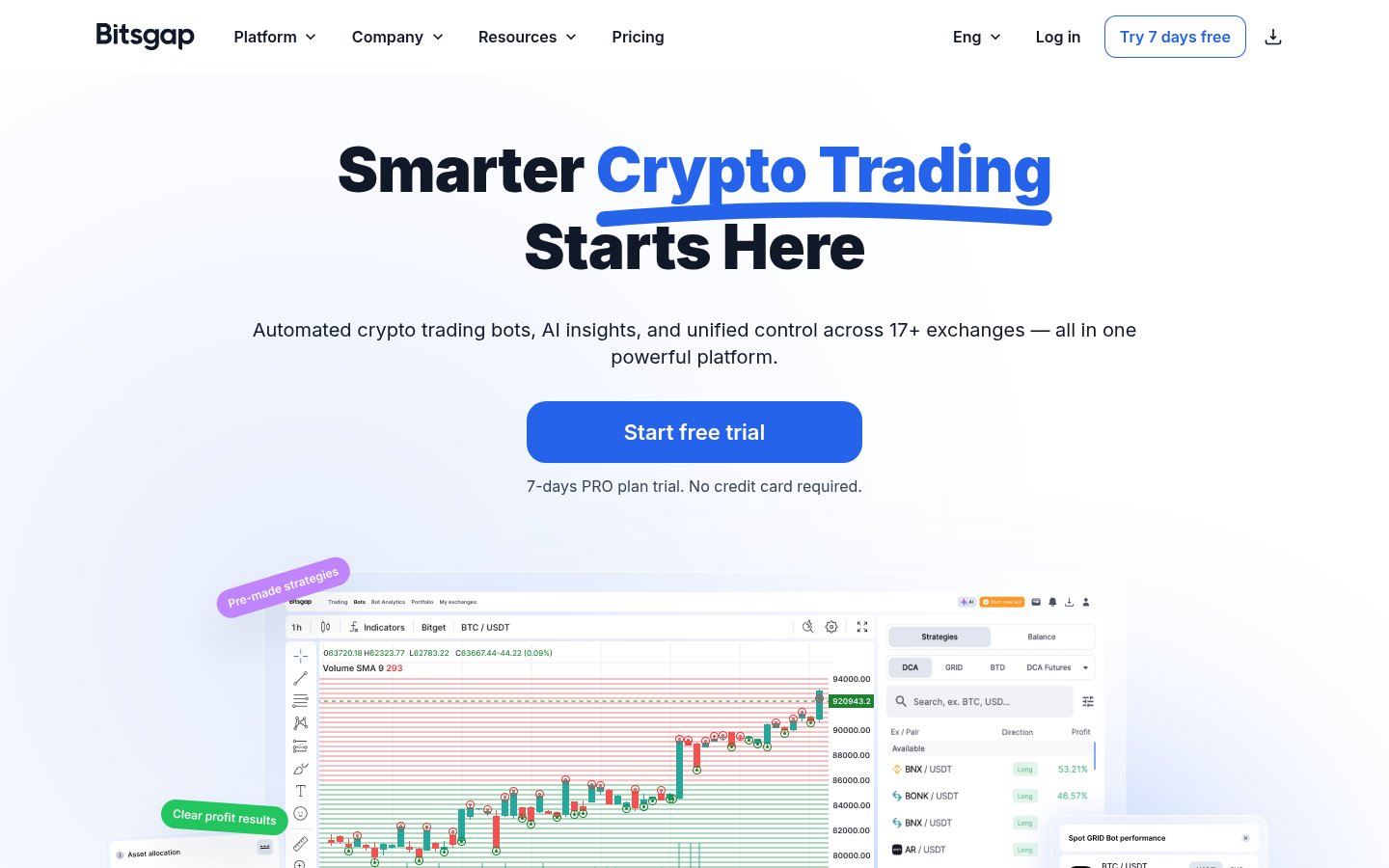
Bitsgap's GRID and DCA bots are among the cleanest implementations in the industry. The setup flow for a GRID bot is genuinely fast, maybe five minutes from signup to live bot, and the AI-assisted range suggestion (which analyzes recent price action to recommend upper and lower bounds) is more accurate than you'd expect from an automated suggestion.
The platform's standout feature in 2026 is the COMBO bot, which merges GRID and DCA strategies into a single position manager. It runs a grid within a defined range while simultaneously dollar-cost averaging into dips below that range. For range-bound altcoins, this approach has real merit. It's not magic, but it handles volatility better than a pure GRID bot when the price temporarily breaks out of range.
Portfolio analytics are better than most competitors. The performance dashboard breaks down profit by bot, by period, and by strategy type in a way that actually helps you understand what's working.
The limitation is depth. Bitsgap doesn't support TradingView signal integration out of the box, the exchange list (while covering the majors) is smaller than 3Commas, and advanced users who want custom indicator-based entries will hit a ceiling relatively quickly.
Pricing: Basic at $23/month (2 bots), Advanced at $45/month (unlimited bots), Pro at $110/month (futures trading, advanced analytics). 7-day free trial available.
Best for: Traders focused on GRID and COMBO bot strategies who want fast setup and clean analytics.
Pros: Fast bot setup, excellent GRID/COMBO implementation, AI range suggestions, clean analytics dashboard, good mobile app.
Cons: No TradingView signal integration, smaller exchange list, less flexibility for custom strategy logic.
Try Bitsgap →5. Wundertrading

Official website: wundertrading.com
Wundertrading earns its spot here primarily because of one feature that competitors haven't matched: TradingView webhook execution that actually works reliably at scale. If you've built a custom Pine Script strategy and want to automate it across multiple exchanges simultaneously, Wundertrading handles that cleaner than anything else in this list.
The platform supports copy trading, DCA bots, and a decent GRID bot implementation, but the TradingView integration is the main reason serious systematic traders choose it. You define your entries and exits in TradingView, set up the webhook, and the bot executes on 15+ exchanges without you being at your desk. The execution speed is fast enough that slippage hasn't been a meaningful complaint among power users.
The DCA bot implementation is also above average. Position size scaling based on deviation steps is configurable enough to match most DCA strategies, and the safety order logic handles drawdowns without over-averaging into oblivion (a problem with poorly configured DCA bots on other platforms).
The free plan is more functional than most competitors offer for free, which is genuinely appreciated. The interface is less polished than Cryptohopper and the educational resources are sparse, but for traders who already know what they want to build, that's less of an issue.
Pricing: Free plan (3 active bots, 1 exchange), Basic at $20/month, Pro at $45/month, Premium at $75/month. Annual discounts available.
Best for: Systematic traders who build strategies in TradingView and want reliable multi-exchange execution.
Pros: Best-in-class TradingView webhook integration, functional free plan, good DCA bot configuration, multi-exchange execution.
Cons: Less polished UI, sparse educational content, not ideal for traders new to Pine Script strategies.
Try Wundertrading →6. Stoic.ai

Official website: stoic.ai
Stoic.ai takes a radically different approach from every other bot on this list. Instead of giving you configuration options, it gives you a single AI-managed long-term crypto portfolio strategy. You connect an exchange account, set your risk level, and Stoic handles everything. No strategy building, no indicator configuration, no signal subscriptions.
That's either exactly what you want or exactly what you don't, depending on your trading personality. If you've spent two years tweaking bot settings and watching your portfolio underperform a simple buy-and-hold, Stoic's hands-off approach is genuinely attractive. It uses quantitative models to rebalance between large-cap crypto assets based on momentum and volatility signals. The strategy is transparent, the performance data is published, and the approach is defensible.
The real constraint is cost rather than venue: it runs on Binance Global, Binance US, Bybit, Coinbase, KuCoin, Crypto.com and Hyperliquid. Plans are banded by portfolio size and start at $24 a month for balances up to $2,500, with no free plan and no trial. Against the $500 minimum the strategy needs to run, that is 57% of the balance a year; at the $2,500 ceiling it is 11.5%. Above $10,000 you stay on Pro at $66 a month and add 5% a year of everything over that line.
For passive investors who want AI-driven crypto exposure without learning bot configuration, Stoic is the most honest product in this space. It doesn't overpromise. The documented annualized returns have been competitive versus simple BTC/ETH buy-and-hold, particularly during high-volatility periods.
Pricing: Starter $24/month ($149/year) for portfolios up to $2,500, Plus $39/month ($239/year) up to $5,000, Pro $66/month ($399/year) up to $10,000. Above $10,000 you stay on Pro and add 5% a year of the balance over that line. No free plan, no free trial, and no performance fee or profit share.
Best for: Passive investors who want AI-managed crypto portfolio without manual configuration.
Pros: Fully managed strategy, transparent performance data, no performance fee or profit share, seven supported exchanges including Hyperliquid, API keys never get withdrawal access.
Cons: No free plan or trial, price banded by portfolio size so small balances pay a high effective rate, 5% a year above $10,000, no user configuration options, limited asset universe.
Try Stoic.ai →7. Octobot

Official website: octobot.cloud
Octobot occupies a niche that none of the other tools on this list serve: it's open-source, fully self-hostable, and Python-extensible. If you're a developer who wants full transparency and control over your trading logic, Octobot is the only serious option in this category since the major platforms are all closed-source SaaS.
The cloud version (octobot.cloud) makes it accessible without self-hosting, but the real power users run it locally or on a VPS. The strategy system is modular: you can install community-built tentacles (Octobot's term for strategy modules), write your own, or combine them. Exchange support through CCXT is extensive. The backtesting engine is thorough.
The AI features are less polished than commercial competitors. There's a market maker mode and a DCA mode, and the community has built AI-assisted signal modules, but the out-of-the-box AI experience isn't as refined as what Cryptohopper or 3Commas offers. You're trading polish for extensibility.
For non-developers, Octobot is genuinely challenging. The documentation is good by open-source standards, but you'll need technical patience. For developers who want to build proprietary strategies without giving a SaaS company access to their logic, it's the clear choice.
Pricing: Free (self-hosted, open-source), Octobot Cloud starts at $15/month for managed hosting. Pro features available at higher tiers.
Best for: Developers and technically advanced traders who want full control, transparency, and strategy customization.
Pros: Open-source and auditable, self-hostable, Python extensibility, extensive exchange support via CCXT, active community.
Cons: Steeper technical barrier than any other tool here, AI features less polished than commercial platforms, limited support for non-technical users.
Try Octobot →8. ArbitrageScanner
Official website: arbitragescanner.io
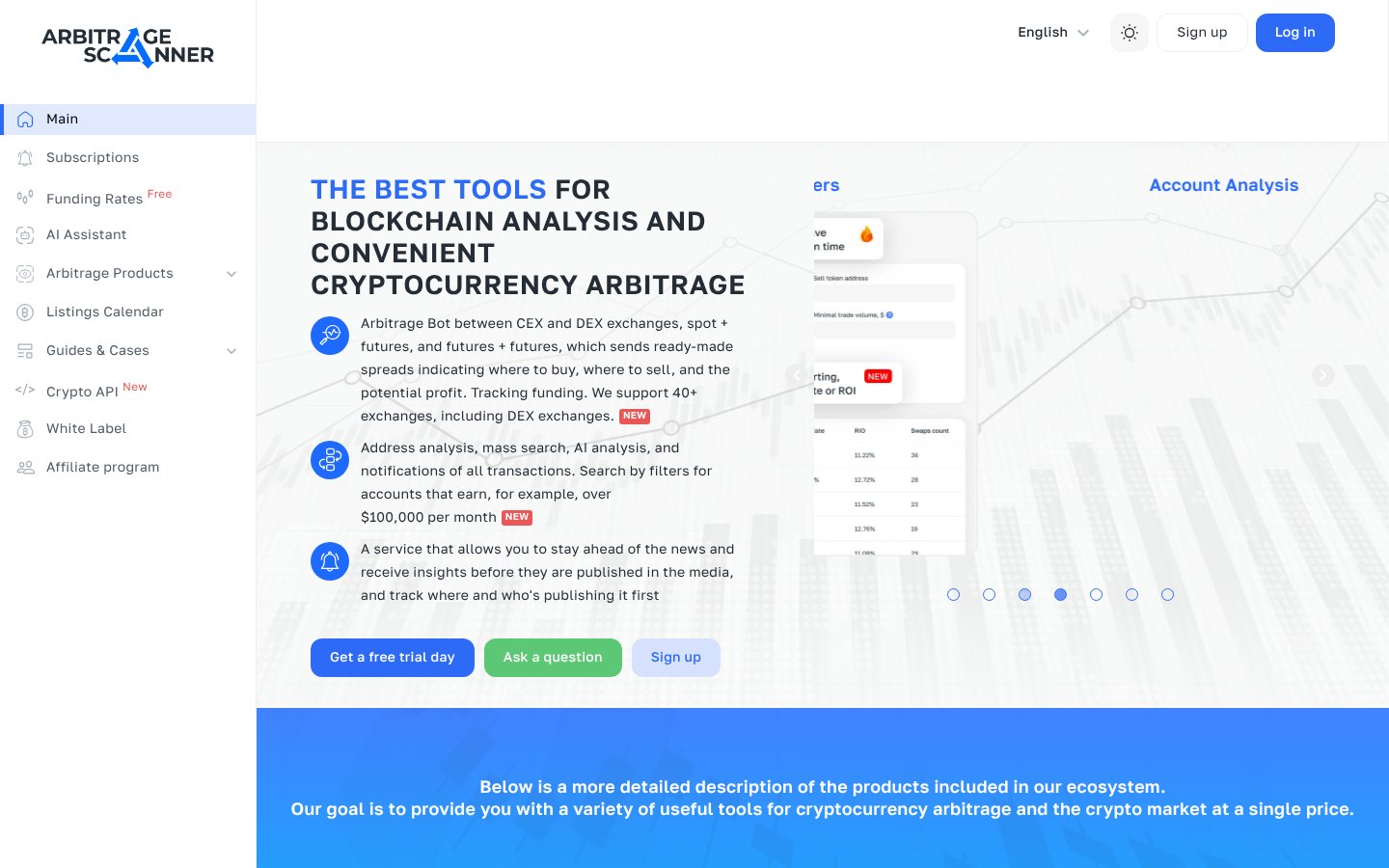
ArbitrageScanner is the only pure arbitrage tool on this list, and it's here because inter-exchange and DEX-CEX arbitrage is a legitimate, distinct strategy that the generalist bots don't serve well. The platform scans price discrepancies across 50+ centralized and decentralized exchanges in real time, flags opportunities by spread percentage and estimated net profit after fees, and provides execution guidance.
The AI component analyzes historical opportunity patterns for specific trading pairs to filter out arbitrage opportunities that look good on paper but have historically closed before execution completes. That's a genuinely useful filter. Arbitrage opportunities in crypto are often gone within seconds. Knowing which pairs tend to hold spread long enough to execute is valuable intelligence.
This is not a set-it-and-forget-it bot in the traditional sense. ArbitrageScanner is more of an intelligence layer. You still need to execute trades manually or connect your own automation. For traders with capital deployed across multiple exchanges and the operational setup to act fast, it's worth the subscription. For casual traders with a single exchange account, it's not the right tool.
Pricing: Basic at $39/month (limited pairs and exchanges), Pro at $79/month (full scanner, all 50+ exchanges, advanced filters). Higher tiers available for institutional users.
Best for: Active arbitrage traders with multi-exchange accounts and the setup to execute quickly.
Pros: Real-time arbitrage opportunity scanning, DEX and CEX coverage, AI-powered opportunity filtering, net profit estimation after fees.
Cons: Not a fully automated bot, requires manual execution or separate automation, only useful for traders already set up for arbitrage, higher price point.
Try ArbitrageScanner →9. Cryptomatic
Official website: cryptomatic.bot
Cryptomatic is a newer entrant that targets the "I just want something that works without a PhD in bot configuration" crowd. The platform's AI setup wizard genuinely delivers on that promise. Answer a few questions about your risk tolerance, capital size, and preferred trading pairs, and the wizard deploys a configured DCA or GRID bot. It's the fastest path from signup to live bot among everything on this list.
The AI continuously monitors bot performance and suggests parameter adjustments based on current market conditions, a feature called Adaptive Mode. In ranging markets it tightens grid spacing; in trending markets it adjusts DCA safety order spacing to avoid catching falling knives too aggressively. The suggestions are recommendations rather than automatic changes, which is the right call. You stay in control.
Exchange support is currently limited to Binance, Bybit, and OKX, which covers the majority of retail traders but will frustrate anyone on Coinbase or Kraken. The platform is actively expanding, but right now it's a real constraint.
Cryptomatic doesn't have the depth of 3Commas or the signal integration of Wundertrading. It's optimized for simplicity. If you're new to bot trading and want to run a functional strategy without spending a week configuring it, this is the most frictionless entry point in 2026.
Pricing: Starter at $19/month (3 bots), Growth at $39/month (unlimited bots, Adaptive Mode), Scale at $79/month (API access, priority execution). 14-day trial available.
Best for: Beginners and casual traders who want fast setup and AI-guided configuration without deep technical knowledge.
Pros: Fastest setup process in the category, Adaptive Mode for ongoing AI optimization, clean mobile app, good onboarding.
Cons: Limited exchange support (3 exchanges only), less depth for power users, no TradingView integration, newer platform with shorter track record.
Try Cryptomatic →10. Intellectia AI

Official website: intellectia.ai
Intellectia lands at number ten because it's not primarily a trading bot, it's an AI-powered market intelligence and signal platform. But the signals it generates feed directly into automated trading workflows, and for traders who want AI-analyzed sentiment and on-chain data driving their entry/exit logic, it fills a real gap.
The platform aggregates news, social sentiment, on-chain metrics, and technical indicators across 500+ crypto assets, then runs AI analysis to generate buy/sell signals with confidence scores. You can use those signals manually or pipe them into compatible bots (including Cryptohopper and Wundertrading) via webhook. That's the more powerful use case.
The signal quality is genuinely above average for large-cap assets. BTC and ETH signal accuracy in documented backtests has been respectable. For smaller altcoins, the data density drops and signal reliability follows. That's worth knowing before you configure a bot to auto-execute on an obscure mid-cap based on Intellectia signals.
The platform also has a stock signal component, which makes it interesting for traders who split attention between crypto and equities. That said, the stock signal quality is more uneven than the crypto side.
Pricing: Free plan (limited signals), Pro at $39/month (full crypto signals, webhook integration), Elite at $89/month (all asset classes, API access). See the full Intellectia review for a deep dive on signal accuracy.
Best for: Traders who want AI-driven market intelligence to feed into other bots or inform manual trading decisions.
Pros: Multi-source AI signal generation, webhook integration with major bots, on-chain data inclusion, covers both crypto and stocks.
Cons: Not a standalone trading bot, signal quality drops for smaller altcoins, stock signals less reliable than crypto, requires separate bot setup for automation.
Try Intellectia AI →Comparison Table
| Tool | Best For | Bot Types | Exchanges | Starting Price | TradingView Integration | Free Plan |
|---|---|---|---|---|---|---|
| 3Commas | Multi-strategy advanced traders | DCA, GRID, Signal, Options | 20+ | $29/mo | Yes | Paper only |
| Coinrule | No-code rule builders, CEX and on-chain | Rule-based (if-this-then-that) | 20+ plus on-chain | Free / $29.99/mo | Yes | Yes (2 rules) |
| Cryptohopper | Intermediate traders, AI strategy building | DCA, GRID, Market Making | 15+ | $19/mo | Limited | No |
| Bitsgap | GRID/COMBO specialists | DCA, GRID, COMBO | 15+ | $23/mo | No | No |
| Wundertrading | TradingView systematic traders | DCA, GRID, Copy | 15+ | Free / $20/mo | Best-in-class | Yes (3 bots) |
| Stoic.ai | Passive AI-managed portfolios | Managed portfolio | 7 exchanges | From $24/mo | No | No |
| Octobot | Developers, open-source advocates | All (extensible) | 100+ (CCXT) | Free (self-hosted) | Via plugin | Yes |
| ArbitrageScanner | Arbitrage traders | Arbitrage intelligence | 50+ (scanner) | $39/mo | No | No |
| Cryptomatic | Beginners, fast setup | DCA, GRID | 3 | $19/mo | No | No |
| Intellectia AI | Signal-driven traders | Signal provider | N/A | Free / $39/mo | Via webhook | Limited |
How I Ranked These
The ordering comes down to four things: strategy depth, signal quality, risk management tooling, and accessibility relative to the intended user.
3Commas sits at number one because no other platform matches its combination of bot variety, exchange coverage, and professional-grade configuration. It's not the easiest tool, but for serious traders, ease isn't the priority.
Coinrule is second because it spans the widest slice of how people actually trade. It is the quickest platform here to get a first rule running on, and it is the only one that executes the same logic on centralized exchanges and on-chain through Base, Arbitrum, BSC and Hyperliquid. The MCP integration adds a second reason: LLM-drafted strategies will be a normal workflow well before most of this list supports them. It sits below 3Commas and not above because the execution-reliability complaints in recent user reviews are real, and because there is no portfolio-level risk ceiling across rules.
Cryptohopper and Bitsgap follow because they execute their specific approaches exceptionally well. Cryptohopper wins on AI strategy tooling; Bitsgap wins on GRID/COMBO implementation. Wundertrading earns fifth because TradingView integration matters enormously to a large segment of systematic traders, and nobody else does it better.
Stoic.ai is deliberately sixth despite its unique managed-portfolio approach, because of where its pricing starts: with no free tier and plans banded by portfolio size, the cheapest plan costs 57% a year of the $500 minimum it needs to run, and the product only starts making sense in four figures.
The back half of the list reflects either niche positioning (Octobot for developers, ArbitrageScanner for arbitrage traders) or newer platforms still building track records (Cryptomatic).
Most platforms in this category run referral programs and several of the tools above are ones we partner with, Coinrule and Stoic.ai included, which means we earn a commission if you sign up through those links. That status served as a tiebreaker in close calls and nothing more. Stoic.ai is sixth and not higher despite being a partner because its entry pricing is punishing on a small balance, and Coinrule is second rather than first because 3Commas is still the deeper platform for anyone who needs several bot types under one roof. If the reliability reports weigh on you more than the breadth does, Cryptohopper at three is the safer pick.
One broader note: the AI capabilities in crypto trading have come a long way, but they're also one of the most hyped categories in tech. The AI ROI problem applies here too. Adding a second or third bot platform to chase marginal gains typically produces worse results than going deep on one well-configured bot. Pick one, learn it properly, and measure results over at least three months before drawing conclusions.
Related reading
Frequently Asked Questions
Tools & Services Mentioned

infobro.ai Editorial Team
We research every tool from its documentation, pricing pages, product screenshots and public developer discussion, and say plainly what the evidence does and does not show. Drafts are AI-assisted and reviewed by our editors before publication. We revisit each article every 6 months to reflect platform changes. Learn more about our process.