Top 10 AI Tools for Finance and Investing in 2026: Ranked by Real-World Edge
From crypto bots to stock signal platforms, these are the AI finance tools that actually deliver in 2026, ranked by what moves the needle.

Entry price, per month
The cheapest plan with a published monthly price. 10 of 10 tools publish one; the rest are quote-only.
- 1. 3CommasFree / $29
- 2. CryptohopperFree / $19
- 3. Bitsgap$23/mo
- 4. Intellectia AIFree / $29
- 5. TradeSanta$18/mo
- 6. WundertradingFree / $9.95
- 7. Stoic AI$24/mo
- 8. ArbitrageScanner$99/mo
- 9. OctobotFree / $14.99
- 10. Cryptomatic$29/mo
Most people using AI for finance in 2026 fall into one of two camps. The first camp dumps stock tickers into ChatGPT and calls it research. The second camp has a dozen browser tabs open with bots, signal platforms, and screeners they barely understand and never actually trust.
Neither approach works. What does work is using the right tool for the right job, which is exactly the problem I've tried to solve here. This list covers AI tools that genuinely matter for finance and investing: crypto bots with real execution logic, stock analysis platforms with defensible signal quality, and a couple of broader tools that belong in any serious investor's workflow.
I've skipped the generic "AI for finance" fluff. Every tool on this list does something specific and does it well enough to earn a place in your stack. If you're thinking about how AI tools fit together into a coherent workflow rather than a pile of subscriptions, the piece on The AI Stack Problem is worth reading before you commit to anything here.
One honest disclaimer: markets are unpredictable, AI signals are probabilistic, and no tool here guarantees returns. What they can do is give you better data, faster execution, and fewer emotional mistakes than going it alone.
1. 3Commas
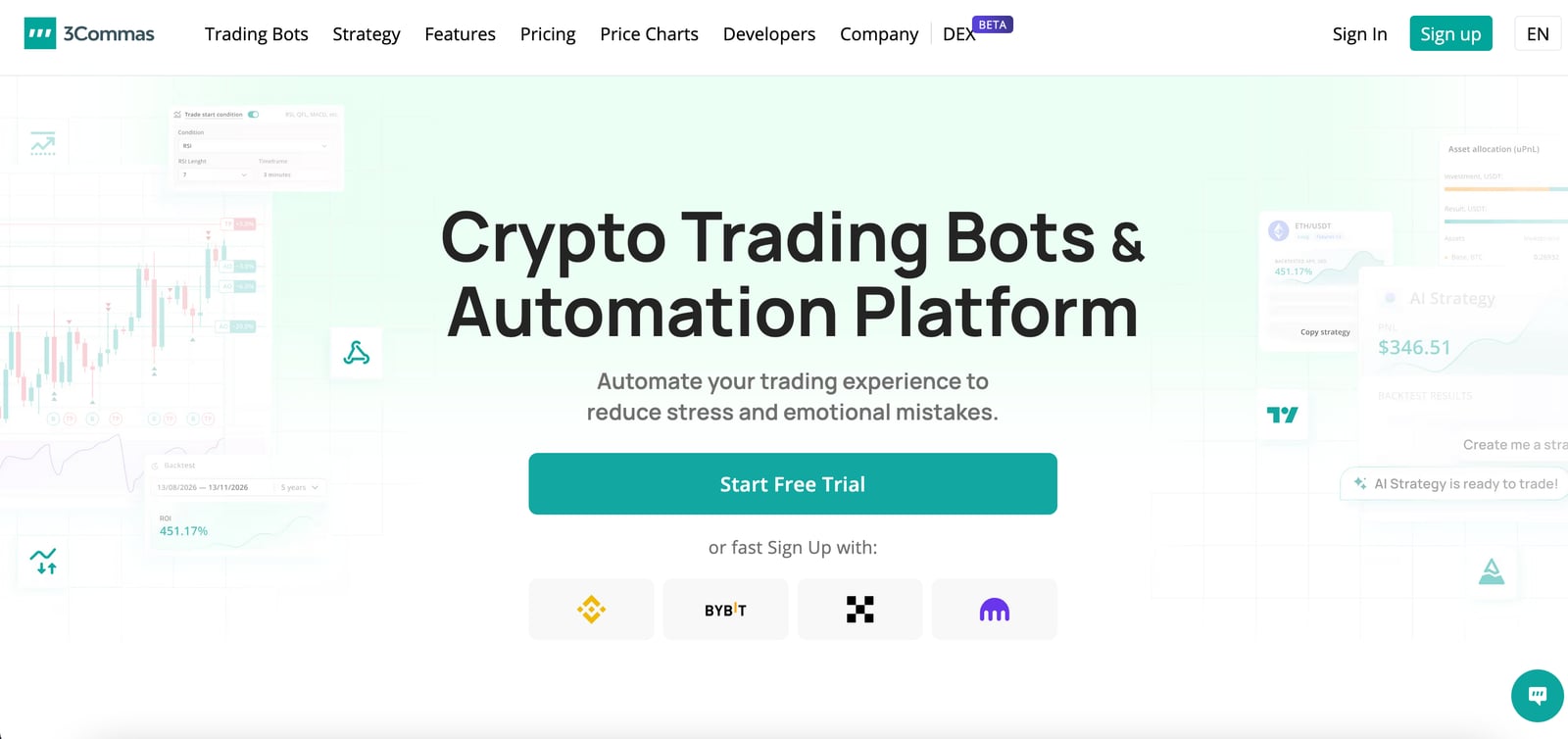
Official website: 3commas.io
3Commas is the closest thing the crypto bot space has to a category standard. It's been around since 2017 and has survived multiple market cycles, exchange collapses, and the general chaos of crypto, which itself tells you something about product-market fit.
The platform runs DCA (dollar-cost averaging) and grid bots across most major exchanges: Binance, Bybit, OKX, Coinbase Advanced, Kraken, and more. The bot logic isn't magic, it's systematic execution of strategies that would be tedious to run manually. What makes 3Commas genuinely useful in 2026 is the SmartTrade terminal, which lets you set take-profit and stop-loss on the same order, and the signals marketplace, where you can subscribe to external signal providers and automate their triggers through your own bot.
Pricing: Free plan available (very limited); paid tiers start at $29/month for the Basic plan, $49/month for Advanced, and $99/month for Pro. Annual billing cuts about 40% off. Signal subscriptions cost extra and vary by provider.
Best for: Active crypto traders who want systematic DCA or grid strategies without coding. Also strong for traders who want to test signal providers before trusting them with capital.
Pros: Huge exchange compatibility, excellent SmartTrade terminal, active community and signals marketplace, battle-tested through multiple bear markets, freemium entry point.
Cons: Free plan is too limited for real use, signal provider quality varies wildly, interface feels dated compared to newer competitors.
Try 3Commas →2. Cryptohopper
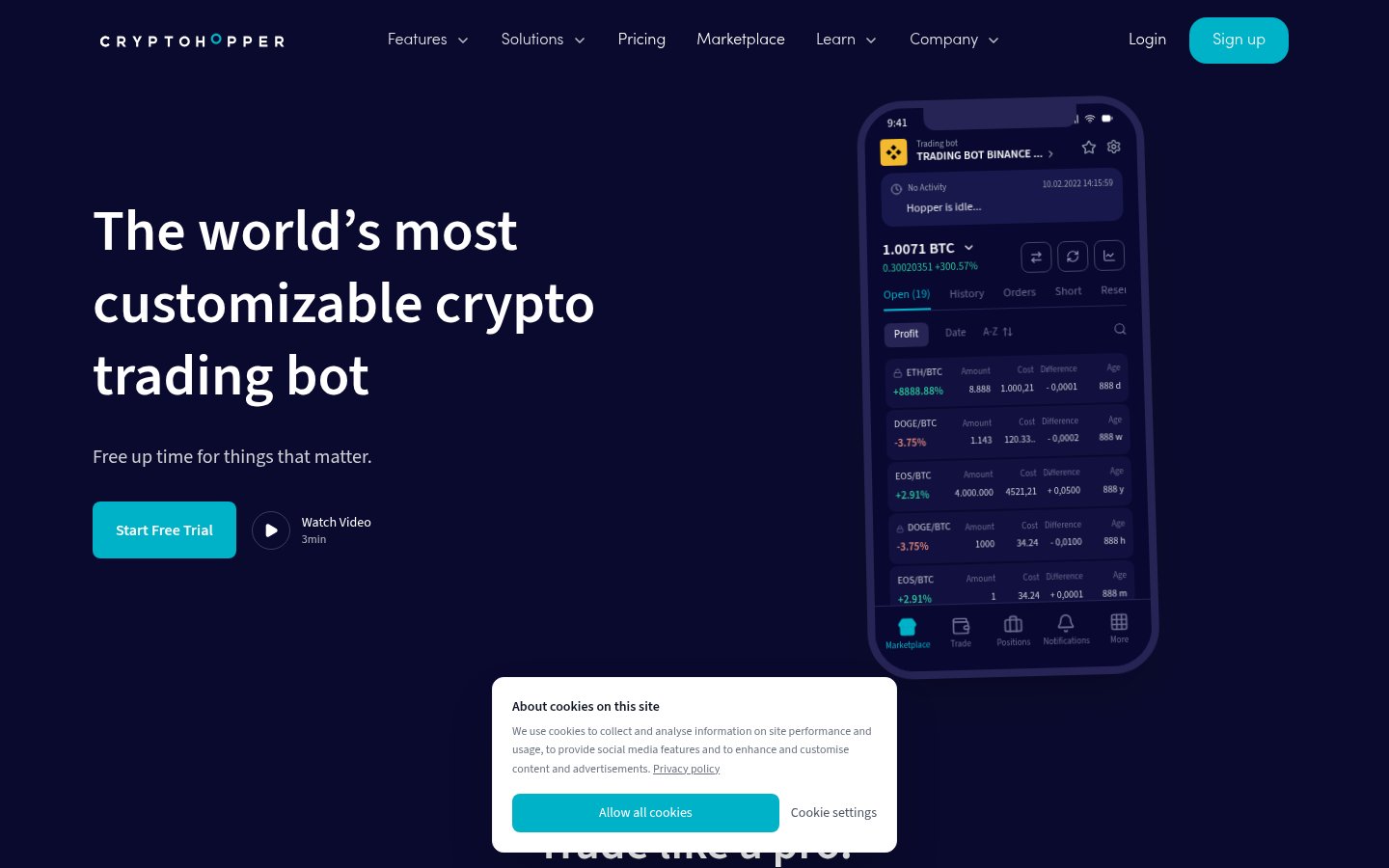
Official website: cryptohopper.com
Cryptohopper has quietly become one of the most complete crypto automation platforms available. Where 3Commas leans hard into DCA bots and signals, Cryptohopper gives you a fuller picture: strategy builder, backtesting engine, paper trading, a marketplace for buying and renting pre-built strategies, and AI-powered market scanning.
The AI Screener feature scans 75+ technical indicators simultaneously and surfaces trade setups that match your configured criteria. It's not generating alpha out of thin air, it's filtering noise so you don't have to stare at charts all day. The Strategy Designer uses a visual drag-and-drop interface, which means non-coders can actually build logic without pretending they understand Python.
The backtesting suite is particularly good. You can test strategies against historical data with realistic slippage assumptions, which is a level of rigor that many cheaper tools skip entirely. In 2026, Cryptohopper supports 100+ exchanges and has added AI-assisted strategy recommendations based on your trading history.
Pricing: Free plan (paper trading only); Explorer at $19/month, Adventurer at $49/month, Hero at $99/month. All paid plans include live trading.
Best for: Traders who want to build, test, and deploy strategies without coding, plus access to a curated marketplace of pre-built bots.
Pros: Excellent backtesting engine, visual strategy builder, large exchange support, active strategy marketplace, paper trading on free plan.
Cons: Learning curve on strategy logic is steeper than it looks, marketplace strategy quality is inconsistent, Hero plan needed for full feature access.
Try Cryptohopper →3. Bitsgap
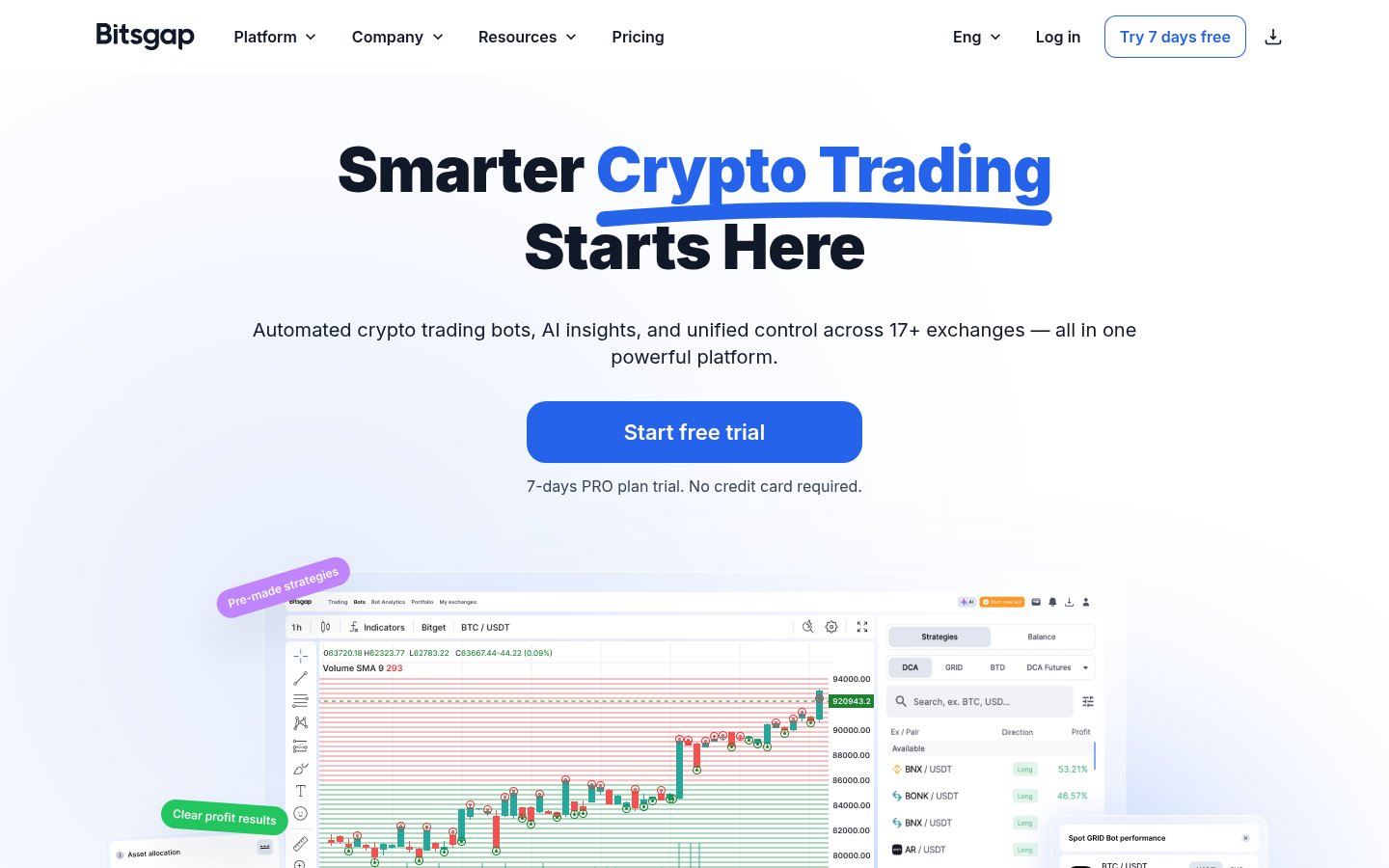
Official website: bitsgap.com
Bitsgap earns its spot here specifically because of grid bot performance. Grid trading works best in ranging, sideways markets, which crypto spends a surprising amount of time in, and Bitsgap's implementation is among the cleanest available. The GRID and COMBO bots are well-optimized, the interface is genuinely intuitive, and the smart orders feature lets you build conditional entry/exit logic without writing a single line of code.
What separates Bitsgap from competitors in 2026 is the AI-powered bot configuration assistant. When you set up a new bot, the system analyzes historical volatility and price ranges for your chosen pair and suggests optimal grid parameters. It's not infallible, but it's a much better starting point than guessing. The platform also runs a demo mode across all bot types so you can validate a strategy before committing real funds.
Bitsgap connects to 25+ exchanges via API, which is fewer than Cryptohopper but covers everything that matters: Binance, Bybit, Kraken, Huobi, OKX, and others.
Pricing: Basic at $23/month, Advanced at $65/month, Pro at $119/month. 7-day free trial available. Annual billing saves ~20%.
Best for: Traders focused on grid and combo bots in ranging markets, especially those who want AI-assisted parameter setup.
Pros: Best-in-class grid bot implementation, AI-assisted bot configuration, demo mode on all strategies, clean UX, solid exchange coverage.
Cons: Fewer exchanges than top competitors, futures trading limited to higher tiers, no signals marketplace.
Try Bitsgap →4. Intellectia AI

Official website: intellectia.ai
Intellectia is the only tool on this list aimed squarely at stock and ETF investors rather than crypto traders. It sits in a specific niche: AI-generated stock signals with fundamental and sentiment analysis layered on top, designed for retail investors who want data-driven conviction without a Bloomberg terminal subscription.
The platform aggregates earnings data, SEC filings, analyst consensus, and social sentiment to produce a composite signal score for individual equities. The AI doesn't just surface a buy/sell indicator, it shows the reasoning behind the score, which matters if you're the kind of investor who won't act on a black-box recommendation. That transparency is a genuine differentiator.
The weakness, as I noted in the Intellectia review, is selectivity: coverage is stronger on large-cap U.S. equities than on small-caps, international stocks, or REITs. If you trade mostly S&P 500 names, that's fine. If you go off the beaten path, you'll hit gaps.
Pricing: Free tier available; Pro plans start around $29/month. Premium tiers with real-time signals run higher.
Best for: Stock and ETF investors who want AI signal scoring with transparent reasoning, focused on U.S. large-cap equities.
Pros: Transparent signal reasoning, aggregates multiple data sources, usable free tier, solid earnings and sentiment analysis.
Cons: Coverage thins out on small-caps and international names, signal quality varies by sector, not useful for crypto traders.
Try Intellectia →5. TradeSanta
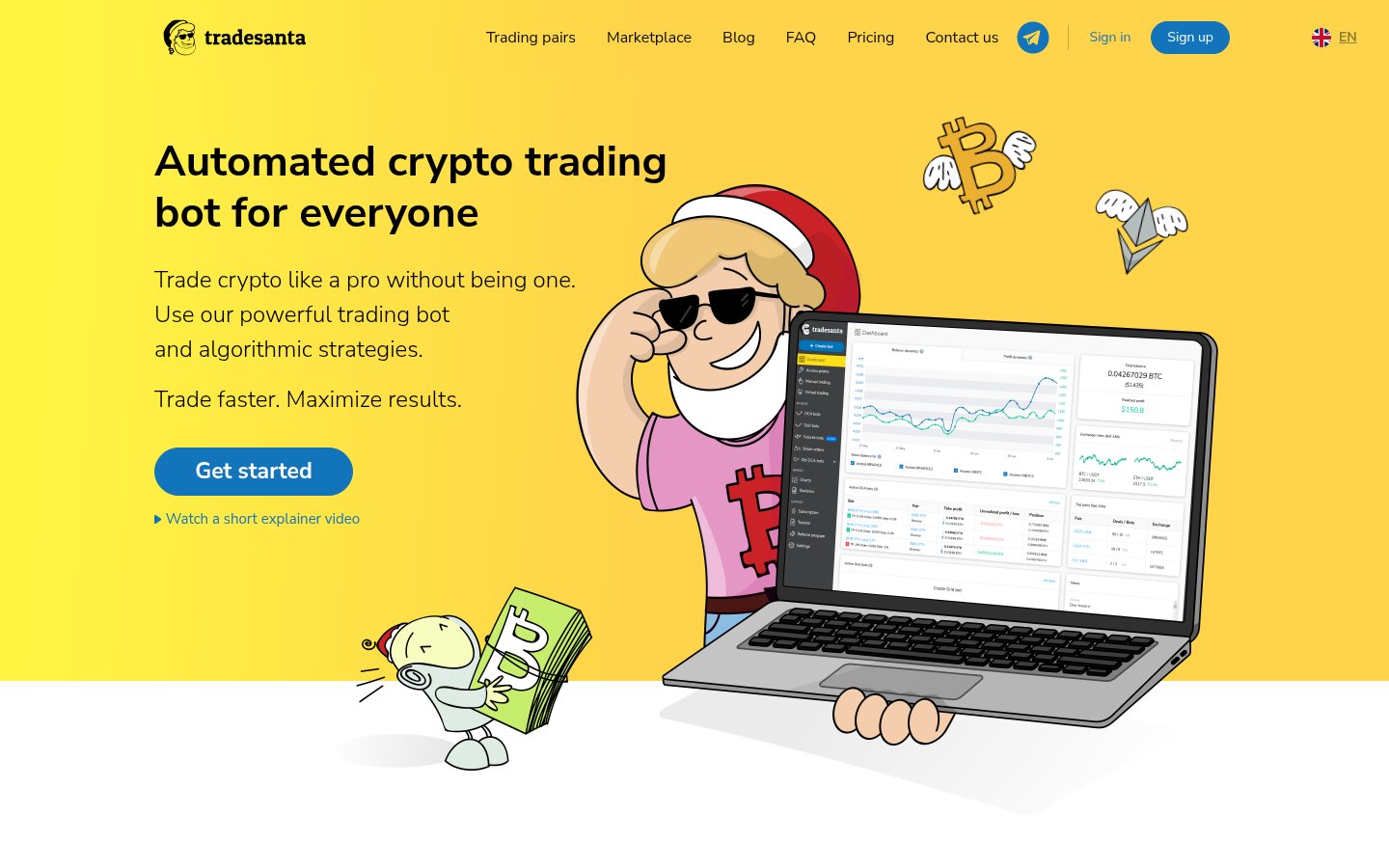
Official website: tradesanta.com
TradeSanta is the most beginner-accessible crypto bot platform on this list, and that's not a backhanded compliment. Getting a DCA or grid bot live in under 10 minutes is genuinely useful for people who've been scared off by more complex platforms. The pre-built templates are sensible defaults, not lazy ones, and the cloud-based execution means your bot runs even when your laptop is closed.
The platform added an AI market analyzer in late 2024 that scans trending pairs and volatility patterns to recommend which markets might suit active bot trading. It's basic compared to Bitsgap's configuration assistant, but it does reduce the blank-page problem for new users.
TradeSanta supports Binance, Bybit, Huobi, OKX, Kraken, and a handful of others. The bot types cover long and short DCA, grid, and futures. At the lower price tiers, you're limited in the number of simultaneous bots, which becomes a real constraint if you want to run diversified strategies across multiple pairs.
Pricing: Basic at $18/month (2 bots), Advanced at $30/month (49 bots), Maximum at $70/month (unlimited bots). Free trial available.
Best for: Beginners who want to get a crypto bot running quickly without a steep learning curve. Also solid for intermediate traders who want a clean, no-fuss DCA implementation.
Pros: Fastest setup of any bot on this list, good pre-built templates, cloud execution, reasonable pricing, short and long bots on all plans.
Cons: Limited bot count on cheaper tiers, fewer advanced customization options than Cryptohopper or 3Commas, AI features are shallow.
Try TradeSanta →6. Wundertrading

Official website: wundertrading.com
Wundertrading occupies a specific space: TradingView signal automation. If you already use TradingView for charting and run Pine Script strategies or follow public indicators, Wundertrading is the cleanest way to turn those signals into automated trades across your exchange accounts. The webhook-to-exchange pipeline is genuinely well-built.
The platform also runs its own DCA and grid bots, and the AI-powered copy trading feature lets you follow verified traders with a live track record. The track records are real (portfolio performance data is shown, not just win rate), which puts Wundertrading ahead of platforms where "verified" means very little.
The NFT bot feature for OpenSea is niche but worth noting for anyone still active in that space. The broader platform feels like it's grown organically around a strong core (TradingView automation) rather than being designed as a cohesive product from day one, and that shows in the UX. Some workflows are intuitive; others require forum digging.
Pricing: Free plan available (limited bots and trades); paid plans from $9.95/month for Basic up to $44.95/month for Advanced. Very competitive compared to category peers.
Best for: TradingView users who want to automate Pine Script signals into live trades. Also useful for copy trading with transparent track records.
Pros: Best TradingView webhook integration available, affordable pricing, transparent copy-trading track records, covers DCA and grid bots.
Cons: UX inconsistency across features, not ideal if you don't use TradingView, AI features feel bolted-on rather than core.
Try Wundertrading →7. Stoic AI

Official website: stoic.ai
Stoic AI takes a different philosophy than most tools here. Rather than giving you controls to fiddle with, it gives you a single strategy, a systematic long-only crypto portfolio approach, and asks you to trust the algorithm. You connect an exchange account, set your investment amount, and Stoic manages rebalancing, position sizing, and entry/exit based on its proprietary model.
That simplicity is the product. For investors who want crypto exposure without the mental overhead of constant decisions, Stoic's hands-off model is genuinely appealing. The AI rebalances daily based on momentum signals and risk metrics, and it's been running long enough (since 2020) that you can evaluate real multi-cycle performance rather than backtested projections.
The catch: the strategy is non-customizable, you're betting on one team's model, and the subscription is banded by portfolio size rather than flat, so a $500 balance pays the same $24 a month as a $2,500 one. If the model's assumptions don't hold in a given market regime, there's no knob to turn. That's either peaceful or terrifying depending on your investing personality.
Pricing: Starter $24/month ($149/year) for portfolios up to $2,500, Plus $39/month ($239/year) up to $5,000, Pro $66/month ($399/year) up to $10,000. Above $10,000 you stay on Pro and add 5% a year of the balance over that line. No free plan, no free trial, and no performance fee or profit share.
Best for: Crypto investors who want a fully managed, systematic portfolio approach on Binance with zero manual intervention.
Pros: No performance fee or profit share, hands-off operation, runs on seven exchanges including Coinbase and Hyperliquid, real multi-year track record, removes emotional decision-making.
Cons: No free plan or trial, price banded by portfolio size so small balances pay a high effective rate, 5% a year on any balance above $10,000, no strategy customization, concentrated single-algorithm risk.
Try Stoic AI →8. ArbitrageScanner
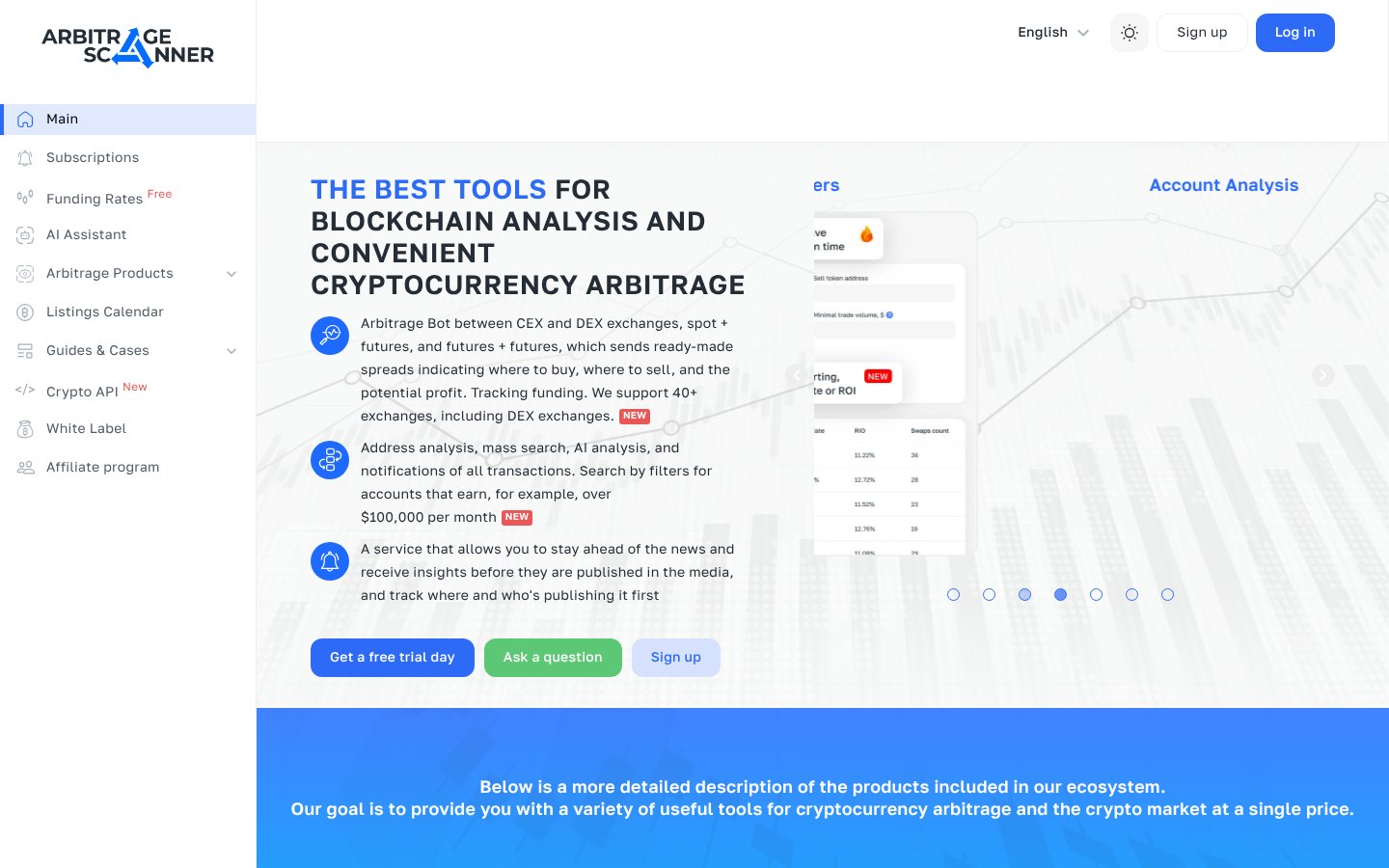
Official website: arbitragescanner.io
Arbitrage in crypto isn't dead, it's just gotten harder to find. ArbitrageScanner is built specifically to surface price discrepancies across 50+ exchanges in real time, covering spot, futures, and P2P markets. The scanner runs continuously and flags opportunities with estimated profit, required capital, and execution path shown upfront.
The AI component here isn't generative, it's pattern recognition on spread data, filtering false positives and accounting for fees, slippage, and withdrawal times before surfacing a signal. That's the right use of AI in this context: not creative, just faster and more accurate than doing it manually.
ArbitrageScanner added inter-exchange triangular arbitrage detection in 2025, which significantly expanded the opportunity surface. The interface is data-dense and not friendly to casual users, which is fine because casual users shouldn't be doing arbitrage anyway.
Pricing: Plans start around $99/month for basic access, with higher tiers up to $299/month for full multi-exchange coverage and API access.
Best for: Experienced crypto traders with capital to deploy across multiple exchanges who want systematic arbitrage opportunity detection.
Pros: Real-time multi-exchange scanning, accounts for fees and slippage, covers spot/futures/P2P, triangular arbitrage detection, serious tool for serious users.
Cons: Expensive, steep learning curve, requires capital across multiple exchanges to execute, opportunities close fast.
Try ArbitrageScanner →9. Octobot

Official website: octobot.cloud
Octobot is the open-source wildcard on this list. You can self-host it for free, which makes it uniquely attractive for privacy-conscious traders and developers who want to run their own strategies without paying a platform fee indefinitely. The cloud version (octobot.cloud) is the managed option if you don't want to maintain your own server.
The strategy library is broad: DCA, grid, market maker, arbitrage, and more. Octobot integrates with TradingView for signal ingestion and supports 10+ major exchanges including Binance, Bybit, and Coinbase. The community has built a solid library of open-source strategies you can clone and modify.
The honest limitation is polish. Octobot's UI has improved since its early years but still feels like a developer tool wearing a product hat. Documentation is uneven. If you hit an obscure configuration issue, you're on the GitHub forum. For developers who are comfortable in that environment, it's a powerful, cost-effective choice. For everyone else, it's friction-heavy.
Pricing: Open-source self-hosting is free. Cloud plans from approximately $14.99/month for Basic, up to $79.99/month for Pro.
Best for: Developers and technically confident traders who want full strategy control, open-source transparency, or a self-hosted setup.
Pros: Fully open-source, free self-hosting option, broad strategy library, active developer community, TradingView integration.
Cons: UI not as polished as commercial competitors, documentation gaps, self-hosting requires technical comfort, support is community-based.
Try Octobot →10. Cryptomatic
Official website: cryptomatic.bot
Cryptomatic is the newest entrant on this list and the most narrowly focused. It does one thing: AI-powered crypto signal generation based on on-chain data, social sentiment, and technical indicators combined into a composite scoring model. There's no trading bot attached, the signals are designed to feed your own execution, whether manual or via another platform's bot.
The on-chain data layer is where Cryptomatic earns its place here. Large wallet movement, exchange inflows/outflows, and miner behavior are incorporated into the signal model, which gives it a data dimension most technically-focused signal services miss entirely. In 2026, on-chain analysis has become increasingly important as crypto markets have matured and whale behavior has become more legible through better data infrastructure.
The platform is still maturing. Coverage is strongest on Bitcoin and Ethereum; altcoin signals are available but thinner. The UI is functional but not exceptional. For traders who already have execution infrastructure and want better signal inputs, it's worth evaluating.
Pricing: Plans from approximately $29/month for basic signal access, up to $99/month for full on-chain data and API integration.
Best for: Crypto traders who already have execution set up (via bots or manual trading) and want AI-generated signals with on-chain data integration.
Pros: On-chain data integration is a genuine differentiator, multi-source signal model, API access on higher tiers, complements existing bot setups.
Cons: No execution layer (signals only), coverage thinner on altcoins, platform still maturing, no free tier.
Try Cryptomatic →Comparison Table
| Tool | Type | Best Market | Pricing Start | Exchanges | Free Tier | Skill Level |
|---|---|---|---|---|---|---|
| 3Commas | Bot + Signals | Crypto | $29/mo | 20+ | Yes (limited) | Beginner-Intermediate |
| Cryptohopper | Bot + Strategy | Crypto | $19/mo | 100+ | Paper trading | Intermediate |
| Bitsgap | Grid/Combo Bot | Crypto | $23/mo | 25+ | 7-day trial | Intermediate |
| Intellectia AI | Stock Signals | Stocks/ETFs | ~$29/mo | N/A | Yes | Beginner |
| TradeSanta | DCA/Grid Bot | Crypto | $18/mo | 6+ | Trial | Beginner |
| Wundertrading | TV Automation | Crypto | $9.95/mo | 10+ | Yes (limited) | Intermediate |
| Stoic AI | Managed Portfolio | Crypto | From $24/mo | 7 exchanges | No | Beginner |
| ArbitrageScanner | Arb Scanner | Crypto | ~$99/mo | 50+ | No | Advanced |
| Octobot | Open-Source Bot | Crypto | Free (self-host) | 10+ | Yes | Advanced |
| Cryptomatic | Signal Platform | Crypto | ~$29/mo | N/A | No | Intermediate |
How I Ranked These
The ordering here reflects three things: breadth of genuine utility, quality of the AI component versus marketing fluff, and real-world staying power.
3Commas leads because it's the most complete ecosystem for crypto automation, has survived real market tests, and serves the widest range of trading styles. Cryptohopper is a close second specifically because of its backtesting quality and strategy marketplace depth. Bitsgap earns third because its grid bot implementation is technically best-in-class for ranging markets, and the AI-assisted setup genuinely helps.
Intellectia is the only stock-focused tool here and lands at four because it serves a real need that crypto-only tools don't address. The rest of the crypto bots rank by a combination of feature depth, pricing fairness, and how honest I think their AI claims are.
Stoic's pricing is banded by portfolio size rather than charged on performance, which makes it expensive on a small balance and reasonable on a larger one, and that is why it sits mid-table despite being genuinely unique. ArbitrageScanner and Octobot rank toward the bottom not because they're worse products, but because they serve narrower audiences with specific technical requirements.
One broader note: the tendency to use AI tools without integrating them into a real system is especially dangerous in finance. A bot running a strategy you don't understand is just automated gambling. Use these tools with position sizing discipline, defined risk parameters, and regular review. The AI handles execution speed. Risk management is still your job.
It's also worth watching how AI verification failures are playing out across industries right now, the KPMG hallucination incident is a reminder that AI outputs in high-stakes domains require human oversight, and financial AI is no different. These tools give you an edge; they don't replace judgment.
Related reading
Frequently Asked Questions
Tools & Services Mentioned

infobro.ai Editorial Team
We research every tool from its documentation, pricing pages, product screenshots and public developer discussion, and say plainly what the evidence does and does not show. Drafts are AI-assisted and reviewed by our editors before publication. We revisit each article every 6 months to reflect platform changes. Learn more about our process.