Intercom Fin vs Zendesk AI Agents: Zendesk's Break-Even Rate
Fin bills $0.99 per outcome. Zendesk bills verified resolutions after a per-agent allowance. A worked cost table prices the full Intercom bill at three volumes and solves for the Zendesk rate at which its native AI breaks even with Fin.
 Stanislav VovchykNov 29, 202613 min read
On this page · 8 sections
- 1. The two pricing models side by side
- 2. Fin counts an outcome sooner than Zendesk counts a resolution
- 3. A worked monthly bill at 2,000, 10,000 and 50,000 conversations
- 4. Better automation means a bigger Fin bill
- 5. Keeping Zendesk and adding Fin
- 6. Email and phone queues
- 7. Who each option is wrong for
- 8. FAQ
In short
- If you are on Zendesk and it quotes under $1.37 per verified resolution, use its native AI agents; above $1.44, add Intercom Fin at $0.99 per outcome.
- Fin is the only option on another helpdesk such as Salesforce, HubSpot or Freshdesk, since Zendesk's AI agents only run on Zendesk.
- Fin bills assumed resolutions when customers leave without asking for more help, while Zendesk only bills LLM-verified resolutions, so Fin's billable count likely runs higher.
- A small messaging-first team with no helpdesk should start on Intercom Essential at $19 a seat; choose Zendesk once you need SLA policies, routing or quality scoring.
Intercom Fin costs $0.99 per outcome, on top of Intercom seats or your existing helpdesk. Zendesk's AI agents bill per verified automated resolution, after a free allowance of 5 to 15 per agent each month.
- Already on Zendesk: if the rate on your Zendesk invoice is under $1.02 per verified resolution, use its own agents. Up to $1.37 they still win if Zendesk counts a quarter fewer resolutions than Fin, as I expect. Above $1.44, add Fin.
- On another helpdesk: start with Fin. Its floor is 50 outcomes a month, about $49.50, with no seats to buy.
- Starting from scratch: Zendesk if you need SLA policies, routing or quality scoring; Intercom Essential for a small team.
The two pricing models side by side
Both products sit in our customer support category.
| Intercom Fin | Zendesk AI agents | |
|---|---|---|
| Billing unit | Outcome, $0.99 each | Automated resolution (verified tier only) |
| Free AI allowance | No free outcomes; the 14-day Intercom trial includes Fin | 5 per agent/month on Suite Team, 10 on Professional, 15 on Enterprise |
| When you're billed | Fin answers and the customer confirms, or leaves without asking for more help | An LLM verifies the request was resolved, checked 72 hours after the first message on messaging and email |
| When you're not billed | Fin can't answer; customer returns to the conversation for more help after an "assumed" resolution | Conversation escalated to a human; AI helped but a human finished it; contained resolutions, which don't count against the allowance |
| Minimum spend and caps | One Full seat on Intercom; 50 outcomes a month (about $49.50) with an existing helpdesk | Allocated free resolutions capped at 10,000 a year on every plan |
| Helpdesk dependency | Intercom helpdesk, or your existing one (Zendesk, Salesforce, HubSpot, Freshdesk) | Zendesk, or a supported helpdesk you keep (Salesforce, Freshdesk, Intercom, Kustomer) |
| Copilot for human agents | $29 per teammate/month annual, $35 monthly | Add-on on Professional and higher |
| Free trial | 14 days, no credit card; none for Fin on Salesforce | 14 days, AI agents included; most trials start on Suite Professional |
Intercom's helpdesk seats, billed annually, cost $19 per seat on Essential for new customers (35% off the regular $29), $85 on Advanced and $132 on Expert. Zendesk's pricing page says annual billing is 20% cheaper than monthly. Zendesk AI also includes quality scoring alongside its agents and copilot, which matters if you grade your human agents' tickets today.
Fin counts an outcome sooner than Zendesk counts a resolution
The same conversation can cost money on Intercom and nothing on Zendesk.
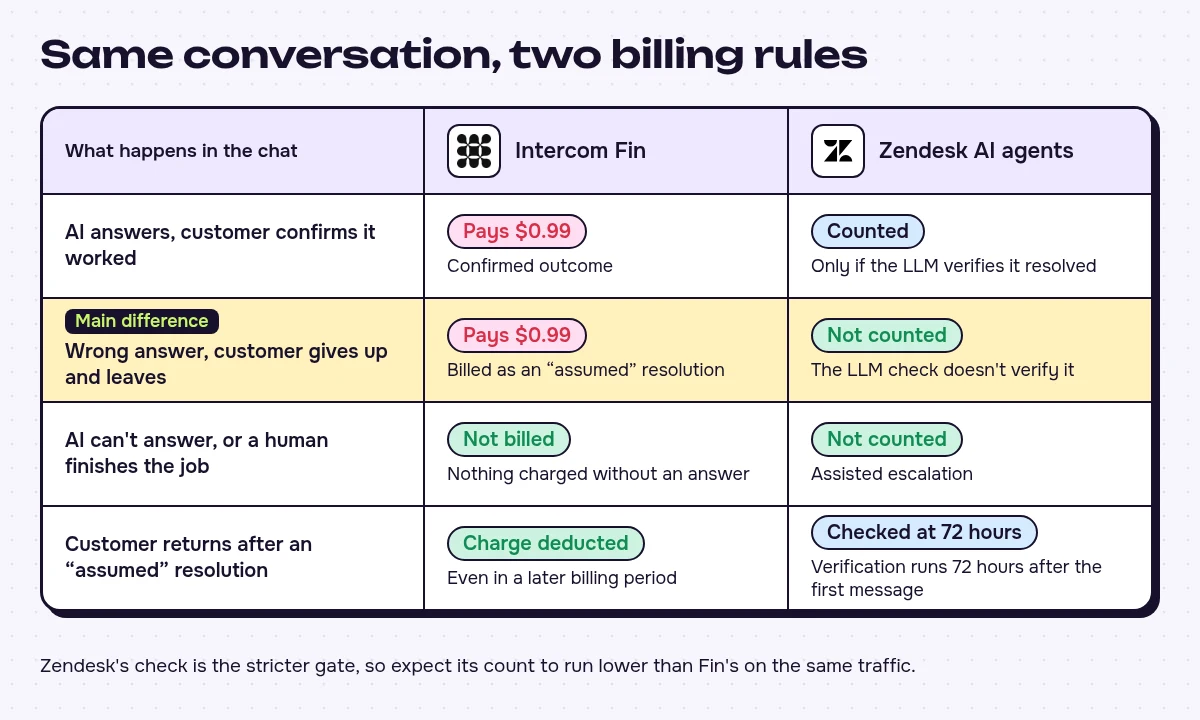
Intercom's help center says Fin only counts a resolution when it gives an actual answer. After that, one of two things makes it billable: the customer confirms the answer worked, or the customer leaves without asking for more help. Intercom calls the second case an "assumed" resolution. If that customer comes back to the same conversation for more help, Intercom deducts the charge, even when the return falls in a later billing period. Intercom bills at most once per conversation, and nothing when Fin can't answer.
Zendesk only evaluates conversations that weren't escalated to a human, and an LLM then checks whether the request was resolved. It sorts AI agent conversations into three tiers:
- Assisted escalation: the AI contributed, a human finished. Not counted.
- Contained resolution: the AI agent handled the interaction to completion without the customer asking for more help. Not counted against the allowance.
- Verified resolution: the AI agent resolved the interaction. Counted.
For messaging and email, Zendesk treats a conversation as ended 72 hours after the first message, and verification runs then.
Do you pay if the answer was wrong? On Intercom, if Fin gives a wrong answer and the customer gives up and leaves, that's an assumed resolution and you pay $0.99. The charge comes off only if they return to that conversation for more help. On Zendesk, a wrong answer that the LLM check doesn't verify never reaches the verified tier, so it doesn't count. A model judging another model won't catch every bad answer, but it's a stricter gate than "the customer didn't come back."
For the same traffic, then, I'd expect Intercom's billable count to run higher than Zendesk's verified count. The cost table below allows for that.
A worked monthly bill at 2,000, 10,000 and 50,000 conversations
Assumptions, so you can swap in your own numbers:
- 5, 15 and 50 human agents at the three volumes.
- 40% of conversations end as a billable Fin outcome. That's my planning figure.
- Intercom seats priced on both Essential ($19, the new-customer annual price) and Advanced ($85 annual), since the Essential discount may not apply to you.
- Zendesk on Suite Professional, so 10 free automated resolutions per agent per month.
- Your existing Zendesk seat cost is left out of setups B and C, because you pay it either way.
| 2,000 / month | 10,000 / month | 50,000 / month | |
|---|---|---|---|
| Human agents | 5 | 15 | 50 |
| Fin outcomes (40%) | 800 | 4,000 | 20,000 |
| Fin outcome charge | $792 | $3,960 | $19,800 |
| A1. Fin on Intercom Essential (seats + outcomes) | $95 + $792 = $887 | $285 + $3,960 = $4,245 | $950 + $19,800 = $20,750 |
| A2. Fin on Intercom Advanced (seats + outcomes) | $425 + $792 = $1,217 | $1,275 + $3,960 = $5,235 | $4,250 + $19,800 = $24,050 |
| B. Fin on your Zendesk (added to Zendesk bill) | +$792 | +$3,960 | +$19,800 |
| C. Zendesk native: free resolutions | 50 | 150 | 500 |
| Billable after allowance, if Zendesk verifies 40% | 750 | 3,850 | 19,500 |
| Zendesk rate at which C costs the same as B | $1.06 | $1.03 | $1.02 |
| Billable after allowance, if Zendesk verifies 30% | 550 | 2,850 | 14,500 |
| Zendesk rate at which C costs the same as B | $1.44 | $1.39 | $1.37 |
Setup A is a full monthly bill, seats included. Setups B and C are AI spend only, on top of the Zendesk seats you already pay, so $887 or $1,217 against $792 does not mean Intercom costs more than Zendesk overall.
Is Intercom better than Zendesk for a small support team? For a team of under about 10 agents with no helpdesk yet, I'd start on Intercom Essential at $19 a seat. Five agents plus Fin come to $887 a month at 2,000 conversations, and Fin's outcomes make up nearly 90% of that, so your resolution rate moves the bill far more than the seat price does. A 5-agent Zendesk Professional account gets only 50 free resolutions a month, too few to justify picking a helpdesk for its AI. I'd change that answer to Zendesk once you need SLA policies or quality scoring.
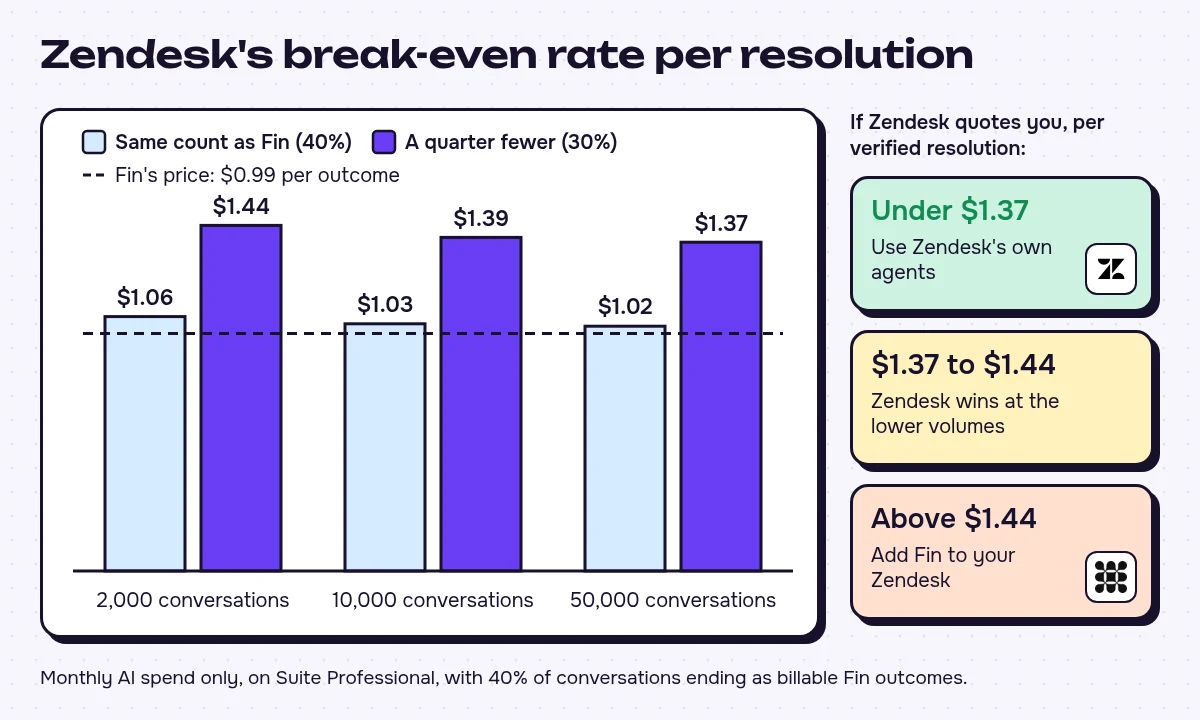
Setup C is solved backwards: the table gives the price per verified resolution at which Zendesk's native agents cost the same in AI spend as adding Fin. If Zendesk verifies as many resolutions as Fin bills, native Zendesk is cheaper whenever its rate is below $1.06 at 2,000 conversations, $1.03 at 10,000 and $1.02 at 50,000. That break-even covers per-resolution spend only. Any monthly AI add-on you pay lowers the break-even by its cost divided by billable resolutions: at 3,850 resolutions, a $385 monthly add-on takes 10 cents off, so $1.03 becomes $0.93.
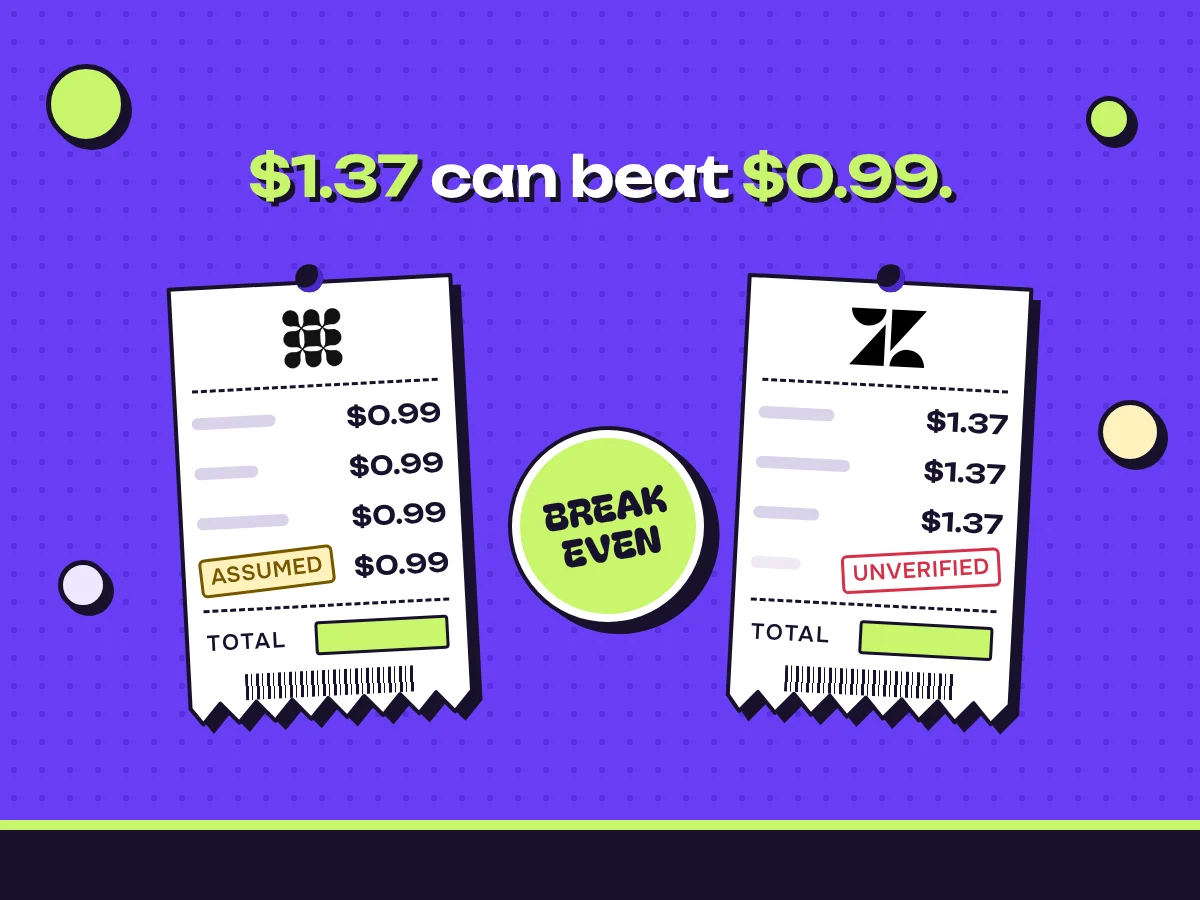
I'd expect the bottom two rows to be closer to what you'll see. If Zendesk's stricter verification counts a quarter fewer resolutions than Intercom's assumed-outcome rule, the break-even rises by 35 to 40 cents, to $1.44, $1.39 and $1.37. A Zendesk rate under those figures produces the smaller AI bill even though it's higher per unit than Fin's $0.99.
The decision rule: if the rate per verified resolution on your Zendesk invoice is under $1.37, its native agents are the cheaper AI bill at all three volumes. Above $1.44, add Fin. In between, Zendesk wins at the lower volumes, where its free allowance covers a bigger share of the work. Those two figures rest on my quarter-fewer assumption. If Zendesk verifies as many conversations as Fin bills, the line drops to $1.02 to $1.06.
Before signing, I'd run Zendesk's 14-day trial, which includes its AI agents, and the Fin for Zendesk free trial side by side on the same traffic, then compare Zendesk's verified count with Fin's outcome count. That gives you your own number to put into the rule in place of my 40%. Zendesk treats messaging and email conversations as ended 72 hours after the first message, so I'd stop sending test traffic on day 11 and read both numbers at the end.
The free allowance matters less as you grow. At 2,000 conversations, 50 free resolutions cover about 6% of the AI's work. At 50,000 they cover 2.5%. Zendesk's annual cap also bites: every plan tops out at 10,000 allocated resolutions a year, about 833 a month, which a Professional account hits at roughly 83 agents.
Copilot adds to all three setups. On Intercom, 15 agents on Copilot cost $435 a month billed annually, or $525 monthly. Zendesk sells Copilot as an add-on on Professional and up.
Better automation means a bigger Fin bill
With per-outcome pricing, the better Fin performs, the more you pay. At 10,000 conversations a month, every 10 points of extra resolution rate adds 1,000 outcomes, or $990 a month on Intercom. The 50-outcome minimum for Fin on another helpdesk is a floor, and the meter keeps running above it.
You still save money, because each outcome is a ticket a human didn't handle. The trouble is forecasting. A support lead who budgets on last quarter's resolution rate will overshoot as soon as someone improves the knowledge base. I'd budget on the resolution rate you expect after the next knowledge-base cleanup, not on last quarter's. Fin's standalone commitment starts at 50 outcomes a month, so the fixed part of the bill stays small.
Zendesk's free allowance scales with headcount, so it absorbs the first 50 resolutions a month on a 5-agent Professional account and the first 500 on a 50-agent one. Past that, its meter grows with volume in much the same way.
Is $0.99 a fair rate? Other support agents in our catalogue price the same unit close by. Kayako charges $1 per resolved ticket for its Kay agent. Siena AI charges $0.90 per automated ticket on top of a $750 monthly platform fee. Yuma AI works out to about $1.20 per resolution on its $14,400-a-year Starter plan, falling to about $0.75 on Scale. Fin's rate sits mid-market. What sets it apart is the small upfront commitment: a 50-outcome minimum against Siena's $750 platform fee or Yuma's annual contract.
Keeping Zendesk and adding Fin
Intercom's pricing page sells Fin on all Intercom plans or standalone with an existing helpdesk such as Salesforce, HubSpot or Freshdesk. The standalone route carries a minimum monthly commitment, which Intercom illustrates with 50 outcomes, about $49.50. Fin for Zendesk, Freshdesk and HubSpot comes with a self-serve free trial; Fin for Salesforce has neither self-serve sign-up nor a trial. The reverse also exists: Zendesk's AI agents work with a supported helpdesk you keep, including Salesforce, Freshdesk, Intercom and Kustomer.
For Zendesk, Fin has its own integration page. It says Fin connects directly to your Zendesk instance and that Zendesk stays your system of record, so nothing migrates. Fin's help article on Zendesk tickets describes how it behaves inside them. Fin replies in the ticket's original channel, so a customer who emailed gets an email back inside the same Zendesk ticket. When Fin hands a ticket on, it unassigns itself so your Zendesk team can pick it up.
I'd only take the Fin-on-Zendesk route when three conditions hold: you're on Zendesk, your volume makes the free allowance a rounding error, and on the same traffic either Zendesk's rate sits above the break-even in the table or Fin resolves clearly more conversations on your content. Otherwise you'd pay two vendors and keep two copies of your knowledge in sync for little gain.
For sensitive queues, note that Fin can use anonymized customer data for model fine-tuning unless you opt out. Intercom's security page describes this as anonymized customer data used for model fine-tuning, and says you can opt out at any time, with the data deleted within 30 days. If you route health, legal or financial questions through Fin, ask your admin to switch that opt-out on before launch.
Email and phone queues
For email on Zendesk, I'd pick Zendesk's own agents at equal rates: an emailed answer the customer never replies to is an assumed outcome on Fin's bill, while Zendesk counts it only if the check verifies it.
For phone, Zendesk's omnichannel routing sends call tickets to agents on Talk Team and above (not Talk Lite), and only while the call is active. For automated calls I'd look at a voice agent priced per minute. Retell AI, for example, charges $0.07 to $0.31 a minute pay as you go. Our guide on putting an AI voice agent on your business phone line covers what to expect from one.
Who each option is wrong for
Fin on Intercom is wrong for a team whose operations are built on Zendesk: complex routing rules, SLA policies and quality scoring. Near the break-even rates in the table, the AI bill comes out about the same on either platform, so switching helpdesks buys you nothing on the AI line. If you run SLA policies and QA in Zendesk, I'd stay.
Fin on Zendesk is wrong for low-volume Zendesk teams. A 5-agent Professional account gets 50 free verified resolutions a month. If your AI only resolves 60 or 70 conversations, paying a second vendor a $49.50 minimum to replace a nearly free allowance makes no sense.
Zendesk's native AI agents are wrong for a team that picks a higher Suite tier for the free allowance. Going from 5 to 10 free resolutions per agent gives a 5-agent team 25 more a month, about $25 of AI work at the rates in the table.
FAQ
Is Fin AI the same as Intercom? They're now the same company. On 12 May 2026 Intercom renamed itself Fin, after its AI agent, and kept the Intercom name for its customer service software platform. On 15 June 2026 Salesforce announced a definitive agreement to buy Fin for about $3.6 billion.
How long does it take to set up Fin or Zendesk AI agents? Fin's Zendesk integration page says Fin can start resolving queries in under an hour once it's connected to your instance. Zendesk's 14-day trial includes access to its AI agents, so you can build and test them before choosing a paid plan.
Can my agents try Copilot before we pay for it? On Intercom, yes: each agent gets 10 free Copilot conversations a month, enough to see who uses it before you buy seats for the whole team. Zendesk sells Copilot as an add-on on Professional and higher plans.
Tools in this article 4




Written by
Stanislav Vovchyk
Founder and editor of infobro.ai
I run infobro.ai: I decide what it covers and how tools are evaluated.
I research every tool from its documentation, pricing pages, product screenshots and public developer discussion, and say plainly what the evidence does and does not show.
More guides