Ecommerce Limitless Artificial Intelligence Reviews: Pay or Pass?
ELAI reviews online are thin, anonymous and often about the wrong product. What each source shows, a checklist to vet the offer, and priced store AI to compare it against.
 Stanislav VovchykNov 18, 202611 min read
On this page · 7 sections
- 1. Three names that sound alike, and only one is the offer
- 2. What each public source says, and how much weight it carries
- 3. A vetting checklist you can run in twenty minutes
- 4. Is AI ecommerce legit? The software is, the "AI store" packages usually aren't
- 5. What would change the verdict
- 6. If you've already paid for ELAI
- 7. FAQ
In short
- Don't pay for Ecommerce Limitless Artificial Intelligence (ELAI) yet, because no public source names its company, owner, price or refund policy.
- ELAI is unrelated to Limitless AI, the pendant maker Meta acquired, and to the Elai video generator, so most reviews you find describe the wrong product.
- Before paying any emailed AI store offer, confirm a registered legal entity, a written refund policy, a clear billing model and card payment with chargeback rights.
- Shopify Basic, Koala's Starter plan and Pebblely Lite cost $63 a month on annual Shopify billing, so a pricier package that hides its software is mostly paying for marketing.
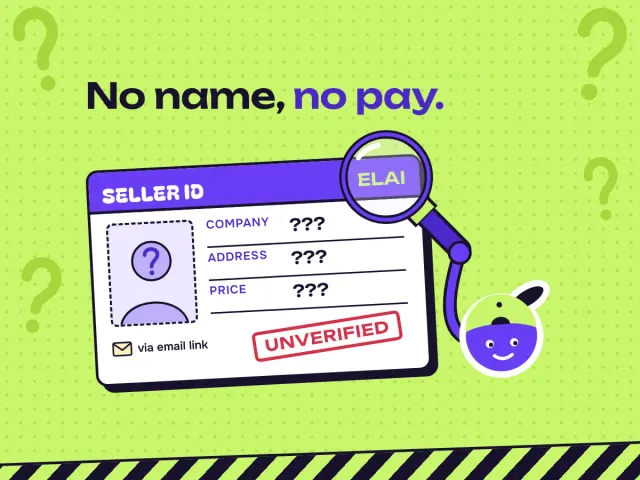
I wouldn't pay for Ecommerce Limitless Artificial Intelligence (ELAI) on the evidence available today. Its public reviews amount to a question on Reddit's r/Scams forum, an unsigned Facebook answers page and a Trustpilot listing that may belong to a different business. None of them names a company, an owner, a price or a refund policy. That isn't proof of fraud, but it's less than any buyer should accept before entering a card number. ELAI is also unrelated to Limitless AI, the pendant maker Meta acquired, which is why most results for this search describe a wearable recorder instead of the offer in your inbox.
Three names that sound alike, and only one is the offer
People searching this phrase run into three unrelated products:
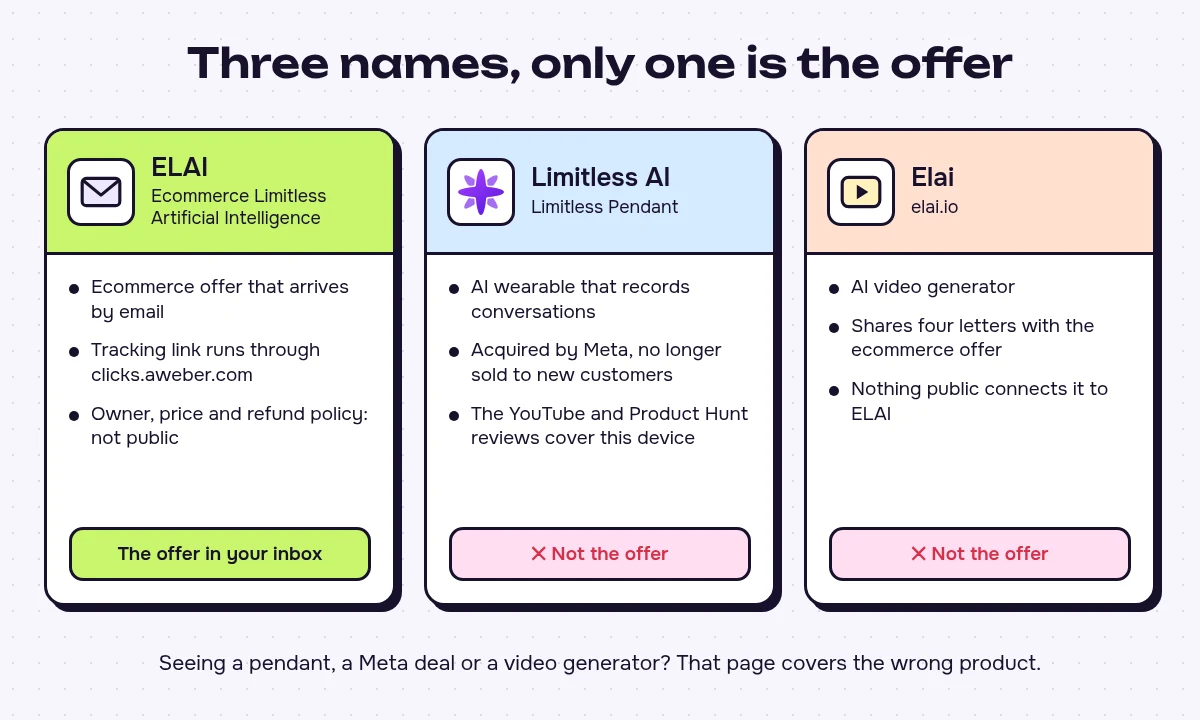
- ELAI, "Ecommerce Limitless Artificial Intelligence." An ecommerce offer that reaches people by email. The r/Scams post asking about it quotes a tracking link on clicks.aweber.com, a domain belonging to the email marketing service AWeber, so at least some of the offer's traffic comes through email campaigns. No public source names who runs ELAI, what it costs, whether it gives refunds or where the business is registered.
- Limitless AI. The company behind the Limitless Pendant, an AI wearable sold as a way to remember conversations without taking notes. Its homepage announces that Meta has acquired it. The pendant is no longer sold to new customers. The YouTube "Limitless AI review" videos and the Product Hunt "Limitless Reviews" page that rank for this query are about that device.
- Elai. An AI video generator at elai.io. It shares four letters with the ecommerce offer, and nothing in the public record connects the two.
If a page about ELAI shows you a pendant, a Meta deal or an AI video generator, it's about the wrong product. Another group of results, a Netscribes blog post and a page hosted on a Sparq domain, uses "e-commerce limitless AI" as a keyword for articles on demand forecasting and dynamic pricing. Those aren't about the offer either.
What each public source says, and how much weight it carries
| Source | Who wrote it | What it claims | Weight |
|---|---|---|---|
| Reddit r/Scams thread, "Is anyone familiar with ELAI" | An anonymous Reddit user | Asks whether ELAI is legitimate and pastes the AWeber tracking link | Low as a verdict. Useful as evidence of how the offer is sold |
| Facebook answers page, "Elai Ecommerce Limitless Artificial Intelligence Review" | No named author; reads as auto-generated | Generic copy about AI agents that "run stores 24/7" and "agentic commerce", plus complaints such as generic copy, inaccurate product details and lack of trust, none of them sourced | Near zero. No price, no company, nothing specific to ELAI |
| Trustpilot, limitless-ai-solutions.com | 7 reviewers | Four-star average | Low, and possibly a different business |
| Limitless AI homepage | Limitless (the vendor) | Company acquired by Meta | High, but only for showing the pendant is unrelated |
| Netscribes blog, Sparq-hosted page | Content marketers | Dynamic pricing, demand forecasting, supply chain | None for this decision. They use the phrase as a keyword, not a product name |
The Trustpilot listing needs a specific check. Nothing on it connects limitless-ai-solutions.com to the ELAI emails. Compare the domain in the listing with the domain on the checkout page you were sent. If they differ, the rating belongs to someone else. Even if they match, 7 reviews is too few to count for or against.
The Facebook page is the most misleading source because it looks like a review. Its text would fit any AI ecommerce product: tools that build pages from transaction data, agents that run stores, assistants that compare products before a customer buys. The complaints it lists are common problems with AI-written storefronts in general. It doesn't say who reported them or whether they relate to ELAI, and it gives no seller, price or refund terms.
Taken together, the sources give you a question, a template and a rating that may be for another company. An offer sold to strangers by email should have a named owner and a written refund policy somewhere public. Until the seller provides those, the burden of proof sits with the seller.
A vetting checklist you can run in twenty minutes
Use these steps on ELAI or on any "AI store" package that arrives by email:
- Find the legal entity. The checkout page, terms of service or footer should name a company. Look it up in your state's Secretary of State business search, or in Companies House if the seller says it's British. If there's no company name, or the name isn't in any registry, you'll have no one to pursue if things go wrong.
- Look up the domain. A WHOIS lookup, such as ICANN's free lookup tool, shows when the domain was registered. A domain registered a few weeks ago selling a "proven system" doesn't add up.
- Read the refund policy before the sales page. Check for a time limit, conditions such as "must complete all modules", and whether refunds cover upsells. A refund promise that only appears in a video, with no written terms, gives you nothing to point to later.
- Flag income claims. Any figure like "$X per day", or screenshots of Shopify sales dashboards, is a claim the seller must be able to back up. Software companies list features and a price. If a seller leads with what you'll earn and can't show what typical buyers earned, treat the figure as advertising.
- Check the billing model. Find out whether the front-end price is a one-off payment, a trial that rolls into a subscription, or the first step in a chain of upsells. In any walkthrough or video of the checkout, look for "OTO" (one-time offer) pages after the first payment.
- Read reviews for patterns, not stars. On Trustpilot, open the reviewer profiles. A cluster of five-star reviews posted within days, from accounts with one review each, tells you more than the average score.
- Check how you're asked to pay. Card payments come with chargeback rights. Wire transfers, gift cards and crypto don't, which is why some sellers prefer them.
On the public record, ELAI doesn't pass step 1, because no source names the company behind it. Before anything else, I'd reply to the email and ask for the legal entity, its registration number, the price and the written refund terms. How the seller answers is useful evidence too.
Is AI ecommerce legit? The software is, the "AI store" packages usually aren't
AI in ecommerce is legitimate and mostly unglamorous. It writes product descriptions, replaces photo backgrounds, answers "where's my order" tickets, recommends products, audits store pages and forecasts demand for larger catalogs. The companies that make these tools publish prices, put their names on them and often offer a free plan or trial.
The bundles that promise a store that runs itself and pays you are a different matter. They typically wrap commodity tools, such as a chatbot and a Shopify theme, in a course and charge you for the wrapper. If what you want is product copy, start with the comparison in which AI is better than ChatGPT for writing instead of an income course.
Here is what the legitimate tools cost on their vendors' pricing pages in November 2026:
| Tool | What it does | Entry price | Free option |
|---|---|---|---|
| Shopify Sidekick | AI assistant inside the Shopify admin | Basic plan $29/mo billed yearly, $39 monthly | Free trial |
| Koala AI | SEO articles and AI SEO agent | $25/mo Starter | 5,000 words, one-time |
| Pebblely | Product photos with generated backgrounds | $9/mo Lite | None |
| Mokker AI | Product photo backgrounds and templates | $13/mo Starter | 20 photos, once |
| Gorgias | Helpdesk with AI agent for stores | $10/mo helpdesk, $40/mo with AI Agent | Free trial |
| Rep AI | Sales and support chat for Shopify and WooCommerce | From $12/mo | Free trial |
| ChatGPT | General writing, including product copy | Go $8/mo (US) | Free plan |
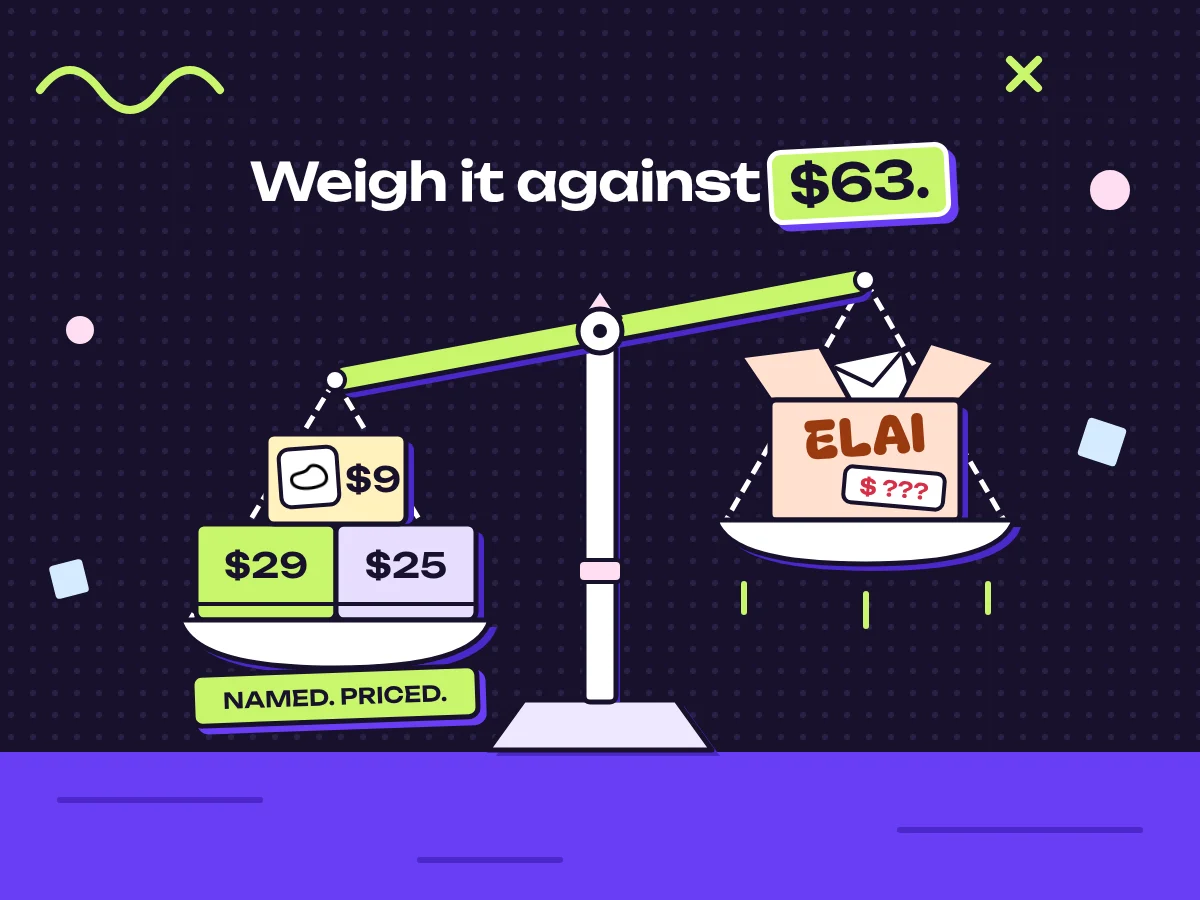
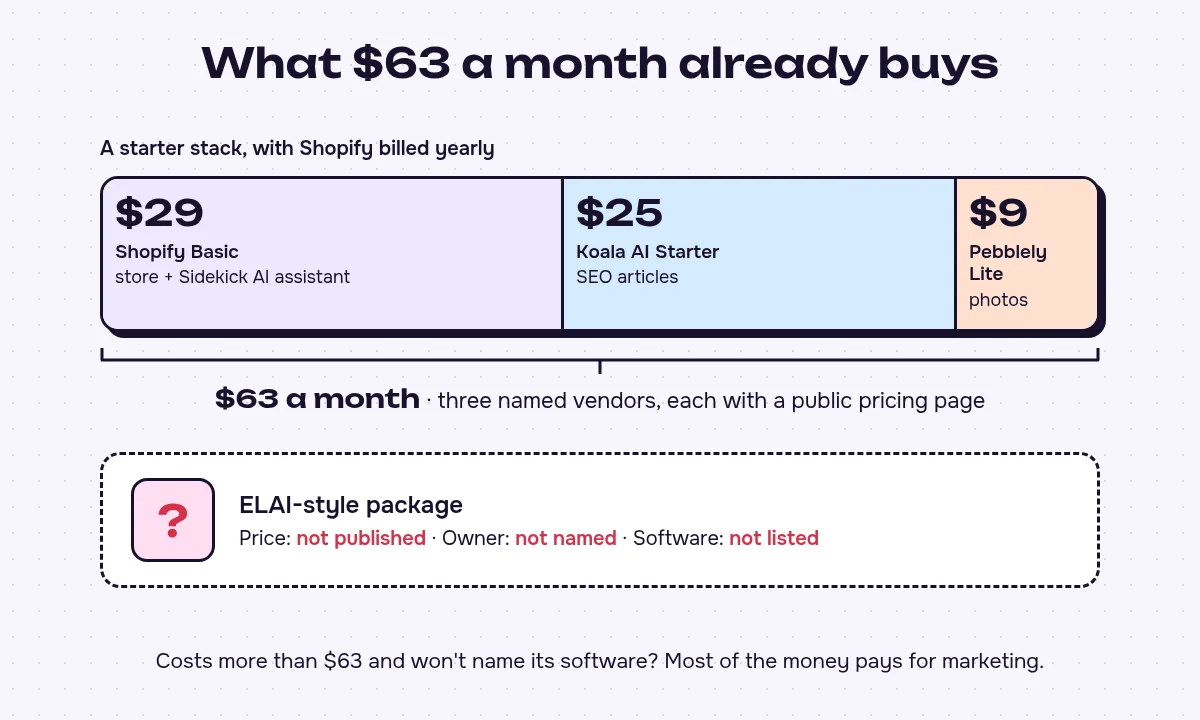
A new store owner could run Shopify Basic, Koala's Starter plan and Pebblely Lite for $63 a month on annual Shopify billing. Each of those companies has a public pricing page and a name you can look up. I'd measure any ELAI-style package against that $63. If it costs more and won't tell you what software it runs on, most of your money is paying for the marketing. The wider ecommerce category lists the rest, including Hypotenuse AI for stores with larger product ranges. Hypotenuse quotes prices on request and holds SOC 2 Type II.
What would change the verdict
Our earlier ELAI review and scam check looked at the same offer. For ELAI to be worth a small, card-paid test, the seller would need to publish all of the following:
- A registered company with named owners that you can find in a business registry.
- A written refund policy with a clear time window and no completion conditions.
- One price page that states what the software does and what it costs, without a chain of upsells.
- Reviews from store owners you can identify, on a platform where the seller's domain matches the listing.
Walk away at once if you see earnings figures, a countdown timer on the price, a request to pay by crypto or wire, or a refund policy that requires you to "complete the program" first.
If you've already paid for ELAI
- Screenshot everything now: the sales page, the email, your receipt, the refund terms and any upsell pages. Sellers can edit or remove these pages.
- Ask the seller for a refund in writing, quote their own terms, and keep their reply.
- Call your card issuer if the seller doesn't respond or refuses. Say the product wasn't as described and ask about a chargeback. Do this quickly, because issuers set time limits on disputes.
- Cancel recurring billing with your card issuer as well as with the seller, so a trial can't turn into a subscription.
- Report it to the FTC. If the offer came through a tracking link like the one in the Reddit post, report the sender to AWeber, the email service that link runs through.
FAQ
Is AI trading legit or fake?
Software that places trades through a broker's official connection is legitimate, and it's sold the way software usually is: a named company, a price and a list of supported brokers. Trading bots sold by email that promise fixed daily returns deserve the same checklist as ELAI, applied in full. Our guide to AI trading bots for Robinhood separates the routes that connect to Robinhood officially from the ones that don't.
Which AI company is most trustworthy?
No single company wins on every measure, so judge vendors on things you can check: whether they publish prices, name a legal entity and say in writing what they do with your data. Privacy terms recorded in our catalogue show how much these policies vary. Writesonic, Frase and Hypotenuse AI say they don't train on customer content and hold SOC 2 Type II. ChatGPT's terms say it does train on customer content. Mistral does unless you opt out. DuckDuckGo's Duck.ai chat says it doesn't. If you'll paste supplier prices or customer data into a tool, that clause matters more than the brand name.
Can I try store AI without paying anyone?
Yes, for small volumes. Alhena AI has a free plan for a shopping and support assistant that covers 25 conversations a month and up to 500 product URLs or SKUs. Claude, Gemini and ChatGPT all have free chat plans that can draft product descriptions, and DeepSeek now offers free chat alongside its paid API. I'd run a free plan for a week before paying anyone. A seller who won't let you see the product before you pay is giving you another warning sign.
Tools in this article 6






Written by
Stanislav Vovchyk
Founder and editor of infobro.ai
I run infobro.ai: I decide what it covers and how tools are evaluated.
I research every tool from its documentation, pricing pages, product screenshots and public developer discussion, and say plainly what the evidence does and does not show.
More guides