Meta Prices Muse Ember Agent Input at 10 Cents per Million Tokens
Meta's new Muse Ember model costs 10 cents per million input tokens and is built for agent execution. A 20-step task comes to about 1.6 cents in input, which matters to teams running high-volume automations. Flat-rate chat subscribers can ignore it.
 Stanislav VovchykNov 10, 20266 min read
On this page · 6 sections
In short
- Meta's Muse Ember, released November 9, 2026, charges 10 cents per million input tokens, but that covers input only, so get Meta's output rate before budgeting.
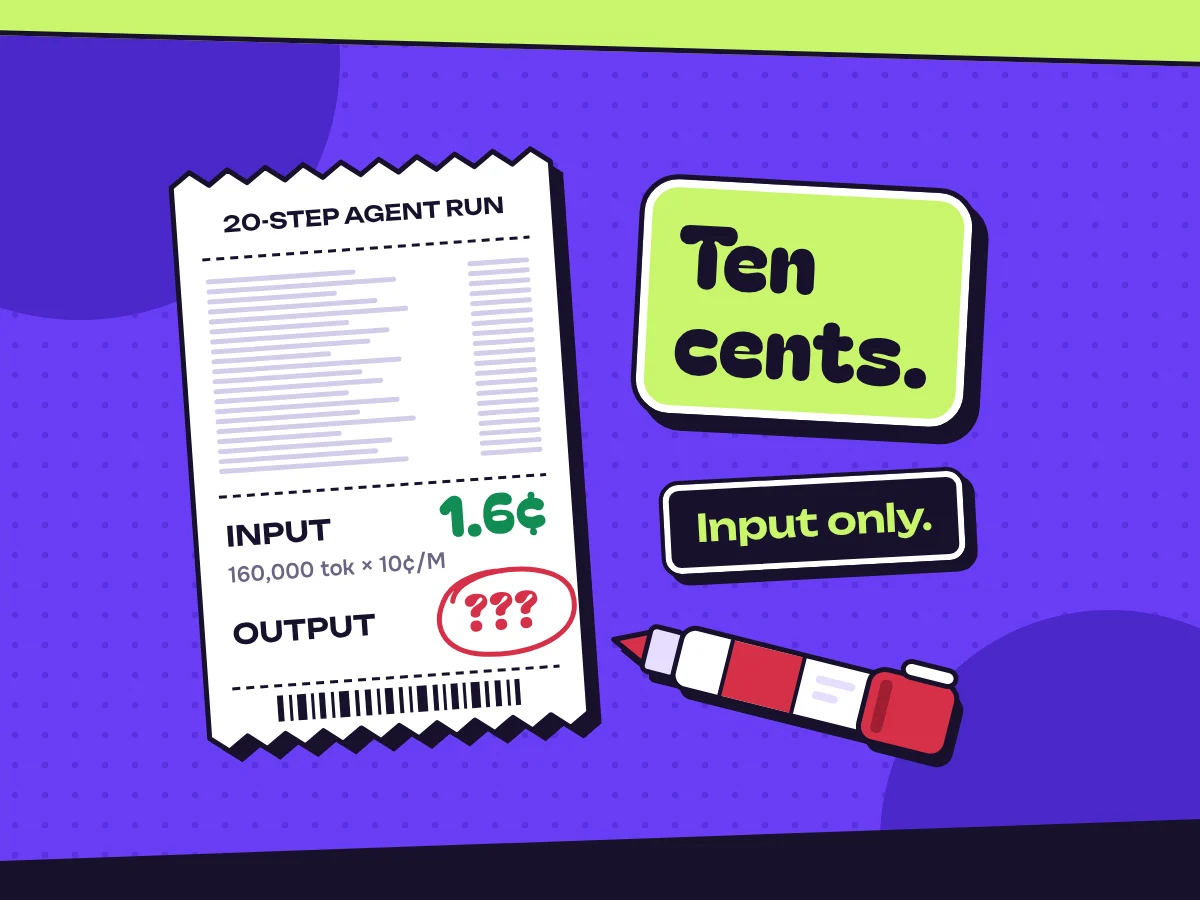
- A 20-step agent loop resending an 8,000-token context uses 160,000 input tokens, about 1.6 cents per task on Ember, or roughly $160 for 10,000 tasks a month.
- Ember matters for high-volume routine agent steps like routing, tagging and extraction, not for ChatGPT Plus or Claude Pro subscribers, who pay flat fees rather than per token.
- Before switching, rerun 50 to 100 failed agent steps on Ember, count wrong tool selections, check Meta's data terms, and set a spending cap on the endpoint.
Meta released Muse Ember on November 9, 2026. It is a lightweight model built to run agent tasks, and input costs 10 cents per million tokens. TechCrunch reported the launch and called Ember significantly cheaper than frontier competitors such as Haiku and Luna. The price matters most to teams whose agents make thousands of small, routine calls. Before you can say what a task costs, you also need Meta's output rate, because the 10-cent figure covers input only.
Ten cents covers input only
Input is the number agent builders watch, because every pass through the loop resends the system prompt, the tool definitions and the growing transcript. Take a 20-step loop that resends an 8,000-token context at each step. That is 160,000 input tokens per task, or about 1.6 cents at Ember's rate. At 10,000 tasks a month, input comes to roughly $160. To compare, multiply your current model's per-million input rate by 0.16. That gives you the same task's input cost today, next to Ember's 1.6 cents.
Every agent step also pays for output tokens, so get Meta's output rate before you budget.
Agent pipelines feel this price, chat subscribers don't
If you pay a flat subscription for ChatGPT ($20 a month for Plus) or Claude ($17 a month for Pro, billed yearly), Ember changes nothing on your bill. Those plans aren't billed per token.
The teams who should look at Ember run multi-step automations where most calls are routine: classifying a ticket, pulling fields out of an email, choosing the next tool to call, checking that a JSON payload is valid. A frontier model is overkill for those steps. If your workflows use MCP connectors, every tool schema the agent loads adds input tokens to every call, which pushes up the 8,000-token context in the example above. Our explainer on how MCP connects ChatGPT and Claude to your apps explains why those definitions add up.
Where Ember fits next to the tools you already run
I'd expect most teams to plug Ember into an orchestration layer, or to weigh it against open models they already run, instead of calling it on its own. Here is how the two most relevant tools look in our catalogue this month:
| Tool | Paid entry plan | Free option | Trains on customer content | Open source |
|---|---|---|---|---|
| n8n | Starter $20/mo, billed annually | Community Edition free; Cloud trial with 1,000 executions | No | Yes |
| Ollama | Pro $20/mo or $200/yr | Local models unlimited on your own hardware; cloud models pay per token, 3 concurrent requests | No | Yes |
If you already self-host n8n, I'd test a cheap hosted model on the routine nodes first. Community Edition is free, so on a self-hosted setup the model's token bill is the only variable cost, and Ember's rate shows up directly in it. Execution billing only applies on n8n Cloud, where Starter costs $20 a month billed annually. If you trial Cloud, keep the two meters apart: the 1,000 trial executions get used up by workflow runs, and Ember tokens are billed on top. The trial also cuts each execution off at 180 seconds, and a long agent loop can hit that limit before it hits any budget.
For teams with their own hardware, I see Ollama as a stronger rival to Ember than Haiku. Models on your own machines run at no per-token cost, and Ollama says it doesn't train on customer content. With a spare GPU box and steady volume, compare Ember with that zero marginal cost and leave Anthropic's price list aside. Teams without a GPU have a closer like-for-like option in Ollama's cloud models, which bill per token, with the free plan capped at 3 concurrent requests and Pro at $20 a month. Price Ember against that rate before you assume it wins. Ember comes out ahead in three cases: when bursts of traffic outrun your local GPU and that 3-request ceiling, when its rate beats Ollama's cloud pricing for your workload, or when an open model gets your agent's tool calls wrong. A cheap model that picks the wrong tool can cost more in retries than it saves.
Which work to move to Ember
I'd send traffic to Ember in these cases:
- High-volume, low-judgement steps. Routing, tagging and extraction nodes that run thousands of times a day, where something downstream catches a wrong answer.
- Prototypes that will need to scale. Apps built on Lovable or Replit that call a model on every user action. Once an app needs more AI than Lovable's built-in allowance, you're bringing your own model, and that is where Ember's per-call price starts to count.
- Teams pricing a self-hosted automation stack. If you're looking at the options in our open-source Zapier alternatives list, a self-hosted orchestrator paired with a 10-cent model is now a cheap combination to price out.
Anthropic launched its Mythos and Fable models the same day, and TechCrunch quoted the company as saying they "show improvements in areas like coding, reasoning, and vision." Those are the jobs I'd keep on a frontier model: planning, writing code, and anything a customer reads without an edit. I'd run both in one setup, with the frontier model writing the plan and Ember carrying out the steps.
Before you move a workflow
Get three answers from Meta and from your own logs. First, does Meta's output-token price keep the blended cost per task below what you pay now? Second, do Meta's data terms for Ember meet your compliance needs? n8n and Ollama both say they don't train on customer content, so hold Meta to that standard. Third, pull the last 50 to 100 failed or retried agent steps from your logs, rerun them on Ember, and count the wrong tool selections before you switch any live traffic over. If it misses more often than your current model, the 10-cent price won't save you anything. Set a spending cap on the new endpoint before it goes to production.
Related reading: Copilot Credits default on Dec 1 for CSP buyers and our Make review on how credits burn on scheduled scenarios.
Sources






Written by
Stanislav Vovchyk
Founder and editor of infobro.ai
I run infobro.ai: I decide what it covers and how tools are evaluated.
I research every tool from its documentation, pricing pages, product screenshots and public developer discussion, and say plainly what the evidence does and does not show.
More news