What AI Recruiting Tools Actually Do After the Resume Gets Screened
Resume screening is table stakes in 2026. Here's what high-performing HR teams are doing with AI in the five stages that actually determine whether a hire works out.
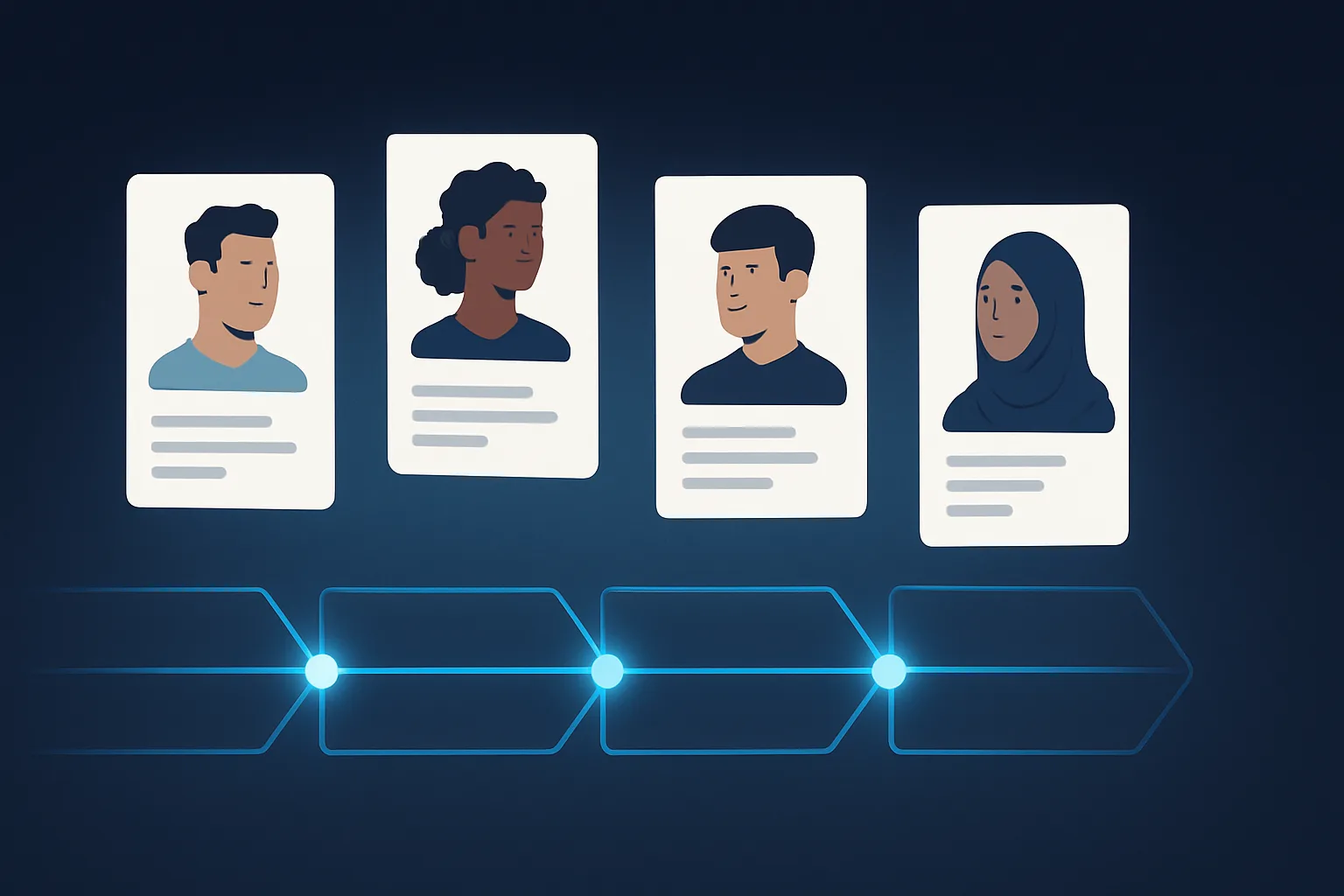
Every HR software vendor on the planet will tell you their product does AI resume screening. And at this point, most of them do. Parsing resumes, ranking candidates by keyword match, filtering out incomplete applications, that's solved. It's table stakes. Competing on resume screening in 2026 is like competing on having a website.
The interesting question is what happens next. Because the resume is just a claim. It tells you what someone says they did. The five stages after the initial screen are where you find out whether any of it is true, and whether the person can actually do the job you need filled.
Around 87% of companies now use AI somewhere in their recruitment process, but most of them have only wired it into the top of the funnel. The teams consistently hiring well have pushed AI into the middle and bottom too. Here's exactly what that looks like in practice.
Stage 1: Skills Assessment That Actually Tests the Skill
The gap between "screening faster" and "screening smarter" shows up immediately once you move past the resume. A candidate who lists Python, stakeholder management, and "experience with enterprise SaaS" has told you almost nothing you can rely on.
Pre-employment assessment tools in 2026 have gotten genuinely good at closing that gap. For technical roles, adaptive coding challenges now mimic real production scenarios rather than abstract puzzles. They measure code quality, debugging logic, and problem-solving speed, not just whether someone can invert a binary tree on a whiteboard. Eightfold AI goes further, analyzing historical hiring outcomes alongside resume data to rank candidates by predicted job fit, not just skills match.
For non-technical roles, soft skills assessment has finally matured past the embarrassing "situational judgment" MCQ tests of the early 2020s. Modern platforms use conversational AI to simulate realistic work scenarios. A customer success candidate might work through a difficult client call. A project manager might handle a scope-creep scenario. The AI scores the response against role-specific competencies.
The practical upshot: by the time a human recruiter touches a candidate, they're looking at a ranked shortlist with assessment scores attached, not a pile of resumes and a guess.
What to watch for: Assessment tools that are bolted onto an ATS as an afterthought often create friction in the candidate experience. The strongest implementations trigger assessments automatically when a candidate clears the initial screen, with no extra login or context-switching required.
Stage 2: Conversational Screening and Scheduling
This is where Paradox has built its reputation. The platform's conversational AI handles the grunt work of early candidate engagement, answering questions about the role, collecting missing information, scheduling screening calls, at a volume no human team can match.
For high-volume roles like retail, logistics, or customer service, the math is brutal without automation. A single job posting for a warehouse role might pull 800 applications in 72 hours. Even if your resume screen cuts that to 200, you still need to schedule 200 screening calls. Paradox handles that in the background, texting candidates, confirming availability, and booking slots directly into recruiter calendars.
The less obvious value is in dropout reduction. A candidate who applied on Monday and doesn't hear back until Thursday is already looking elsewhere. Conversational AI that responds within minutes keeps candidates in the funnel long enough for a human to actually evaluate them.
Greenhouse approaches this differently, embedding conversational AI into structured interview workflows rather than handling top-of-funnel volume. Its recent acquisition of a conversational AI company has pushed it toward voice-enabled candidate interactions during structured interviews, which is a more ambitious use case.
One thing worth knowing: The conversational AI tools that work at scale run on volume. If you're hiring 20 people a year, you won't see the ROI. These tools earn their keep when you're filling dozens of roles simultaneously with hundreds of applicants per role.
Stage 3: Interview Intelligence
Recording and transcribing interviews has been around for years. The 2026 version is different because the AI now does something useful with the transcript beyond storing it.
HireVue is the most established name here, built around structured asynchronous interviews for early-stage screening. Candidates record responses to standardized questions on their own schedule, and the platform evaluates responses against role-specific competencies. Enterprise pricing is substantial, industry figures suggest annual costs between $30,000 and $150,000+ depending on volume, so it's not a fit for smaller teams.
Greenhouse's AI Notetaker approach is simpler and more accessible: live interviews get recorded and summarized automatically, with the summary feeding directly into scorecard workflows. Recruiters spend less time on post-interview write-ups and more time on the actual evaluation.
The consistency argument for AI interview tools is real. Human interviewers are notoriously inconsistent, influenced by candidate order, time of day, whether they've eaten lunch, and dozens of other irrelevant factors. Structured AI-assisted evaluation creates a more comparable candidate pool. The limitation is that the AI can only evaluate what the structured questions actually surface. If your interview questions are bad, the AI analysis is bad too.
For sales and BD roles specifically, tools like Gong have already proven that AI conversation analysis at scale surfaces patterns humans miss. It's not a stretch to apply the same logic to interview analysis, and several ATS vendors are moving in that direction.
If your team is thinking through the broader picture of how AI agents behave in workflows, the reporting on OpenAI Found More Agents Running Amok is a useful reminder that more automation needs more governance, not less.
Stage 4: Sourcing Beyond the Inbound Queue
Most companies hire reactively. A role opens, a job post goes up, and the team works whatever comes in. AI sourcing tools flip that model.
Fetcher automates outbound sourcing by continuously scanning candidate databases, identifying people who match open roles, and drafting personalized outreach. Findem goes further with attribute-based search, letting you filter candidates by actual career trajectory attributes rather than just keywords on a resume.
The sourcing quality argument is more interesting than the speed argument. A recruiter manually searching LinkedIn for a senior ML engineer with healthcare experience and startup backgrounds will burn a full afternoon and maybe find 30 profiles. An AI sourcing tool surfaces 300 profiles in the same time, ranked by fit.
The honest caveat: sourcing volume without quality control creates its own problem. If your outreach is reaching the wrong people, you're damaging your employer brand at scale. Textio addresses the adjacent problem, using AI to analyze job descriptions and outreach copy for language that systematically excludes qualified candidates. The platform flags gendered phrasing, unnecessarily exclusionary requirements, and copy patterns that correlate with low response rates from diverse applicants.
This connects to a point worth making plainly: AI sourcing tools amplify whatever biases exist in your job descriptions and evaluation criteria. If the job post requires a degree that isn't actually necessary for the role, the AI will happily screen out every non-degree candidate at 10x the speed. The technology doesn't fix the process, it scales it.
Stage 5: Pipeline Analytics and Decision Support
This is the stage most teams have done the least with, and it's where the biggest efficiency gains are sitting.
Greenhouse's Model Context Protocol implementation is one of the more interesting developments in hiring tech right now. It creates a governed, permission-aware layer that lets approved AI tools connect directly to Greenhouse data, enabling automated bottleneck analysis across the recruiting pipeline. Which roles are stalling at the offer stage? Which sourcing channels produce candidates who actually stay past 6 months? Which interviewers consistently rate candidates too low relative to eventual performance? These are questions that take a data analyst days to answer manually and an AI pipeline analytics tool minutes.
Eightfold AI adds internal mobility analysis to this picture. Rather than defaulting to external hiring for every open role, the platform identifies current employees whose skills trajectory makes them candidates for internal moves. That's genuinely useful at enterprise scale, where a company of 5,000 people might have dozens of employees who are a better fit for an open role than any external candidate, but nobody has the bandwidth to check.
The data picture for recruiting has a cost dimension worth understanding. Running AI across a full hiring pipeline generates meaningful compute overhead, especially when you're doing video analysis, asynchronous interviews, and real-time sourcing simultaneously. The broader enterprise AI cost story makes the point that cheaper tokens don't mean cheaper bills, and HR tech is no exception.
What a Connected Hiring Stack Actually Looks Like
Most teams don't have one platform doing all five stages well. They have a combination: an ATS as the backbone, assessment tools plugged in for specific role types, a conversational AI layer for high-volume positions, and analytics either native to the ATS or pulled separately.
The integration question matters more than any individual tool's feature set. An assessment tool that doesn't write scores back to your ATS creates manual data entry. A sourcing tool that doesn't sync with your candidate CRM creates duplicate outreach. The automation and integration challenge that plagues most software stacks hits HR tech as hard as anywhere else.
Here's a rough framework for thinking about what to prioritize based on hiring volume:
| Hiring volume | Top priority | Secondary priority |
|---|---|---|
| Under 50 hires/year | Skills assessment | Interview notes automation |
| 50-300 hires/year | Conversational scheduling + assessment | Pipeline analytics |
| 300+ hires/year | Full-funnel automation | Internal mobility analysis |
| High-volume (warehouse, retail, CS) | Conversational AI (Paradox-style) | Asynchronous video screening |
Manatal and Workable are worth mentioning for smaller teams specifically. Both offer AI-assisted features across the hiring workflow without the enterprise price tags and implementation timelines that come with platforms like Eightfold or HireVue. The tradeoff is depth, you get enough AI to move faster, not enough to replace analytical headcount.
The One Thing Most Teams Are Getting Wrong
They're treating AI as a screening accelerator and nothing else.
Getting faster at processing the inbound queue is valuable. But the harder problem in most hiring processes isn't speed, it's signal. You need better information about candidates earlier, better calibration between hiring managers and recruiters, and better feedback loops so you learn which of your early signals actually predicted good hires six months later.
AI is capable of improving all three. The teams getting the most out of it are using assessment data to calibrate hiring managers ("your instinct on culture fit has zero correlation with 12-month retention, here's the data"), using interview intelligence to identify where their process loses good candidates, and using pipeline analytics to close the loop between hiring decisions and outcomes.
That's a more sophisticated use of the technology than running resumes through a filter. It also requires someone in HR who's willing to treat hiring as a data problem, not just a people problem. Both things are true at once, and the teams who've figured that out are the ones winning on talent right now.
For context on how other functions are applying this same data-driven mindset to AI tooling, how finance teams are using AI agents in 2026 covers a lot of the same integration and governance challenges from a different angle.
Frequently Asked Questions
Tools & Services Mentioned

infobro.ai Editorial Team
We research every tool from its documentation, pricing pages, product screenshots and public developer discussion, and say plainly what the evidence does and does not show. Drafts are AI-assisted and reviewed by our editors before publication. We revisit each article every 6 months to reflect platform changes. Learn more about our process.