
OpenAI Codex
OpenAI's coding agent for the desktop, CLI, IDE, web and iOS, included in ChatGPT plans
Own OpenAI Codex? Claim it, free to correct the facts and get the verified badge.
Pricing
Free · from $8/mo
API
Yes
Company
OpenAI OpCo, LLCUnited States
Platforms
Codex is the best-value coding agent for teams already paying for ChatGPT, mainly because Plus and Business bundle cloud tasks and automatic GitHub PR review at no extra seat cost. Its weak spots are opaque usage limits on the cheaper tiers and an API-key route that drops every cloud feature. Start on Plus or Business, and treat Pro as something you buy only after you've hit the limits.
Best for: GitHub-based teams already on ChatGPT plans
Read the full reviewWhat is OpenAI Codex?
OpenAI Codex is a coding agent that handles software tasks locally on your machine or in OpenAI's cloud. You can use it from a desktop app, a command-line tool, an IDE extension, the web, iOS, or an SDK for scripted workflows.
Access comes with ChatGPT plans. Free and Go users get lighter coding use in the desktop app. Plus and higher plans add Codex on the web, the CLI and the IDE extension, plus cloud integrations such as automatic code review and Slack. Usage limits depend on the model, the size of the task, and whether it runs locally or in the cloud. Developers can also run Codex with an API key, which is billed at standard API rates but doesn't include cloud features.
Codex suits individual developers as well as teams that need SAML SSO, SCIM, RBAC, audit logs and data residency controls on the Business and Enterprise tiers.
Key features
- Desktop app for local coding chats
- Command-line interface (CLI)
- IDE extension
- Cloud tasks through Codex on the web
- Automatic GitHub code review
- Slack integration
- SDK for scriptable workflows
- Works with an API key and pay-per-use billing
Use cases
Who it's for
Delegating coding tasks
Hand off a feature or bug fix to Codex in the cloud and let it work while you do something else.
Automated code review
On Plus and higher plans, Codex can review GitHub pull requests automatically.
Terminal and IDE help
Run Codex locally from the CLI or the IDE extension while you code.
Scripted pipelines
Use the SDK with an API key to build Codex into your own workflows.
OpenAI Codex pricing
From the vendor's site, checked Oct 26, 2026; we re-check prices monthly. Prices change — confirm on their pricing page.
| Plan | Free | Go | Plus | Pro | Business | Enterprise & Edu | API Key |
|---|---|---|---|---|---|---|---|
| Paid monthly | Free | $8/mo | $20/mo | From $100/motiers at $100, $200 or $500 | $25/moper user | Custom quotecontact sales | Pay per usagebilled at API rates |
| Paid yearly | Free | — | — | — | $20/mo−20% | — | — |
| Models | GPT-6 Luna | GPT-6 Luna | GPT-6.1 Sol, GPT-6 Luna | — | — | — | — |
| Cloud features | — | — | Yes | — | Yes | — | No |
| Also |
|
|
|
|
|
|
|
| Cost for a team, per month | 1 person | 5 people | 20 people |
|---|---|---|---|
| Goflat, up to 1 | $8 | — | — |
| Plusflat, up to 1 | $20 | — | — |
| Proflat, up to 1 | $100 | — | — |
| Businessper seat | $40 | $100 | $400 |
Billed yearly where the plan offers it. — means the plan doesn't allow that many people.
Which plan do you need?
- OpenAI CodexGo$8/mo
- CursorPlus$8/mo
- GitHub CopilotPro$10/mo
- ClaudePro$17/mo
- DevinPro$20/mo
The cheapest paid plan with a published price that fits. Custom and sales-quoted plans aren't included.
Get an email when OpenAI Codex changes its prices
One mail per change, a stop link in each. Nothing else.
How OpenAI Codex compares
- At $8/mo, OpenAI Codex starts cheaper than 3 of 4 similar tools with published prices (median $10).
- OpenAI Codex has a free plan, like all 4 alternatives below.
- It offers an API, which only 1 of the others does.
| Tool | Starts at | Free plan | Free trial | API | Open source | |
|---|---|---|---|---|---|---|
| OOpenAI Codex | $8/mo | — | — | |||
G GitHub Copilot | $10/mo | — | — | — | OpenAI Codex vs GitHub Copilot | |
C Cursor | $8/mo | — | — | — | OpenAI Codex vs Cursor | |
C Claude | $17/mo | — | — | OpenAI Codex vs Claude | ||
D Devin | $20/mo | — | — | — | OpenAI Codex vs Devin |
Compare 8 capabilities
| Capability | OpenAI Codex | GitHub Copilot | Cursor | Devin |
|---|---|---|---|---|
| Agent mode | ||||
| Tab completion | — | — | ||
| CLI / terminal | ||||
| Cloud agents | ||||
| AI PR review | ||||
| Bring your own key | — | — | ||
| Local / self-hosted models | — | — | ||
| MCP support |
Capabilities as stated on each vendor's own site; — means the site doesn't say. The closest alternatives in our directory by category. “Starts at” is the cheapest paid plan per month, as each vendor lists it.
OpenAI Codex data and privacy
Trains AI on your content
Not stated
Data retention
Not stated
Where data is stored
Not stated
Security and compliance
From OpenAI Codex's own privacy and security pages , checked Oct 28, 2026. We only show what the vendor states in writing; “not stated” means the pages don't say.
OpenAI Codex release activity
3 changelog entries since Oct 2026, latest Oct 27, 2026. Changelog
Pros and cons
Strengths
- Free plan includes basic Codex use in the desktop app
- Available in the desktop app, CLI, IDE, web, iOS and SDK
- Enterprise controls such as SCIM, RBAC, EKM and data residency
- API key option for pay-per-use billing
Limitations
- Free and Go plans have no published usage numbers
- Plus usage limits are given only as estimated ranges
- API key use doesn't include cloud features such as code review or Slack
OpenAI Codex review
 Stanislav VovchykUpdated Nov 3, 20267 min read
OpenAI Codex Review: What You Get on Each ChatGPT Plan
OpenAI no longer sells Codex as a separate product. Its homepage, captured in November 2026, says "Codex is included in your ChatGPT plan," across the Plus, Pro and Business tiers. Our verdict: Codex is a strong buy if your code lives on GitHub and you want to hand off well-specified tasks and PR reviews. It suits a small team best on Business. If you'd rather work through a problem with an agent step by step, it's a weaker choice than Claude Code.
This review covers the current coding agent, not the 2021 Codex model that powered early autocomplete tools and shares the name. It draws on OpenAI's Codex homepage and on dated third-party reviews (Truvora, GoodVibeCode, Shattered.io, Zack Proser).
What Codex is now
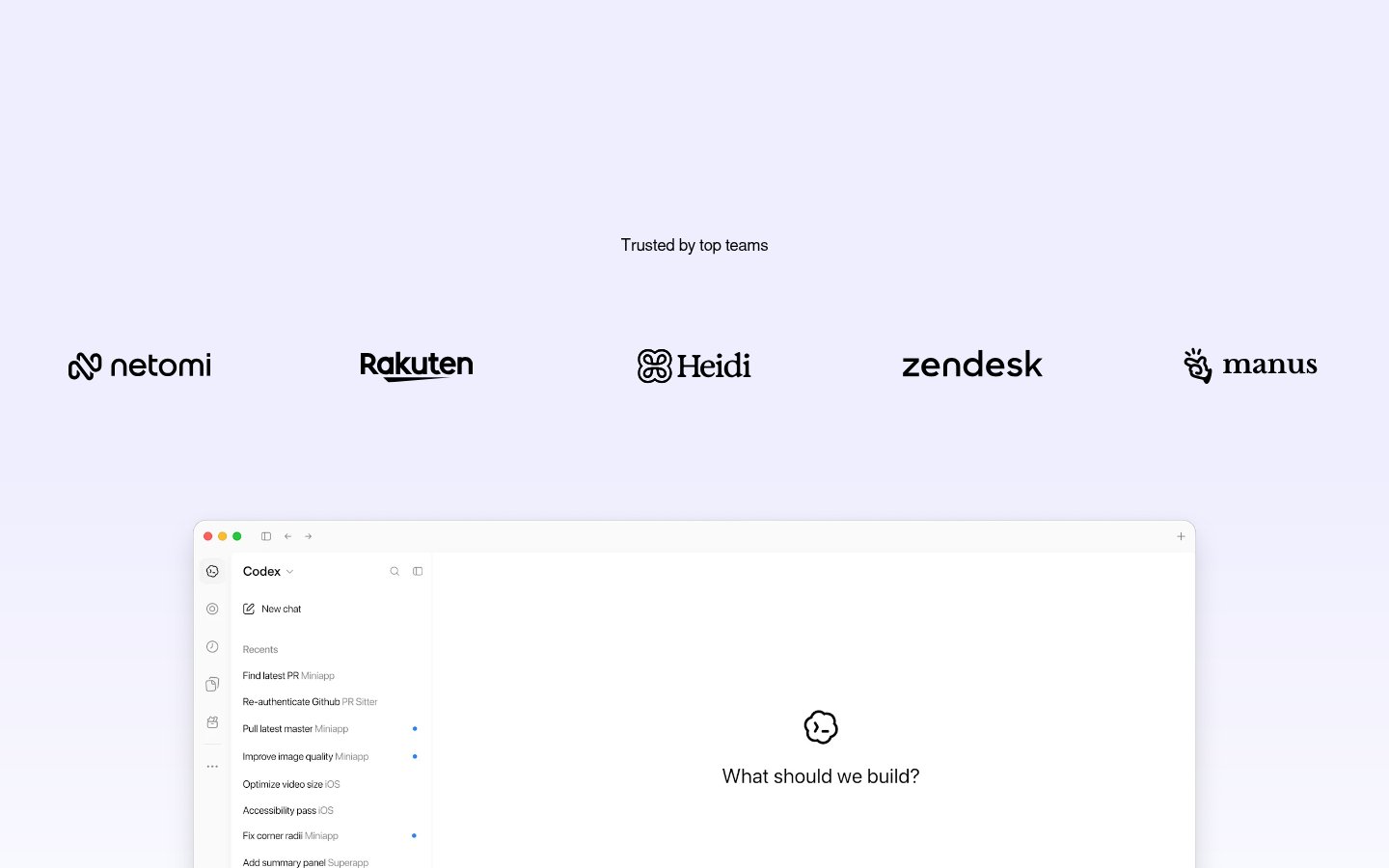
OpenAI describes Codex as "the same agent everywhere you code," connected to all your devices through your ChatGPT account. You give it a task: a bug, a refactor or a feature. It reads the repository, edits files, runs commands and tests, and returns a diff or pull request. The homepage says it runs "many agents in parallel, using computer and browser tools to verify work," and that plugins connect it to other apps. GoodVibeCode's feature list (27 September 2026) adds MCP support, skills and scheduled automations.
The surfaces do different jobs, and most reviews blur them:
GoodVibeCode points out that OpenAI's quickstart covers the desktop app, CLI and IDE extension, and treats isolated cloud tasks as a separate workflow you configure. Budget setup time for cloud tasks.
Which model powers it. The Codex homepage we captured doesn't name a default model, and the dated sources we have mix model generations. Tembo's July 2026 guide prices gpt-5.3-codex on the API. SSOJet cites GPT-5.5 at 82.7% on Terminal-Bench 2.0, taken from OpenAI's GPT-5.5 announcement. Mem0's comparison documents GPT-6 Astra with a 1.05-million-token context window, 128K maximum output and five reasoning levels. In every version, Codex runs OpenAI models only. Tembo calls this "model lock-in," and it's a fair point if you want to switch to a Claude model for one hard refactor. Context sizes also change: a pull request in the open-source openai/codex repo cut the model context from 372k to 272k tokens, and that change drew 371 points on Hacker News.

How usage limits work
OpenAI's homepage describes limits in plain words rather than numbers. Plus covers "focused coding sessions each week," Pro covers "full workdays," and Business is "unlimited subject to abuse guardrails." The mechanics come from secondary sources. Taskade, which sells a competing product, says Codex moved to token-based credit metering on a rolling five-hour window in April 2026. Tembo notes that the ChatGPT-plan route "has its own session limits."
When you hit the limit, you wait for the window to reset or use credits. One user on OpenAI's developer forum wrote that she runs out so often she plans her sleep around when credits come back. That tells you how one heavy user's workload fits a plan. It doesn't set a rule for anyone else, and we haven't stress-tested limits. Local /review runs count against your plan allowance (more on this below), so heavy local review uses up the same budget as coding. If you expect all-day use on a large monorepo, run Plus for a month and see whether you reach the cap before you pay for Pro.
Coding quality and AGENTS.md
You steer Codex mainly through repository instructions in an AGENTS.md file. Put your build and test commands, conventions and review rules there. Codex uses them both when it writes code and when it decides what to flag in a PR. GoodVibeCode's editorial review says Codex is "strongest when teams provide repository instructions and explicit validation." An agent that runs your test suite before it hands back a diff is much easier to trust.
Multi-turn work has improved, according to people who use it daily. Zack Proser wrote in May 2025 that multi-turn conversations "often derailed." By March 2026, after nearly a year of daily use at WorkOS, he called Codex "production-ready." In its February 2026 comparison, Pockit Tools on Dev.to notes that recent releases added mid-task clarification prompts and project context that persists across tasks. Mem0 describes Codex running tasks in disposable cloud environments or isolated Git worktrees, which keeps parallel work on separate branches from colliding.
Where it fails: the quality claims on OpenAI's page come from customers OpenAI picked. Harvey's Joey Wang says early iteration time fell 30-50%, and that figure isn't independently measured. An OpenAI forum thread titled "Codex is replacing efficient primitives with slower AI workflows" (May 2026) shows the other side. Truvora rates Codex 4.3/5 after five weeks of testing, and GoodVibeCode gives it 4.8/5 as an editorial score. Neither rating comes from a public benchmark.
Code review on GitHub and locally
Code review is the strongest reason to pay. According to the homepage, Codex "automatically reviews pull requests, surfaces findings, and answers questions" on GitHub. There are three ways to use it:
- Automatic GitHub review. Connect GitHub to Codex, give it access to the repositories you want covered, and turn on automatic review. Codex then comments on new PRs and replies to follow-up questions in the thread.
- The
/reviewcommand. In the CLI,/reviewchecks a diff against a base branch, your uncommitted changes or a single commit. Shattered.io's write-up of OpenAI's docs says it doesn't modify your working tree while it runs. - The desktop Code Review view. Shattered.io reports that this view, added at DevDay on 29 September 2026, puts the diff next to a plain-language summary. You can ask follow-up questions and submit Comment, Approve or Request changes without opening GitHub.
The billing split matters for teams. Shattered.io cites OpenAI's pricing documentation: Code Review usage charges apply only to reviews run through GitHub, while local reviews count against your general Codex plan. A team watching spend can run the first pass locally and save GitHub reviews for PRs that are close to merging.
Custom review rules go in AGENTS.md, as described above. Two homepage testimonials support the review feature. Ramp's Austin Ray says Codex PR reviews "catch bugs our team would have missed." Duolingo's Aaron Wang says it performed best on the company's internal backend Python code-review benchmark. Neither benchmark is public. Shattered.io's late-2026 comparison ranks Cursor's Bugbot ahead of Codex for PR review and says most serious teams run at least two review tools.
GitLab is the gap. OpenAI's homepage and every review we drew on describe GitHub pull requests only, and none of them documents GitLab merge request review. If you're a GitLab shop, don't buy Codex mainly for review until you've seen it work on your instance.
Security and where your code runs
The CLI, IDE extension and desktop app run on your machine, against your working copy. Cloud tasks and GitHub reviews run in environments OpenAI hosts, which the homepage describes as "reusable cloud environments for every repo." The choice between local and cloud is the main security decision. If your code can't leave your network, stick to the local surfaces.
Locally, the agent runs commands on your own system, so set its approval and permission settings before you point it at a repo that holds credentials. One documented weak spot: a GitHub issue asking for a way to exclude sensitive files from Codex was still open when it reached Hacker News (227 points, 143 comments). Until that's fixed, keep secrets out of any repo you hand to the agent.
Codex vs Claude Code vs Cursor
Is Codex as good as Claude Code? No public benchmark settles it, because the dated scores run on different tests. SSOJet cites GPT-5.5 at 82.7% on Terminal-Bench 2.0 (from OpenAI's announcement) and Claude Opus 4.8 at 88.6% on SWE-bench Verified (from LLM-Stats). Both scores belong to models that have since been replaced. Mem0 warns that leaderboards measure a model and its harness together, so the result can't be pinned on the model alone. Choose on the documented differences:
Pockit Tools sums up the split: pick Codex "if you think of AI as an employee you manage," and Claude Code if you want a colleague you collaborate with. Mem0 reaches a similar verdict. It calls Codex the stronger harness for parallel, branch-isolated work and Claude Code the stronger one for interactive, deep-context engineering. Proser runs both: he gives Codex maintenance tasks in the morning and does focused work in Cursor or Claude Code.
Who should skip Codex
Teams on GitLab that want automated merge request review should look elsewhere for now. Skip it too if your code can't leave your network and you'd be limited to the local surfaces. At that point you give up the cloud tasks and hosted review that set Codex apart. If you want to switch between Claude and OpenAI models depending on the task, a model-agnostic tool will suit you better. And if you like working through an unclear problem with the agent as you go, Pockit Tools' comparison suggests Claude Code. Cursor fits better if you want AI built into the editor you work in all day.
Setting up Codex
- Pick your sign-in first. Signing in with your ChatGPT account connects the desktop app, CLI, IDE extension and web to one plan and one usage pool. An API key bills per token instead.
- Install the surface you'll use most: the CLI for terminal work or the IDE extension for VS Code. The desktop app comes with ChatGPT.
- Connect GitHub from Codex on the web, give it access to the repos you want, and turn on automatic reviews for the ones that should get them.
- Add AGENTS.md to the repo with build and test commands, coding conventions and the review rules you want enforced.
- Run
/reviewagainst your base branch before you open a PR, so the GitHub review has less to catch.
OpenAI Codex FAQ
Is there a free plan?
Yes. The Free plan covers quick coding tasks in the desktop app, subject to rollout.
How much does Codex cost?
Go is $8/month, Plus is $20/month, and Pro starts at $100/month. Business is $20 per user per month billed annually. Enterprise pricing is through sales.
Can I use Codex with an API key?
Yes. It works in the CLI, SDK and IDE extension at API rates, but cloud features aren't included.
Where can I use Codex?
In the desktop app, CLI, IDE extension, on the web, on iOS, and through the SDK.
Used OpenAI Codex? Rate it
Sign in to rate this tool and share how you use it.
OpenAI Codex in our articles
OpenAI Codex
Free · from $8/mo