Best of
Top 9 AI Tools for Small Business Owners in 2026: Ranked by Actual ROI
May 24, 2026 · 15 min read

Open-source workflow automation and AI agents with 770+ app integrations
Own Activepieces? Claim it, free to correct the facts and get the verified badge.
Pricing
Free · from $20/mo
API
Yes
Open source
Yes
Company
Activepieces Inc.United States
Platforms
Activepieces is the better pick than Zapier for small teams that need self-hosting or want to bring their own AI keys, and Plus at $20 a month is its sharpest offer. The $200 Team plan is a steep step up, and audit logs, SCIM and Git Sync all sit behind an unpriced Ultimate tier. AI step costs of 2 to 20 credits make bills hard to forecast unless you use your own keys.
Best for: Small technical teams and agencies that want AI agents plus self-hostable automation without Zapier's pricing
Read the full reviewActivepieces is a workflow automation platform where teams build flows and AI agents that connect to 770+ apps. You describe a job in plain words and chat drafts the flow, or you open the visual builder for branching, retries, waitpoints, subflows, human approvals and inline TypeScript.
Agents pick their own tools from your connected apps and any MCP server, and you can require approval on steps that touch money, customers or production. The workspace also includes Tables for shared data, a knowledge base agents can search, and an MCP server so Claude and Cursor can run what you built. The core and every piece are MIT-licensed.
It suits business teams that want to automate repetitive work without a dedicated automation team, and companies that need SSO, audit logs, secret managers and self-hosting on Docker, Kubernetes or air-gapped servers. The cloud runs in Frankfurt.
Who it's for
An agent pulls invoices from the inbox, matches them to purchase orders and waits for approval before payment.
Classify inbound form submissions with an AI step, notify sales in Slack and add other leads to a HubSpot nurture.
Answer recurring questions automatically and escalate cases that need a human.
Give each team its own project with SSO, roles and audit logs, on the vendor cloud or your own servers.
From the vendor's site, checked Oct 26, 2026; we re-check prices monthly. Prices change — confirm on their pricing page.
Free
month
$0
Plus
month
$20/mo
Team
month
$200/mo
Ultimate
year
Custom
Embed
year
From $36k a year
What the free plan gets you
| Cost for a team, per month | 1 person | 5 people | 20 people |
|---|---|---|---|
| Plusflat, up to 5 | $20 | $20 | — |
| Teamflat | $200 | $200 | $200 |
Billed yearly where the plan offers it. — means the plan doesn't allow that many people.
Which plan do you need?
The cheapest paid plan with a published price that fits. Custom and sales-quoted plans aren't included.
| Tool | Starts at | Free plan | Free trial | API | Open source | |
|---|---|---|---|---|---|---|
| AActivepieces | $20/mo | — | ||||
Z Zapier | $19.99/mo | — | Activepieces vs Zapier | |||
N n8n | — | — | — | Activepieces vs n8n | ||
M Microsoft Power Automate | $15/mo | — | — | — | Activepieces vs Microsoft Power Automate | |
M Make | $9/mo | — | — | Activepieces vs Make |
| Capability | Activepieces | Zapier | n8n | Microsoft Power Automate | Make |
|---|---|---|---|---|---|
| Self-hosting | — | — | — | ||
| MCP server | — | ||||
| AI agent builder | |||||
| Custom code steps | — | — | |||
| Prompt-to-workflow | — | ||||
| Desktop RPA | — | — | — | — | |
| Custom connectors | |||||
| Embedded integrations | — | — | — |
Capabilities as stated on each vendor's own site; — means the site doesn't say. The closest alternatives in our directory by category. “Starts at” is the cheapest paid plan per month, as each vendor lists it.
Trains AI on your content
No
“Your automations, runs, documents and prompts are never training data.”
Data retention
Kept only as long as you choose (configurable retention window)
“Your automations, runs, files, documents and connections, kept only as long as you choose.”
Where data is stored
EU (Frankfurt) by default, other regions on request, or self-hosted
“Our cloud runs in Frankfurt by default, and we can host elsewhere if your policy needs it, so ask.”
Security and compliance
From Activepieces's own privacy and security pages , checked Oct 28, 2026. We only show what the vendor states in writing; “not stated” means the pages don't say.
Strengths
Limitations
 Stanislav VovchykUpdated Nov 2, 202610 min read
Updated November 2026. Plan names and prices are as of November 2026.
Activepieces' pricing is built around credits, and that single fact decides whether it's cheap or expensive for you. A run that only moves data between apps costs little. A run with several AI steps can cost 10 times more, unless you bring your own model keys. Read the plan structure with that in mind.
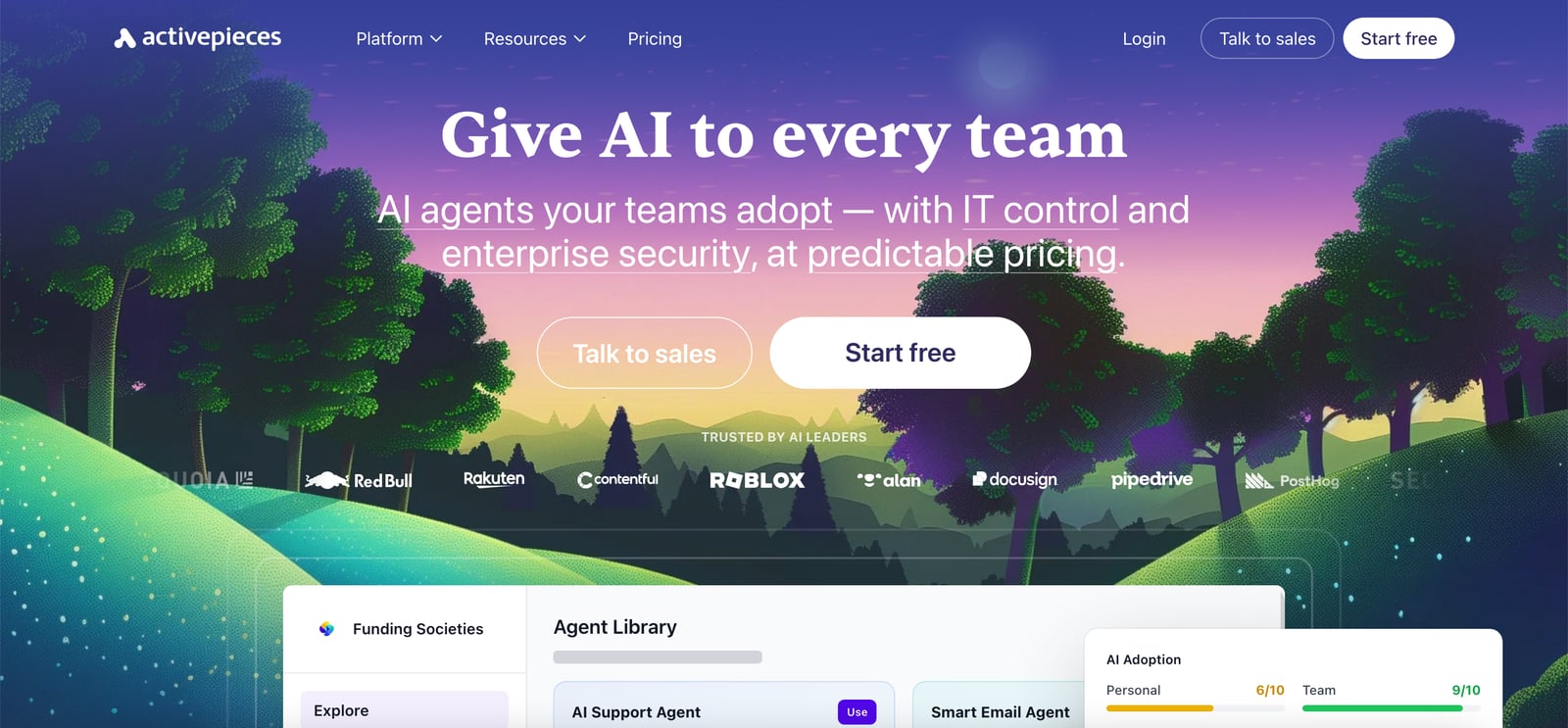
The product is one workspace holding chat, agents, flows, tables, connections and an MCP server. You build a flow on a visual canvas: a trigger such as a webhook or new form submission, then steps across apps. The vendor's homepage demo shows a webhook feeding an OpenAI classification step, which then branches to Slack for hot leads or HubSpot for a nurture sequence. Branching, retries, waitpoints, subflows, error handling and human approvals are all listed as builder features.
You don't have to start on the canvas. The chat feature drafts a flow from a plain-language request, for example "when a deal closes in HubSpot, add a row to Revenue and post it in #wins". The homepage example returns a four-step flow you can then edit. Treat it as a first draft generator. The vendor's own framing is "chat drafts most of your flows, the builder gives you full control when they get hard."
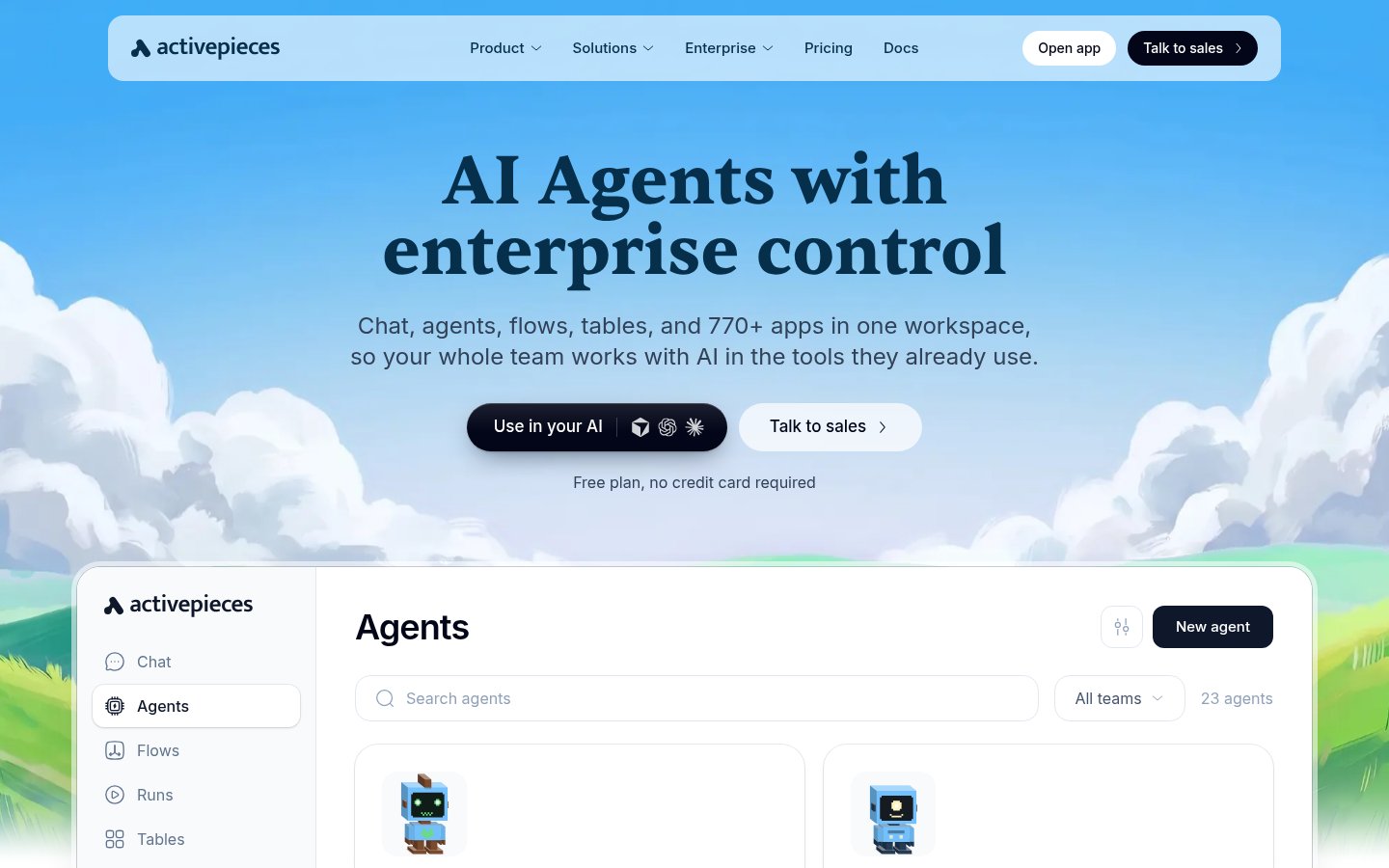
Connectors are called pieces. The vendor lists 770+, all MIT-licensed and built in the open. For anything missing, an HTTP piece calls any REST or GraphQL endpoint with auth and pagination handled, and you can write TypeScript inline for a single hard step while keeping the rest visual. That's a more practical escape hatch than Zapier's closed connector model, though Zapier's catalogue is larger.
Agents with approval gates. An agent takes a task in plain words, picks from the apps you've connected plus any MCP server you point it at, and works through the steps. The vendor's invoice example finds the invoice, matches it to a purchase order, checks the budget, then stops at an "Approve payment" prompt for $4,200 before scheduling and logging it in QuickBooks. You choose which steps need a person, such as anything touching money, customers or production, and the rest run unattended. For finance and support automations, that pause point matters more than any model choice. Agents also read from Tables (row-based data every flow can write to) and a searchable knowledge base, so you can keep state and reference documents inside the same product.
Self-hosting that isn't an enterprise upsell. Every plan, including Free, lists "cloud or on-prem" hosting. The deployment options are the vendor's cloud, your own Docker or Kubernetes setup, or fully air-gapped with no outbound network. The vendor says it's the same build in each case. One customer case study, from the health insurer Alan, says it needed an integration platform that could use internal data "without hosting it in the US." The vendor also states it doesn't use customer content to train AI and that data retention is configurable. If data residency decides your shortlist, this is the strongest reason to choose Activepieces over Zapier. For how it stacks up against other self-hostable tools, see open source Zapier alternatives by licence and self-hosting cost.
Governance layered by plan. Projects give each team a sealed-off space with its own members and credentials. Global connections let you authorise an app once and reuse it across flows. Both come with Team. SSO through Okta or Entra also starts at Team. Audit logs streamed to a SIEM such as Splunk, secret managers like HashiCorp Vault, SCIM, custom roles, and Releases and Git Sync are all Ultimate-only. The vendor also says runs resume from their last checkpoint rather than restarting, which would matter for a multi-step run that charges a card before failing.
The governance split is the biggest catch. If your security team requires audit logs or SCIM provisioning, the $200 Team plan doesn't cover you. You're in a sales conversation for Ultimate with no published price. Git Sync for moving flows between staging and production sits in the same tier, so teams that want proper release management pay for the enterprise plan to get it.
Credits are the second issue. The vendor says AI steps cost between 2 and 20 credits each unless you bring your own AI keys, which drops an AI step to 1 credit. That gap is wide enough that you can't forecast a bill from run counts alone. Plain logic inside a flow costs nothing extra, because runs are priced per run, but an AI-heavy agent can burn through a plan quickly. BYOK is only available from Plus upward, so Free users pay the higher rate.
On the Free plan, runs past your quota don't go through until credits refresh. The vendor says this directly. An automation that stops mid-month is a bigger problem than a slow one, so don't put anything customer-facing on Free.
There's also the connector gap. 770+ pieces is a fraction of what Zapier lists, so check that your specific apps are on the vendor's pieces page before committing. The HTTP piece covers most API-based gaps, but it means you're building the integration yourself.
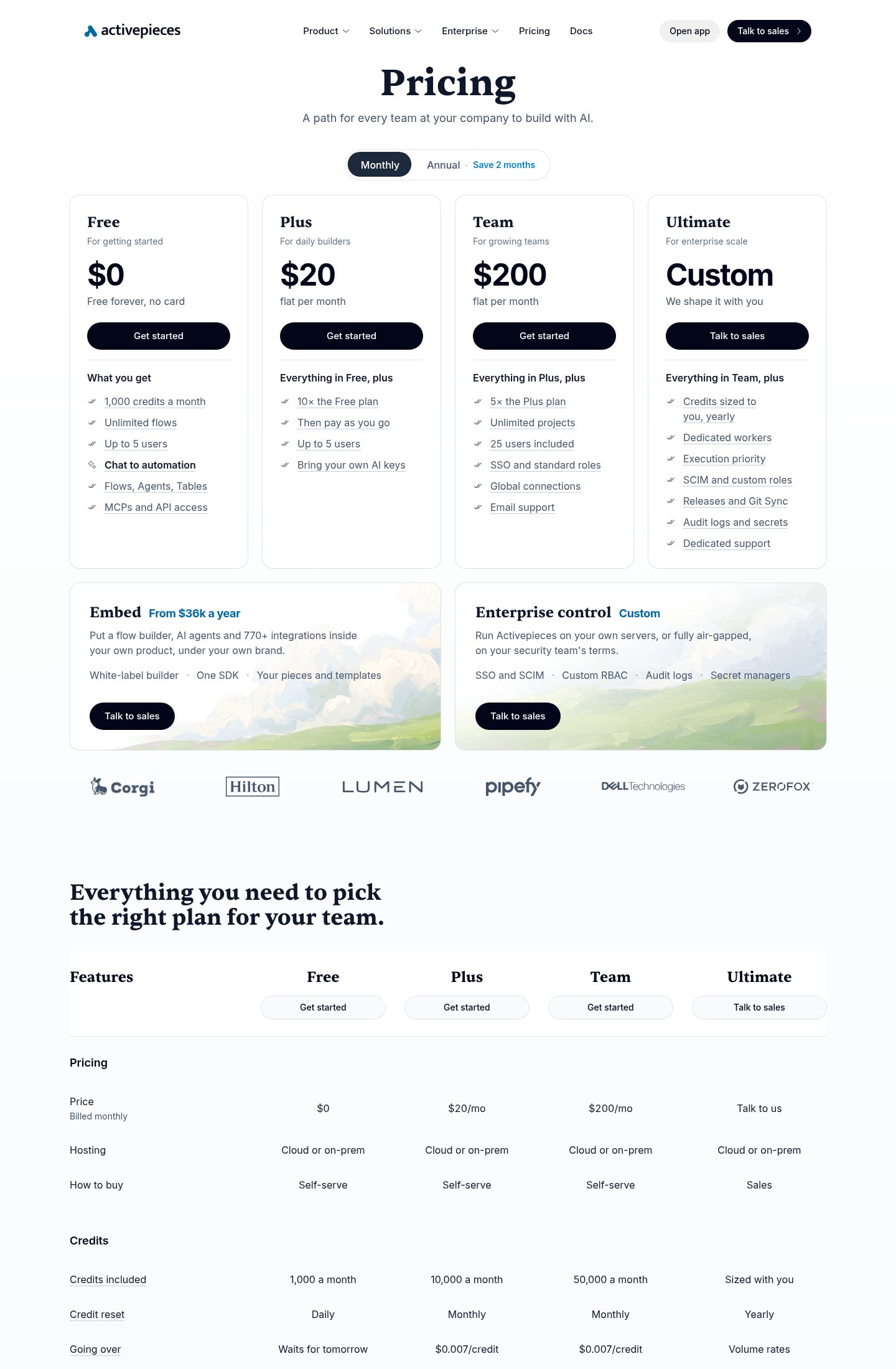
The Free plan is unusually generous in what it includes: unlimited flows, agents, tables, MCPs and API access, up to 5 users, no card. The limit is 1,000 credits a month. That's enough to learn the product and run light jobs, not enough for a production workload with AI steps.
Plus at $20 a month is the best deal on the page. It gives 10 times the Free credits (10,000 a month), BYOK, and pay-as-you-go overage at $0.007 a credit. A five-person team pays $20 flat, not per seat, because the plan caps at 5 users. If those five people run AI steps on their own model keys at 1 credit each, 10,000 credits goes a long way.
Team at $200 a month is where the maths gets harder. It includes 50,000 credits, which is 5 times Plus, plus 25 users, unlimited projects, SSO, standard roles and email support. Credits cost $0.004 each within the allowance versus $0.002 on Plus, so you pay double per credit for the extra seats and controls. Note that overage is the same $0.007 on both plans, so heavy users get no discount for moving up. A sixth user forces a team off Plus and into a tenfold price jump. If you only need those extra seats and don't need SSO or projects, that's an expensive way to buy them.
The low entry price and self-hosting option make Activepieces cheaper than Zapier for small, technical teams. Compared with n8n, which is a developer-oriented tool built around a visual node editor, Activepieces asks less of non-developers but offers fewer places to dig in. Embedding the builder in your own product starts at $36k a year, a separate buying decision from the plans above.
Pick Activepieces if you're a small team that wants AI agents and automation in one tool, a team with a data residency requirement that needs to self-host without an enterprise contract, or an agency that needs per-client projects and can justify $200 a month. It's also a sensible pick for anyone comfortable bringing their own model keys, since that's what keeps credit costs predictable.
Skip it if your apps depend on long-tail connectors that Zapier covers and Activepieces doesn't, if you need audit logs or SCIM without negotiating an enterprise deal, or if your team is 6 to 24 people who need neither SSO nor projects and would be paying $200 for headcount alone. Also skip it if you expect to run large volumes of AI steps on the vendor's models, since the 2 to 20 credit range makes costs hard to predict.
Start on the vendor's cloud with the Free plan to confirm your connectors exist, then decide whether to self-host. Hosting choice doesn't change plan gating: the pricing page lists cloud or on-prem on every tier, but governance features like audit logs and secret managers still sit in Ultimate. Confirm with sales before assuming a self-hosted install includes them.
Yes. The Free plan costs $0 with no card and no time limit. It includes 1,000 credits, unlimited flows and up to 5 users.
Plus is $20/month and Team is $200/month. Ultimate has custom pricing, and Embed starts at $36k a year. Annual billing saves 2 months.
Yes. It runs with Docker or Kubernetes on your own infrastructure, including fully air-gapped setups. The cloud option runs in Frankfurt.
Yes. The core and all pieces are MIT-licensed.
Any app with an API works through the HTTP piece or a webhook. You can also build your own pieces in TypeScript.
No reviews yet. Used Activepieces? Be the first.
Sign in to rate this tool and share how you use it.
Best of
May 24, 2026 · 15 min read
Best of
May 17, 2026 · 16 min read
News
Aug 7, 2026 · 6 min read
Activepieces
Free · from $20/mo
No-code workflow automation and AI agents across 9,000+ apps for businesses
Visual workflow automation and AI agent builder, cloud or self-hosted
Low-code cloud, desktop RPA and process mining automation for enterprises